Managing engineering projects is rarely simple. Civil, mechanical, or multi-disciplinary work demands more than basic task management: it calls for engineering project management software that unites project schedules, budgeting, resource allocation, compliance, and team collaboration in one place.
The best project management software for engineers connects Gantt charts, time tracking, and phase-based billing to real-time project data. In this guide, you will find a ranking of the 10 best engineering project management tools, a buying framework, and answers to the questions engineers ask most often.
What Is Engineering Project Management Software?
Engineering project management software is a specialized type of project management platform designed to meet the complex needs of engineering organizations. Unlike traditional project management tools, these specialized tools support highly technical business processes such as design collaboration, document control, compliance tracking, and advanced integrations.
At its core, this type of project management software helps engineering managers and project managers plan, execute, and track progress on engineering projects with precision. It centralizes critical project data, including project budgets, project timelines, task dependencies, and documentation, while giving teams a single place to collaborate across departments and locations.
Benefits of Project Management Software for Engineers
The best project management software for engineers does far more than organize tasks. By combining technical oversight with financial management, it helps your firm balance precision, compliance, and profitability. Here are the key benefits your firm can expect:
- Improved Collaboration Across Teams. Engineering projects often involve multiple disciplines: civil, electrical, mechanical, and environmental engineering. Project management software creates a single source of truth where all teams coordinate, share files, and follow project progress in real time, with seamless communication that reduces the load on project managers.
- Accurate Scheduling and Resource Management. Engineers, contractors, and equipment are valuable resources. With resource management tools built for project scheduling, your firm can allocate them efficiently, balance every team’s workload, and keep project milestones achievable even when resource availability changes.
- Stronger Budget and Cost Control. One of the most common risks in complex engineering projects is cost overrun. Project management software for engineers lets managers monitor project costs as they occur, compare them to project budgets, and prevent surprises before they threaten project profitability.
- Enhanced Compliance and Risk Management. Civil engineering projects in particular must meet strict safety and regulatory standards. Platforms built for engineering project management provide compliance tracking and detailed reporting to reduce risk and maintain accountability.
- Higher Client Satisfaction. With transparent project timelines, accurate reporting on project status, and clear communication, engineering firms deliver projects more reliably, which strengthens long-term client relationships.
What Features Should the Best Engineering Project Management Software Have?
Generic tools may be enough for simple project management and basic task management, but engineering firms need project management features that can handle technical workflows, multi-phase engineering projects, and client billing. Here are the key features to look for:
Advanced Scheduling & Gantt Charts
Engineering projects often span months or years, with strict taskand project dependencies between phases. Gantt charts and scheduling tools make it easy to visualize project timelines, keep tracking project progress simple, and adjust the project plan when delays occur, even across multiple projects at once. Look for critical path visibility and baseline comparisons, so you can see exactly how the current timeline differs from the original project plan.
Resource Management & Allocation
Civil and engineering firms rely on precise resource planning because they bill for every working hour. The right resource management tools let you assign engineers, subcontractors, and equipment efficiently while monitoring utilization rates and labor costs. Heatmaps and capacity forecasts should show who is available next month, not just today, so staffing decisions happen before bottlenecks form.
Time Tracking & Billing Integration
For firms billing by the hour, milestone, or phase, integrated timesheets and invoicing are critical. The best platforms automatically link logged hours to invoices and profitability reports.
Look for phase-based billing, which mirrors how A&E firms actually structure contracts (schematic design, design development, construction documents, and construction administration), and for subconsultant management that handles pass-through costs without manual processes. Approval workflows and mobile entry keep timesheets accurate, and accurate timesheets are the foundation of every invoice, utilization report, and profitability analysis downstream.
Budgeting & Cost Control
A strong financial management module is non-negotiable for engineering project management tools. Real-time expense tracking, budget forecasting, and earned value tracking, which compares work completed to budget spent, keep engineering projects financially sustainable. Live visibility into project costs allows project managers to act the moment actuals drift from the project plan. Budget burn alerts prompt early intervention, and historical cost data makes future estimates sharper with every completed project.
Advanced Reporting
Having the data is one thing; using it is another. The best project management software for engineers turns project data into progress reports, financial insights, and intuitive executive dashboards that support decisions about project performance. Scheduled reports and drill-down views mean executives, project managers, and clients each see the numbers at the right level of detail.
Multi-Project & Portfolio Management
Larger firms manage multiple projects simultaneously. Portfolio management dashboards give executives a clear overview of all active engineering projects, project budgets, and resource use, replacing spreadsheets with real-time insights. Roll-up views also reveal which engagements drive margin and which drain it, informing which work the firm pursues next.
Document Management & Compliance
Engineering projects generate drawings, specifications, RFIs, and contracts. Built-in version control keeps every stakeholder working from the latest project details, while compliance reporting supports audits on regulated and government work. Audit trails showing who changed what, and when, are especially valuable on public-sector and regulated engineering projects.
Seamless Integrations
The best engineering project management tools connect with accounting software (QuickBooks), CRM platforms, and design tools, so your firm never has to jump between multiple platforms. A two-way accounting sync matters more than most feature lists suggest: it eliminates double entry and the reconciliation errors that erode margins on complex projects. Open APIs matter too, letting your firm connect niche design or HR systems without waiting on the vendor’s roadmap.
How to Choose Engineering Project Management Software: 5 Criteria
Every demo looks clean; whether a project management tool actually fits engineering workflows usually becomes clear only after implementation. These five checks tell you before you buy.
- Engineering-Specific Features, Not Endless Configuration. Phase-based billing, earned value tracking, and subconsultant cost management should work natively, not after months of customization.
- Deep, Two-Way Accounting Integration. A CSV export is not an integration. Real-time, two-way sync with QuickBooks prevents revenue leakage, duplicate entries, and month-end reconciliation.
- Adoption Across Every Role. Extensive features create no value if a clunky user interface sends teams back to spreadsheets; a steep learning curve is the most common reason teams abandon new project management software.
- Implementation in Weeks, Not Quarters. Long migrations disrupt operations and lose historical project data.
- Room to Grow. A platform that fits five engineers should still fit 50. Portfolio management, multi-currency billing, and advanced capabilities like resource forecasting support long-term engineering projects as your firm takes on more complex projects.
10 Best Engineering Project Management Software
Choosing the best project management software for engineering firms requires balancing technical functionality with financial oversight. To help you narrow down the options, we have compiled and compared the 10 best engineering project management tools. These platforms were selected based on verified user reviews, engineering-specific key features, accounting integration depth, and suitability for engineering and civil projects.
The Best Engineering Project Management Tools: Comparison
| Tool | Best For | Key Features | Pricing* | G2 / Capterra Rating* |
|---|---|---|---|---|
| BigTime | Overall choice for engineering firms billing for time and expertise | Time tracking, invoicing, resource planning, forecasting, Jira & QuickBooks sync | Tiered per-user plans; free trial available | 4.5 / 4.6 |
| BQE Core | A&E firms that want built-in project accounting | Billing, time & expense tracking, project accounting, CRM | Modular, custom pricing | 4.3 / 4.4 |
| Deltek | Large, established firms with compliance needs | ERP, project accounting, business intelligence, compliance reporting | Custom pricing | 4.1 / 4.1 |
| Microsoft Project | Enterprise scheduling & portfolio optimization | Gantt charts, critical path analysis, portfolio modeling, Power BI | From $10/user/month | 4.0 / 4.4 |
| Jira | Software engineering teams using agile workflows | Scrum & Kanban boards, backlog management, bug tracking, dev integrations | Free up to 10 users; paid tiers per user | 4.3 / 4.4 |
| monday.com | Visual work organization | Custom boards, automations, Gantt & workload views | From $9/user/month | 4.7 / 4.6 |
| Wrike | Automations & workflow control | Portfolio dashboards, proofing, resource planning, advanced security | From $9.80/user/month | 4.2 / 4.3 |
| Asana | Team collaboration | Multiple views, templates, task comments, basic automation | Free up to 10 users; from $10.99/user/month | 4.3 / 4.5 |
| ClickUp | Customizable, budget-friendly task management | Multiple views, docs, dashboards, automation builder | Free plan; from $10/user/month | 4.7 / 4.7 |
| Autodesk Construction Cloud | Civil engineering & construction with BIM | BIM/CAD integration, field tools, document control | Custom pricing | 4.3 / 4.4 |
BigTime
Best for: engineering firms and professional services firms that bill clients for time and expertise.
Reviews: G2: 4.5, Capterra: 4.6

Pros & Cons
Pros:
- Purpose-built for engineering and professional services firms, with deep financial management features.
- Two-way integrations with Jira, QuickBooks, and other core business systems.
- Comprehensive resource planning, utilization monitoring, and forecasting.
- Multi-currency billing for global engineering projects.
- Built-in time tracking, invoicing, and payment processing.
- Extensive knowledge base and a responsive support team.
Cons:
- The rich feature set may feel overwhelming for very small teams at first.
- Not a CAD or BIM design tool (but integrates smoothly with engineering workflows).
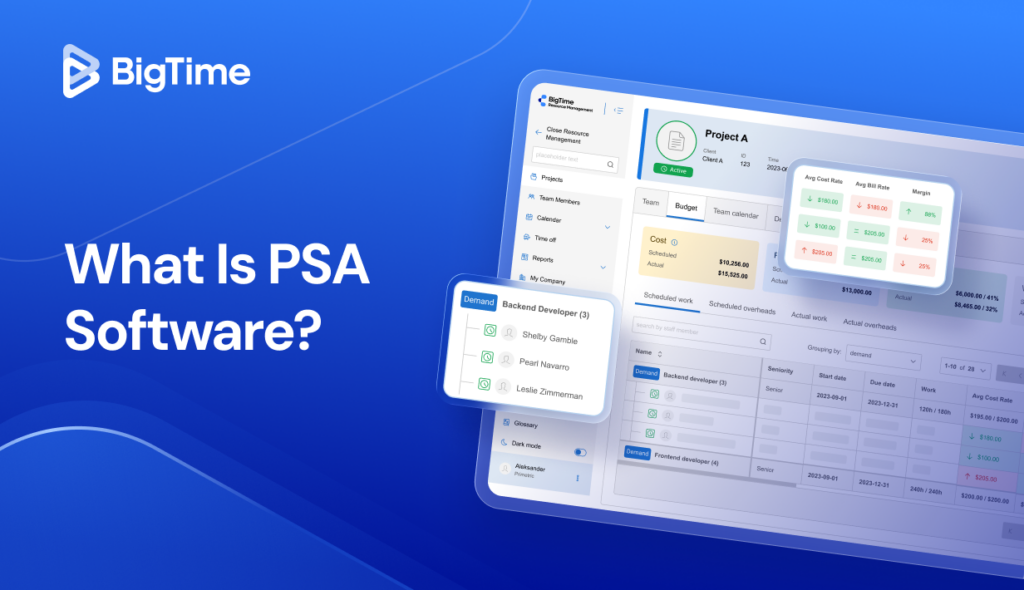
BigTime leads this ranking because it combines technical project oversight with robust financial management. As a PSA platform designed for firms that bill clients for time and resources, BigTime is particularly well suited to engineering consultancies and civil engineering firms.
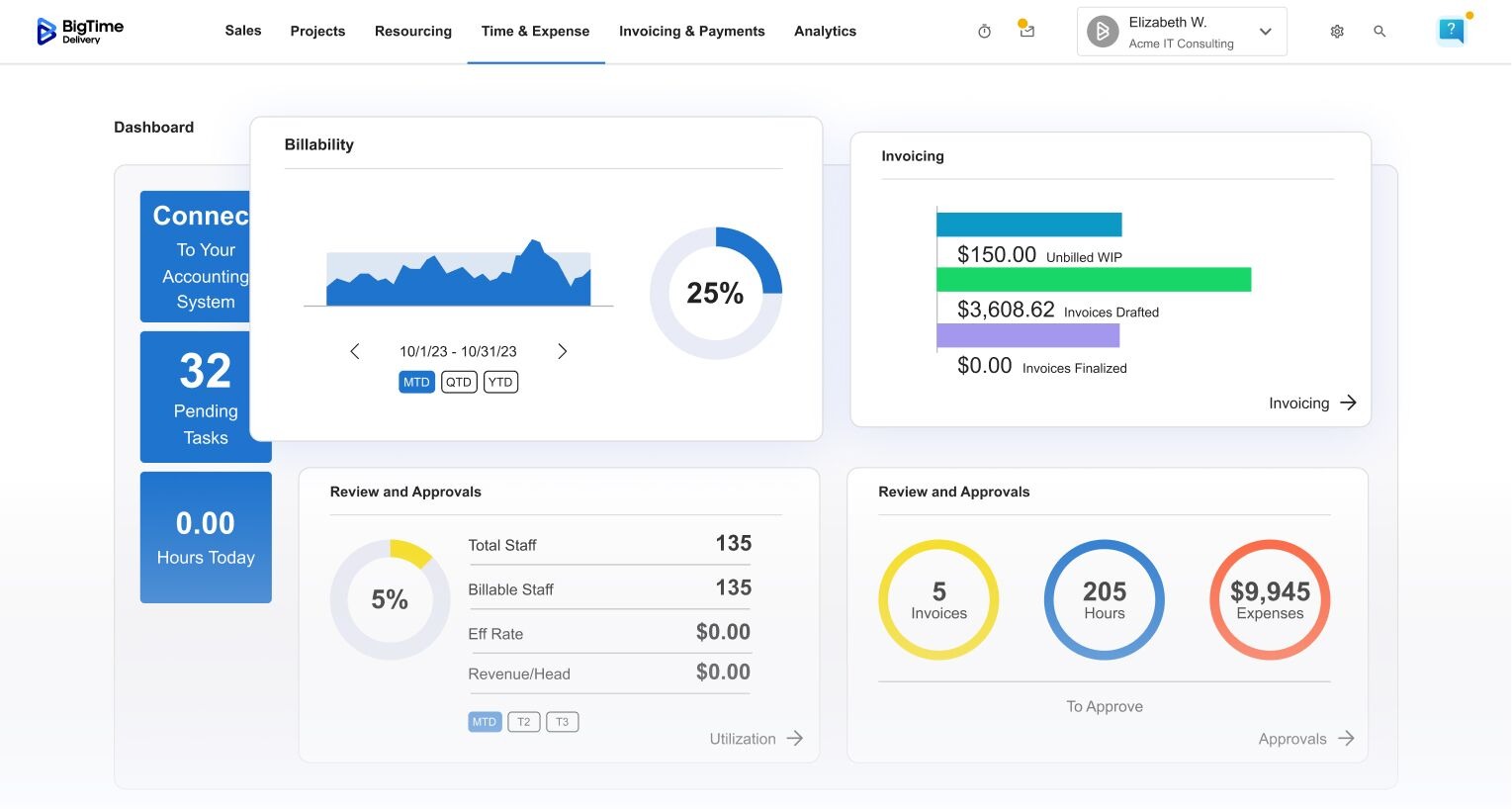
With BigTime, your project managers gain visibility into every stage of their engineering projects, from project schedules and budgets to resource allocation and client billing tools. The platform integrates with Jira for agile delivery and QuickBooks for accounting, so your team never has to jump between disconnected systems. By bridging project delivery and financial performance, BigTime enables your firm to maximize both efficiency and profitability.
Scalability is another strength. Whether you run a small civil engineering firm managing a handful of projects or a large enterprise overseeing multi-million-dollar infrastructure programs, BigTime adapts to your needs. Its analytics give executives the clarity to keep projects on time, within scope, and under budget.
Key Features
- Jira Sync: import issues, epics, and story points into BigTime to connect agile delivery with financial tracking.
- Time & Expense Management: built-in timesheets, approvals, and expenses linked directly to invoices.
- Resource Planning: assign engineers, monitor utilization, and forecast capacity for future engineering projects.
- Invoicing & Payments: generate invoices and accept payments within the platform via BigTime Wallet.
- Multi-Currency Support: essential for global firms managing international engineering projects.
- Forecasting & Dashboards: advanced analytics for capacity, budgets, and project performance.
Pricing
BigTime offers tiered plans (Essentials, Advanced, and Premier) with per-user pricing. A free demo is available to explore the platform’s capabilities.
BQE Core
Best for: architecture and engineering firms that want project accounting built into their project management software.
Reviews: G2: 4.3, Capterra: 4.4
Pros & Cons
Pros:
- Comprehensive features for A&E firms, combining billing, time and expense tracking, and project accounting.
- Modular pricing structure lets firms select only the capabilities they need.
- Strong analytics and business intelligence for financial visibility.
- Phases structured as nested sub-projects for detailed monitoring on complex projects.
Cons:
- Users frequently report sluggish performance and slow loading times.
- QuickBooks Online integration is an add-on rather than a native, two-way sync.
- Setup and configuration take time, especially without in-house finance or IT support.
- A steep learning curve for project managers focused on day-to-day scheduling rather than accounting.
BQE Core is a well-known name in the A&E space, and for good reason: it brings project management, accounting, time tracking, and CRM into a single system. For firms with dedicated finance or operations roles, BQE Core offers deep reporting on project costs and profitability, and its nested phase structure maps naturally onto engineering projects.
That depth comes at a price. BQE Core’s finance-first workflows create a steep learning curve for project managers, and reviewers on G2 and Reddit regularly mention performance issues and slow support response times. Firms comparing options in this category often weigh BQE Core directly against BigTime; see the BigTime vs BQE comparison for a feature-by-feature breakdown.
Key Features
- Billing and payment processing with project accounting.
- Time and expense tracking tied to phases and budgets.
- Customer relationship management for pipeline visibility.
- Business intelligence dashboards and reporting.
Pricing
BQE Core uses modular, custom pricing based on firm size and selected modules; contact sales for a quote.
Deltek
Best for: large, established engineering firms with multi-office operations and compliance-heavy work.
Reviews: G2: 4.1, Capterra: 4.1
Pros & Cons
Pros:
- Enterprise ERP depth: project accounting, financial planning, and business intelligence in one platform.
- Compliance reporting suited to government contracts and audit-ready documentation.
- Scales across multiple offices and large project portfolios.
Cons:
- Complex to configure and costly to maintain; implementation often requires specialized consultants.
- The user interface feels dated compared to more modern solutions, and users describe workflows as clunky.
- Finance-first design can slow adoption among project managers and delivery teams.
Deltek has been a fixture in the A&E space for decades, and large firms that need enterprise-grade financial control still rely on it. Built-in accounting removes the need for separate financial software, and its reporting covers project performance, compliance, and business processes across multiple entities.
The trade-off is agility. Implementations are long, customization typically requires technical expertise, and long-time users report few meaningful updates to the experience. For growing firms that want financial depth without ERP weight, lighter platforms deliver faster time to value.
Key Features
- ERP and CRM capabilities for enterprise operations.
- Financial planning, budgeting, and project accounting.
- Time tracking and expense management.
- Business intelligence and compliance reporting.
Pricing
Custom pricing based on modules, user count, and firm size; contact sales for a tailored quote.
Microsoft Project
Best for: enterprise teams that need granular project schedules and portfolio optimization.
Reviews: G2: 4.0, Capterra: 4.4
Pros & Cons
Pros:
- Robust Gantt charts, critical path analysis, and dynamic scheduling for complex projects.
- Portfolio modeling and business intelligence through Power BI.
- Familiar experience for organizations already in the Microsoft ecosystem.
Cons:
- A steep learning curve that typically requires dedicated project management staff.
- Focused on planning; financial features and invoicing need complementary systems.
- Less suitable for agile project management than dedicated agile platforms.
Microsoft Project remains the reference point for enterprise scheduling. Its project planning features help planners identify scheduling risks early, particularly on multi-year, multi-discipline builds where civil, structural, and MEP work must stay coordinated. Portfolio optimization tools also help leadership decide which engineering projects fit current resources and budgets.
The platform’s depth is also its limitation. Microsoft Project concentrates on schedules rather than day-to-day delivery, so firms typically pair it with separate systems for time tracking, billing, and collaboration, which fragments project data across the organization.
Key Features
- Gantt charts, dependencies, and critical path analysis.
- Portfolio modeling and scenario planning.
- Business intelligence reporting via Power BI.
- Real-time co-authoring for distributed teams.
Pricing
Cloud plans start at $10 per user/month (Project Plan 1), with expanded portfolio features in Plan 3 and Plan 5.
Jira
Best for: software engineering teams that run sprints and iterative delivery.
Reviews: G2: 4.3, Capterra: 4.4
Pros & Cons
Pros:
- Extremely flexible workflows that can be tailored to any engineering discipline.
- Advanced Scrum and Kanban boards for agile project management.
- Detailed reporting, including burndown charts and velocity metrics.
- A strong ecosystem with thousands of integrations and add-ons.
Cons:
- Complex setup that requires time and administration.
- Agile terminology can overwhelm non-technical teams.
- No native financial management, billing, or utilization monitoring.
Jira is among the most widely used project management software for engineers working in iterative environments. Backlog refinement, sprint planning, and issue and bug tracking make it easy to manage development workflows, while its reporting suite gives project managers clear visibility into velocity and bottlenecks.
That flexibility comes at a cost. Jira can be complex to configure, and for firms outside software, such as civil or mechanical practices, it may feel overly technical. Because it lacks built-in project budgeting and billing, software development teams often sync Jira with BigTime to connect delivery with financial tracking.
Key Features
- Customizable workflows for engineering projects.
- Scrum and Kanban boards with backlog management and WIP limits.
- Burndown, velocity, and cumulative flow reporting.
- Bug tracking and roadmaps for multi-project planning.
Pricing
Free plan for up to 10 users. Paid tiers (Standard, Premium, and Enterprise) are billed per user/month.
monday.com
Best for: teams that want visual work organization with minimal onboarding.
Reviews: G2: 4.7, Capterra: 4.6
Pros & Cons
Pros:
- Highly visual boards with color-coded project timelines.
- Multiple views, including Gantt, Kanban, and workload.
- Built-in automations for repetitive updates and assigning tasks.
- Broad integration options, from Slack to Google Workspace.
Cons:
- Time tracking and workload management sit behind higher-tier plans.
- Boards can become cluttered on larger engineering projects.
- Financial and agile reporting are thinner than in dedicated platforms.
monday.com is a flexible, visually driven platform that appeals to technical teams looking for an intuitive way to organize work. Engineers can switch between timelines for scheduling, Gantt charts for dependencies, and workload views for balancing assignments, making it versatile across project types.
For engineering-specific needs, monday.com has limits. It offers great visual clarity but lacks deep financial reporting, so firms that need time tracking, invoicing, and profitability data typically pair it with a PSA platform like BigTime.
Key Features
- Customizable boards with columns for tasks, dates, and owners.
- Timeline, Gantt, Kanban, and workload views.
- Automations for recurring project updates.
- Dashboards for following project progress across teams.
Pricing
Free plan for up to two users. Paid plans start at $9 per user/month (Basic), $12 (Standard), and $19 (Pro), with custom Enterprise pricing.
Wrike
Best for: larger teams that want automation and custom workflows across departments.
Reviews: G2: 4.2, Capterra: 4.3
Pros & Cons
Pros:
- Multiple views, including Gantt charts, calendars, and Kanban boards.
- Proofing and approval workflows for technical documents.
- Portfolio dashboards and resource planning for large teams.
- Enterprise-grade security with advanced permissions and SSO.
Cons:
- A steep learning curve, especially for smaller engineering firms.
- The interface can feel cluttered without structured onboarding.
- Deeper reporting and resource features are locked behind premium tiers.
Wrike is an enterprise-focused project management platform with robust features for teams managing complex projects. Project managers can monitor work at both the task and portfolio level, and leadership gains visibility across multiple projects through customizable dashboards.
The abundance of options can overwhelm smaller teams, and many of Wrike’s most valuable capabilities require higher tiers. For financial visibility and profitability, Wrike is typically paired with a PSA platform.
Key Features
- Gantt charts, Kanban boards, calendars, and workload views.
- Configurable workflows and dynamic request forms.
- Portfolio dashboards and real-time reporting.
- Proofing and approvals for technical documents.
Pricing
Paid plans start at $9.80 per user/month (Team), with Business, Enterprise, and Pinnacle tiers adding advanced features.
Asana
Best for: cross-functional team collaboration.
Reviews: G2: 4.3, Capterra: 4.5
Pros & Cons
Pros:
- Clean design with a minimal learning curve.
- List, timeline, board, and calendar views for flexible planning.
- Strong collaboration tools with task comments and notifications.
- Useful templates for engineering and technical work.
Cons:
- No built-in invoicing or profitability reporting.
- Limited time tracking without add-ons.
- Large engineering projects with many tasks can become hard to navigate.
Asana is a user-friendly choice for teams collaborating across multiple departments. Its task management features make it easy to manage deadlines and dependencies without overwhelming new users, and engineers can switch views depending on how they prefer to plan.
Simplicity brings trade-offs. Asana lacks native financial capabilities, so firms cannot follow budgets, time, or billing inside the platform, and its agile reporting trails Jira for sprint-driven teams.
Key Features
- Task and project organization with customizable templates.
- List, Timeline, Calendar, and Kanban views.
- Comments, attachments, and real-time notifications.
- Integrations with Slack, Google Workspace, and Microsoft Teams.
Pricing
Free plan for up to 10 users. Paid plans start at $10.99 per user/month (Premium) and $24.99 (Business), with custom Enterprise pricing.
ClickUp
Best for: customizable task management on a budget.
Reviews: G2: 4.7, Capterra: 4.7
Prs & Cons
Pros:
- All-in-one workspace combining tasks, docs, dashboards, and goals.
- Multiple views (list, board, Gantt, and timeline) with deep customization.
- Automation builder for repetitive business processes.
- Hundreds of integrations, including engineering and collaboration tools.
Cons:
- The sheer number of options can feel overwhelming.
- Setup and governance require real time investment.
- Advanced reporting and permissions sit in higher-tier plans.
ClickUp positions itself as the one app to replace them all, and for smaller engineering teams it can come close: task organization, documentation, whiteboards, and dashboards live in a single system. That makes it attractive for firms that want to centralize work without juggling separate apps.
Without careful setup, however, ClickUp becomes cluttered, and its most advanced analytics require Business or Enterprise tiers. For financial visibility and profitability, firms typically add a dedicated platform.
Key Features
- Agile-ready boards, lists, and timelines.
- Integrated docs and whiteboards for design and brainstorming.
- Automation builder for recurring updates.
- Goals and dashboards for KPI monitoring.
Pricing
Free Forever plan available. Paid plans start at $10 per user/month (Unlimited) and $19 (Business), with custom Enterprise pricing.
Autodesk Construction Cloud
Best for: civil engineering and construction teams that need BIM and field collaboration.
Reviews: G2: 4.3, Capterra: 4.4
Pros & Cons
Pros:
- Tailored specifically to civil and construction engineering projects.
- Design collaboration with native BIM and CAD integration.
- Field monitoring and mobile access for on-site teams.
- Centralized documentation with version control.
Cons:
- Expensive compared to general-purpose project management software.
- Complex setup for new users.
- Limited flexibility beyond construction-focused workflows, with no financial oversight.
Autodesk Construction Cloud is a project management platform focused on design collaboration and field execution for large scale projects. With native BIM and CAD integrations, engineers, architects, and contractors work together on models and technical specifications in real time, reducing costly design errors.
It is not a universal solution. Pricing sits at the enterprise level, features are geared toward construction rather than other engineering disciplines, and the platform lacks financial insight, so firms look elsewhere for billing and profitability data.
Key Features
- BIM and CAD integration for design collaboration.
- Centralized document control with versioning.
- Field tools for quality, safety, and progress.
- Dashboards and mobile access for on-site teams.
Pricing
Custom pricing based on company size, project scope, and required modules.
What Is the Best Free Engineering Project Management Software?
Free plans can be appealing to small teams or firms just getting started. Options like Asana’s free tier, ClickUp’s Free Forever plan, or the open-source OpenProject let teams organize tasks, share documents, and collaborate without upfront costs. For small-scale engineering projects, these solutions can be enough to track progress and keep communication clear.
When it comes to civil engineering or more complex projects, however, free project management software falls short. They lack the robust features firms truly need, such as:
- Resource allocation and utilization monitoring.
- Budget and cost management with earned value visibility.
- Time tracking, phase-based billing, and invoicing.
- Compliance reporting and subconsultant management.
- Multi-project portfolio visibility.
Firms that rely solely on free tools face growing pains as engineering projects scale: disorganized workflows, missed deadlines, and inaccurate financial oversight. Free plans work as a temporary fix for small teams, but they were never designed for the complexity of professional engineering projects. For scalability and profitability insights, a purpose-built PSA platform like BigTime delivers far more than free project management software for engineers, making it a long-term investment rather than a stopgap.
Which Engineering Project Management Software Is the Best?
Engineering projects are among the most demanding to manage. They involve task coordination, compliance requirements, budgeting, and client billing, and most project management software for engineers falls short when it comes to combining delivery with financial oversight.
That is where BigTime stands out. Built for engineering firms and professional services organizations that need to manage both projects and profitability, BigTime bridges the gap between project execution and financial control, making it the most complete option in this ranking.
With advanced time tracking, resource planning, utilization dashboards, and project invoicing, BigTime helps engineering teams deliver on time while keeping every engagement profitable. Its integrations with Jira and QuickBooks mean your team keeps its existing workflows; BigTime simply adds the financial and operational insight that has been missing.
For civil engineering, mechanical work, or complex engineering projects that span disciplines, BigTime scales with your growth, deepens your visibility into project performance, and keeps your firm compliant and profitable at every stage. You can explore it for yourself; just book a free demo to see how BigTime can convert valuable insights into higher profitability.
Frequently Asked Questions
What Software Do Civil Engineers Use to Manage Projects?
Civil engineering teams typically combine a design tool, such as AutoCAD or a BIM platform like Autodesk Construction Cloud, with project management software that handles schedules, time tracking, and budgets. Firms that bill clients for their work usually add a PSA platform such as BigTime to connect delivery with invoicing and project profitability.
How Is Engineering Project Management Software Different From Traditional Tools?
Traditional project management tools focus on task management and team collaboration. Engineering-specific platforms add phase-based billing, earned value tracking, resource management, document management, and compliance features that generic tools support only through heavy customization.
What Is the Best Project Management Software for Small Engineering Firms?
Small firms benefit most from user-friendly tools with fast implementation. BigTime’s entry tier covers time tracking, invoicing, and project delivery in one place, while free plans from ClickUp or Asana can cover very simple project management needs until the firm grows.
Is Microsoft Project Good for Engineering Projects?
Microsoft Project excels at complex project schedules, Gantt charts, and portfolio optimization, which makes it popular for large scale projects. It offers limited financial management and no client invoicing, however, so most firms pair it with a PSA platform.
Which Project Management Software Is Best for Software Engineering Teams?
Jira remains the standard for software development teams thanks to agile boards, sprint planning, and bug tracking. Teams that also need to monitor budgets and billable hours often sync Jira with BigTime to connect agile delivery with financial tracking.
How Much Does This Type of Software Cost?
Mainstream project management software typically ranges from about $9 to $30 per user per month, while enterprise systems like Deltek and BQE Core use custom quotes. Most vendors, including BigTime, offer a free trial so you can validate fit before committing.