Kantata positions itself as a leading PSA solution, with advanced features for resource planning, time and project tracking, and financial management. But in reality, many teams find it unnecessarily complicated, expensive to maintain, and far from user-friendly. These challenges push many teams to look for alternatives that are more modern, intuitive, and cost-effective.
In this article, we’ll explore the best Kantata alternatives in 2026, their key features, and how they compare, so you can find a platform that actually simplifies — not complicates — your work.
In this article, we will:
- Explore the best alternatives to Kantata available in 2026.
- Highlight essential features these tools should offer to truly support your business.
- Compare pricing, pros, and cons so you can make an informed decision.
Why to Look for Alternatives to Kantata
While Kantata promises robust PSA capabilities, many teams find it more frustrating than helpful.
While it does provide detailed resource management, project tracking, and financial management, the overall experience can be frustrating for teams that need efficiency rather than complexity. Its interface feels outdated, setup is lengthy, and even basic use often requires extensive training. Instead of streamlining work, it can add unnecessary complexity.
Cost is another major drawback. Kantata hides much of its functionality behind higher-tier plans, making it expensive to unlock features that competitors include by default. Additionally, Kantata’s pricing is not transparent, and many of its most valuable features are locked behind higher-tier subscriptions. For smaller firms in professional services, this makes the platform feel overpriced; for larger ones, costs scale quickly.
Ultimately, Kantata lacks the flexibility and usability today’s businesses expect. That’s why many organizations are turning to alternatives that are easier to adopt, more affordable, and far more intuitive.
What Features Should the Best Kantata Alternatives Have?
Switching from Kantata isn’t just about finding another PSA tool — it’s about finding one that removes the frustrations while giving your team more power and flexibility. The best Kantata alternatives combine ease of use with strong functionality so that companies can grow without being weighed down by steep learning curves or hidden costs.
Here are the features to look for when evaluating alternatives to Kantata:
Intuitive Interface
A modern interface that is simple to navigate reduces onboarding time and makes it easier for teams to get value from the software without endless training. It also makes it easier for professional services firms to share responsibilities and knowledge without forcing project managers to use tools they do not enjoy.
Scalable Resource Management
The best Kantata alternatives offer drag-and-drop resource scheduling, skill-based assignments, and overbooking alerts on top of resource and task management. This ensures resource allocation is smooth and grows with your business, and requires as few manual entries as possible. The best project management solutions also facilitate team collaboration, allowing multiple managers to see and edit allocations without a single error.
Time and Expense Tracking
Accurate time logging and expense monitoring are essential for services firms. Strong Kantata alternatives automatically convert these records into project insights and client-ready reports, helping managers monitor project progress in the real time instead of relying on summaries.
Financial Oversight
Unlike Kantata’s costly add-ons, the right solution should include project budgets, rates, and invoicing within the core product, giving managers a real-time view of profitability. The best-in-breed tools will also include live updates, overheads, and automated billing and invoicing, making budget tracking just a formality.
Flexible Project Planning
Complex projects require precise plans – and the best Kantata alternatives can help you create them. Tools that offer multiple views — Gantt charts, Kanban boards, and customizable templates — make it easier to manage projects of different sizes and complexities. Customizable workflows and project types are also a great advantage!
Advanced Reporting and Dashboards
Extensive business intelligence features are yet another characteristics of the best Kantata alternatives. Instant, customizable reports provide actionable insights into performance, capacity, and financial health, without requiring extra setup or hidden upgrades. Some of the most robust features also offer other advanced features and reporting capabilities, including AI-powered insights and reports.
2026 Kantata Alternatives Ranking
When it comes to choosing a replacement for Kantata, not every tool will be the right fit. Some focus on affordability and simplicity, while others are built to handle the complex demands of large professional services firms. What they all share is the ability to address Kantata’s shortcomings — from its high costs to its steep learning curve and rigid workflows.
The following ranking highlights the top Kantata alternatives for 2026, based on their overall balance of features, usability, pricing transparency, and scalability:
- BigTime – The best overall PSA solution, combining intuitive design, advanced features, and transparent pricing for professional services firms.
- Wrike – Powerful but overly complex, with key features locked behind expensive plans.
- ClickUp – Highly customizable yet cluttered and difficult to manage at scale.
- Smartsheet – Familiar spreadsheet style that quickly becomes rigid and hard to maintain.
- Monday.com – Visually engaging, but boards grow messy and reporting is limited.
- Trello – Simple to adopt, but far too basic for professional services automation.
- Notion – Flexible but chaotic without strict discipline, lacking true PSA depth.
- Airtable – Customizable yet prone to clutter, requiring constant upkeep.
- Basecamp – Easy to use but far too simplistic for complex project needs.
- Accelo – Feature-rich, but suffers from the same steep learning curve as Kantata.
Alternatives to Kantata – Comparison
When evaluating Kantata alternatives, it’s important to understand not only what each tool offers but also where it falls short. Below is a side-by-side comparison of the top options in 2026, so you can see which platforms truly solve Kantata’s shortcomings, and which introduce new challenges.
| Tool | Description | Strengths | Limitations |
| BigTime | PSA software built for professional services firms. | Intuitive interface, powerful PSA features, scalable, transparent pricing. | Slight learning curve due to breadth of features. |
| Wrike | Advanced project management platform for large teams. | Highly customizable workflows, strong planning tools. | Complex setup, expensive higher-tier features. |
| ClickUp | All-in-one work management platform. | Wide range of views, deep customization, integrates multiple workflows. | Overly complex, cluttered interface, performance issues at scale. |
| Smartsheet | Spreadsheet-style project management solution. | Familiar format, supports multiple views, strong detail control. | Rigid, hard to maintain, lacks modern usability. |
| Monday.com | Visual collaboration and project tracking tool. | Attractive boards, flexible views, simple automation. | Messy at scale, limited reporting, expensive advanced features. |
| Trello | Kanban-style task management tool. | Extremely easy to adopt, lightweight, affordable entry plan. | Too basic for PSA, no advanced reporting or financial management. |
| Notion | Flexible workspace for notes, wikis, and light project management. | Highly customizable, combines docs and databases. | Chaotic without structure, lacks PSA essentials. |
| Airtable | Database-driven collaboration and project tool. | Customizable workflows, multiple views, strong integrations. | Requires constant upkeep, clutter risk, lacks PSA depth. |
| Basecamp | Simple collaboration and communication platform. | Easy to use, flat pricing, strong team communication features. | Too simplistic, missing advanced project management tools. |
| Accelo | PSA software with billing and automation capabilities. | Strong PSA focus, end-to-end project and billing features. | Complex setup, dated interface, steep learning curve like Kantata. |
BigTime
Reviews: G2: 4.5, Capterra: 4.6
Pros:
- Comprehensive PSA platform designed specifically for professional services firms.
- Combines project management, time tracking, resource planning, and invoicing in one solution.
- Advanced reporting with customizable dashboards for real-time insights.
- Seamless integrations with accounting tools like QuickBooks and Sage.
- Transparent pricing with a free trial available.
- Perfect for all types of professional services companies, from creative agencies and construction firms, to software development companies.
Cons:
- Broad feature set can present a learning curve for new users.
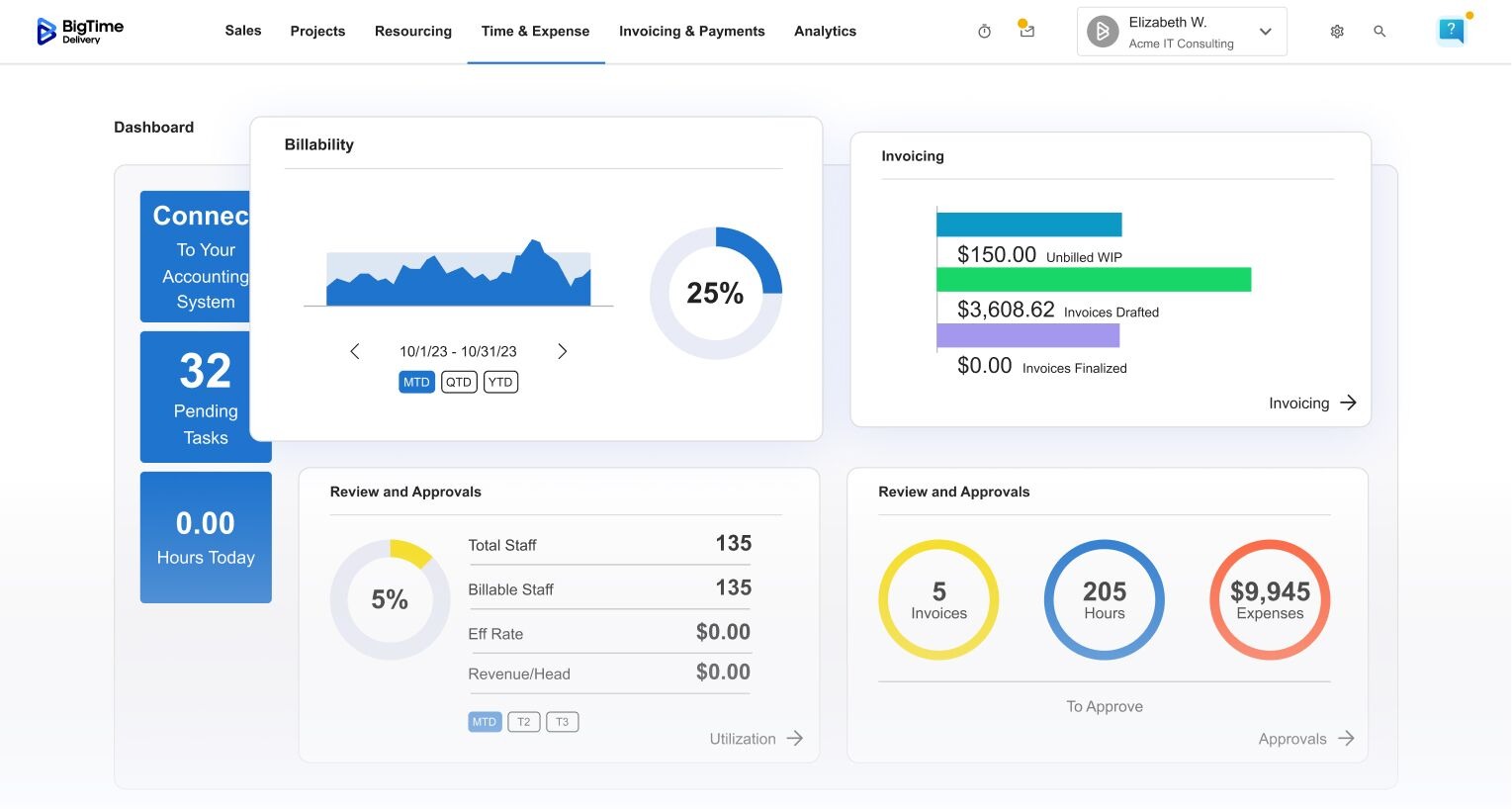
BigTime is more than just another project management tool — it’s a full professional services automation platform that is a perfect Kantata alternative. Unlike Kantata, which often feels rigid and dated, BigTime was built to handle the needs of growing professional services organizations that want improved workflow automation and better visibility across their projects, resources, and financials. Its strength lies in unifying all critical processes: from tracking time and expenses to planning resources and generating branded invoices.
One of BigTime’s standout qualities is scalability. Smaller firms can adopt it quickly and grow into its advanced features over time, while larger teams can benefit from its detailed reporting and resource management right away. With automated updates, advanced Gantt charts, and live data insights, managers get a clear, real-time view of utilization rates, profitability, and project health without wrestling with complicated interfaces.
Another major advantage is integration. Instead of forcing companies to work within a closed system, BigTime’s project management software connects seamlessly with popular accounting and business tools, giving teams a flexible ecosystem tailored to their workflows. For companies tired of Kantata’s complexity and costs, BigTime offers a simpler, smarter, and more transparent solution.
Key Features:
- Intuitive Resource Management: Skill-based assignments, drag-and-drop resource allocation, and real-time utilization tracking with collaboration features help managers create flawless plans in seconds – and in cooperation with other teams.
- Comprehensive Project Management: Track progress in multiple tools at once, including Gantt charts, detailed budgets, and project milestones for simple or complex projects and ensure project success every step of the way.
- Time & Expense Tracking: User-friendly interface turns burdensome time tracking into just a few seconds of work, while automatic conversion of time logs and expenses into progress saves hours of managers’ time.
- Advanced Reporting: Monitor project delivery from an offer to a final summary with customizable dashboards and real-time reporting across projects, teams, and finances. Measure your preferred project management KPIs in seconds with customizable workflows and templates.
- Invoicing & Billing: Create branded invoices directly from project data, simplifying client billing, and include payments in your financial reporting. Integrate BigTime with invoicing tools for even better results.
- Integrations: Add QuickBooks, Sage, and other essential business systems for a connected workflow and create a digital environment tailored to your business needs.
Pricing: Free trial available. Paid plans start at $20 per user per month (Essentials package).
Wrike
Reviews: G2: 4.2, Capterra: 4.3
Pros:
- Highly customizable with multiple views including Gantt charts, boards, and calendars.
- Supports complex workflows and approval processes.
- Strong integrations with enterprise tools.
Cons:
- Steep learning curve, especially for teams new to advanced project management.
- Interface can feel cluttered and unintuitive.
- Many of the most valuable features are locked behind costly higher-tier plans.
Wrike is often positioned as a powerful option for teams that want deep control over projects, tasks, and approvals. It offers extensive customization with custom fields, detailed workflows, and multiple planning views that make it attractive to larger organizations managing complex projects.
However, Wrike’s biggest weakness is its complexity. The platform is not beginner-friendly, and onboarding can take weeks or even months. Its interface is crowded, and many users complain that navigating between different features feels overwhelming. What’s worse, the most useful capabilities — such as advanced reporting and time and expense tracking — are not included in lower plans, which forces teams to upgrade to expensive tiers if they want full functionality. Affordable pricing is not an option here!
Key Features:
- Custom Workflows: Tailor processes with approvals, stages, and automation.
- Multiple Views: Gantt, board, calendar, and table views for flexible planning.
- Proofing & Approvals: Tools for review and approval cycles in creative or enterprise workflows.
- Dashboards & Reports: Advanced project monitoring and reporting features available in higher plans.
- Integrations: Connects with tools like Salesforce, Slack, and Microsoft Teams.
Pricing: Free plan available. Paid plans start at $9.80 per user per month (Team), with advanced features available in Business and Enterprise tiers.
ClickUp
Reviews: G2: 4.7, Capterra: 4.7
Pros:
- Offers multiple views (List, Board, Gantt, Timeline, etc.) for flexible project planning.
- Combines tasks, docs, chat, and goals in a single platform.
- Free plan available with access to core features.
Cons:
- Extremely steep learning curve due to overwhelming customization options.
- Interface can feel cluttered and disorganized without careful setup.
- Performance issues reported with large workspaces and heavy automation.
- Advanced features like goals and custom reporting locked behind higher-tier pricing.
- Limited project financials and tracking features.
ClickUp has quickly become one of the most talked-about Kantata alternatives, thanks to its ambition to be the “one app to replace them all.” With multiple views, built-in documentation, and a wide array of features, it appeals to teams looking to consolidate their work into a single space.
But with its depth comes significant complexity. ClickUp’s flexibility often turns into a weakness, as teams struggle to configure and maintain an environment that makes sense for their needs. The interface becomes overwhelming, and without strict structure and training, the platform risks slowing teams down rather than speeding them up with valuable insights. Additionally, some of its most valuable tools — like advanced reporting and whiteboards — are paywalled behind higher subscription tiers and custom pricing, adding to the cost of ownership.
For teams willing to invest time and effort into setup and ongoing maintenance, ClickUp can be a powerful Kantata alternative. For those seeking a simple, scalable solution, however, it can feel more like a burden than a benefit.
Key Features:
- Multiple Views: Gantt, Board, Calendar, and Timeline to match different planning needs.
- Docs & Whiteboards: Create collaborative documents and brainstorming spaces.
- Custom Fields & Statuses: Build detailed workflows tailored to your team.
- Automations: Reduce repetitive tasks with custom rules, though setup can be tricky.
- Reporting & Goals: Track performance with dashboards and goal-setting (premium plans).
Pricing: Free plan available. Paid plans start at $10 per user per month (Unlimited) and $19 per user per month (Business).
Smartsheet
Reviews: G2: 4.4, Capterra: 4.5
Pros:
- Familiar spreadsheet-style layout that many teams can adapt to quickly.
- Multiple planning views available, including grid, Gantt, and calendar.
- Strong automation and enterprise-grade security features.
Cons:
- Interface feels outdated and quickly becomes cluttered with large datasets.
- Steep learning curve for teams unfamiliar with spreadsheet-based project management.
- Advanced features like resource management and reporting locked behind expensive plans.
- Less visually engaging than more modern alternatives.
Smartsheet is a long-standing tool that appeals to teams who prefer a spreadsheet-like environment for project management. Its grid-based format allows for detailed tracking of project timelines, budgets, and tasks, while its Gantt and calendar views add some flexibility for planning and allow to identify potential bottlenecks early. For companies that rely heavily on Excel or similar tools, Smartsheet can feel like a natural upgrade.
But what makes Smartsheet powerful also makes it problematic. The spreadsheet format becomes cumbersome as projects grow, leading to cluttered, difficult-to-manage sheets that demand careful upkeep. Unlike modern Kantata alternatives, Smartsheet lacks an intuitive interface, and its reliance on formulas and manual organization often slows teams down. On top of that, many of the features that make it competitive — like resource allocation and advanced reporting — are hidden behind premium tiers, driving up costs.
Key Features:
- Grid, Gantt, Calendar, and Card Views: Multiple ways to organize, monitor, and assign tasks.
- Formulas & Linking: Spreadsheet-style logic for project dependencies and centralized communication.
- Automation Rules: Automate manual updates with conditional workflows.
- Resource Management: Allocation tools available in higher plans.
- Dashboards & Reporting: Create custom visualizations of project performance.
Pricing: Free trial available. Paid plans start at $7 per user per month (Pro) and $25 per user per month (Business), with advanced features in Enterprise tiers with customized pricing.
Monday.com
Reviews: G2: 4.7, Capterra: 4.6
Pros:
- Highly visual boards that are easy to understand at first glance.
- Offers multiple views such as Kanban, Timeline, and Calendar.
- Integrates with popular tools like Slack, Zoom, and Google Drive.
Cons:
- Boards quickly become cluttered and overwhelming with complex projects.
- Reporting and workload features are very limited in lower-tier plans.
- Advanced functionality requires costly upgrades, making it expensive at scale.
- Steep learning curve for teams unfamiliar with visual-heavy project tools.
Monday.com markets itself as a colorful, visual way to manage projects and tasks, appealing to teams that want something easy to pick up. With customizable boards, multiple project views, and a wide array of integrations, it initially looks like a strong alternative to Kantata.
However, the tool’s visual-heavy design can quickly turn into chaos when used for larger or more complex projects. Without strict organization, boards become cluttered, making it harder to track progress. Many of the features teams expect from a modern project management solution — such as advanced reporting, integrated time tracking, and automation — are either missing or locked behind higher-priced plans. This not only makes scaling expensive but also leaves smaller teams with an incomplete solution.
Key Features:
- Custom Boards: Columns for status, people, due dates, and more.
- Multiple Views: Timeline, Calendar, Kanban, and Gantt charts.
- Automations: Build custom rules to reduce manual work.
- Integrations: Connect with dozens of business tools to centralize workflows.
- Dashboards: Monitor progress with limited analytics, stronger in higher-tier plans.
Pricing: Free plan available. Paid plans start at $9 per user per month (Basic) and $12 per user per month (Standard), with advanced features in Pro and Enterprise tiers.
Trello
Reviews: G2: 4.4, Capterra: 4.5
Pros:
- Extremely easy to use with a simple drag-and-drop Kanban interface.
- Low barrier to entry; great for small teams and personal projects.
- Power-Ups allow for integrations and feature extensions.
Cons:
- Far too basic for professional services automation.
- Becomes cluttered and confusing with larger projects or teams.
- Relies heavily on add-ons (Power-Ups) for even basic project management features.
- Limited reporting, resource management, and financial oversight.
Trello is one of the most recognizable project management tools, thanks to its simple board-and-card setup that anyone can understand in minutes. It’s well-suited for small projects or teams that just need to track simple to-do lists.
But this simplicity is also Trello’s biggest weakness. Unlike true Kantata alternatives, Trello lacks resource planning, time tracking, financial management, or advanced reporting. Even as a lightweight project tool, teams often find themselves adding multiple Power-Ups just to cover basic functionality, which adds both complexity and cost. As projects grow, boards quickly become unmanageable, making it a poor choice for professional services firms.
Key Features:
- Kanban Boards: Visual drag-and-drop organization of tasks.
- Checklists & Custom Fields: Basic structuring tools for tasks.
- Power-Ups: Extend functionality with calendars, Gantt charts, and integrations.
- Automations: Built-in Butler automation reduces repetitive actions.
- Collaboration: Commenting, file attachments, and notifications for teamwork.
Pricing: Free plan available. Paid plans start at $5 per user per month (Standard) and $10 per user per month (Premium).
Notion
Reviews: G2: 4.7, Capterra: 4.7
Pros:
- Extremely flexible, combining notes, databases, and task tracking in one space.
- Supports team wikis and documentation alongside project workflows.
- Affordable entry-level pricing.
Cons:
- Becomes chaotic without strict organization and discipline.
- Lacks core PSA features like resource planning, time tracking, or invoicing.
- Steeper learning curve than expected for teams new to flexible workspaces.
- Limited offline functionality.
Notion has exploded in popularity as an all-in-one workspace where teams can take notes, build databases, and manage lightweight projects. Its flexibility allows users to design custom workflows, making it attractive for teams that want a highly personalized setup.
But what makes Notion powerful also makes it risky. Without strict rules and structure, workspaces quickly become cluttered and difficult to navigate. Unlike true Kantata alternatives, Notion lacks core professional services automation features such as financial oversight, resource allocation, or advanced reporting. Teams often end up relying on external tools or workarounds, which defeats the purpose of consolidating workflows in one place.
For startups or small teams focused on documentation and lightweight collaboration, Notion can work well. But for professional services firms looking to replace Kantata with a scalable PSA solution, Notion falls far short.
Key Features:
- Databases & Tables: Create task lists, Kanban boards, and calendars.
- Pages & Docs: Build collaborative notes and wikis with rich media.
- Custom Properties: Add structured data fields for sorting and filtering.
- Templates: Use pre-built or custom templates to speed up setup.
- Collaboration: Comments, mentions, and sharing for teamwork.
Pricing: Free plan available. Paid plans start at $8 per user per month (Plus) and $15 per user per month (Business).
Airtable
Reviews: G2: 4.7, Capterra: 4.7
Pros:
- Highly flexible with a mix of spreadsheet and database functionality.
- Multiple views (Grid, Kanban, Calendar, Timeline, Gallery) to visualize work.
- Rich field types like attachments, linked records, and checkboxes.
Cons:
- Steep learning curve for teams unfamiliar with database-style tools.
- Workspaces easily become cluttered and disorganized without strict processes.
- Lacks built-in PSA essentials like time tracking, resource planning, or invoicing.
- Advanced features locked behind higher-priced plans.
Airtable is designed to give teams a database-driven approach to project and information management. Its flexibility allows for tailored workflows, and teams can model everything from editorial calendars to product roadmaps in a way that feels more powerful than a simple spreadsheet.
That same flexibility, however, is often a liability. Without careful setup and discipline, Airtable quickly becomes messy and difficult to manage. Teams expecting a true Kantata alternative will be disappointed to find that it lacks core PSA capabilities, forcing them to supplement with external tools to monitor projects and KPIs, such as profitability or resource utilization. Even its advanced automation and permissions features are limited to premium plans, making it expensive to scale.
Key Features:
- Views: Grid, Kanban, Calendar, Gallery, and Timeline for visualizing data.
- Relational Databases: Link tables for structured, connected information.
- Automations: Trigger workflows based on rules and conditions.
- Integrations: Connect with tools like Slack, Google Drive, and more.
- Rich Fields: Support for attachments, checkboxes, and custom data types.
Pricing: Free essential plan available. Paid plans start at $10 per user per month (Plus) and $20 per user per month (Pro).
Basecamp
Reviews: G2: 4.1, Capterra: 4.3
Pros:
- Very easy to use with minimal setup required.
- Encourages team communication with message boards and built-in chat.
- Flat monthly pricing is attractive for larger teams.
Cons:
- Far too basic for complex project or PSA needs.
- Lacks features like Gantt charts, resource planning, or advanced reporting.
- Minimal customization and workflow flexibility.
- Better suited for small teams than growing firms.
Basecamp is known for its simplicity. It provides a centralized space for communication, to-do lists, schedules, and file sharing. For small teams or those just starting with project collaboration software, it can serve as a lightweight solution that keeps everyone aligned.
But for professional services organizations looking for a true Kantata alternative, Basecamp falls short. It lacks advanced project management tools, offers almost no reporting or financial tracking, and simply cannot handle the complexity of multi-layered projects. What makes it appealing for casual team coordination makes it unfit for companies that need scalability and detailed control over resources, budgets, and profitability.
Key Features:
- Message Boards: Team communication in a centralized place.
- To-Do Lists: Basic task assignments and deadlines.
- Schedules: Calendar-based milestone and event planning.
- Campfire Chat: Real-time communication built into projects.
- Docs & Files: Shared storage for documents and files.
Pricing: Flat $99 per month for unlimited users (Business plan). Free Personal plan available with limited features.
Accelo
Reviews: G2: 4.2, Capterra: 4.2
Pros:
- Strong PSA focus with project management, billing, and automation features.
- Designed for professional services firms with client-facing projects.
- Offers end-to-end visibility across sales, projects, and financials.
Cons:
- Complexity rivals Kantata, with a steep learning curve for new users.
- Interface feels dated compared to modern PSA tools.
- Setup and configuration can be time-consuming and overwhelming.
- Higher-tier features drive up costs quickly.
Accelo positions itself as a complete PSA solution for professional services firms, combining project delivery, billing, time tracking, and automation in one system. On paper, it looks like a strong competitor to Kantata, offering similar depth in managing client projects from start to finish.
However, many of the same criticisms aimed at Kantata apply here. Accelo is not particularly user-friendly, and new teams face a difficult onboarding process. Its interface feels outdated and unintuitive, and without proper training, it’s easy for workflows to become confusing. The platform’s depth comes with complexity, making it best suited for larger firms that can dedicate time and resources to setup and management.
For smaller teams or those seeking a more streamlined and intuitive Kantata alternative, Accelo can feel overwhelming and unnecessarily complicated. While it offers strong PSA capabilities, its usability issues keep it from being the best choice for most medium sized teams in professional services firms.
Key Features:
- Project Management: Track projects, milestones, and deliverables.
- Billing & Invoicing: Generate client invoices directly from project data.
- Time & Expense Tracking: Monitor hours worked and expenses in real time.
- Automation: Build workflows to reduce manual updates and errors.
- Client Management: End-to-end visibility from sales pipeline to project delivery.
Pricing: Custom pricing available based on team size and features. Typically higher for full PSA functionality.
Which Kantata Alternative Is the Best?
Looking at the list of Kantata alternatives, it’s clear that many tools try to solve parts of the PSA puzzle. Some are excellent for task management but lack financial oversight. Others provide strong resource planning but come with steep learning curves and expensive paywalls. While each solution has its strengths, very few offer the right balance of usability, scalability, and depth that professional services firms need.
This is where BigTime stands out. Unlike Kantata, which often feels rigid, costly, and overly complex, BigTime is purpose-built for professional services teams that need complete visibility across projects, resources, and finances. It combines advanced features like time and expense tracking, skill-based resource management, and real-time reporting with an intuitive interface that makes adoption far smoother than other PSA tools.
BigTime also grows with your business. Smaller firms can start with core features and scale into advanced ones, while larger organizations benefit from comprehensive project management, invoicing, and integrations from day one. Add to that its transparent pricing and free trial, and it’s easy to see why BigTime consistently ranks as the best Kantata alternative.
If you’re ready to simplify your workflows, improve profitability, and leave behind the complexity of Kantata, BigTime is the smarter choice.
Book a weekly demo to see BigTime in action, or start with a free trial to experience its capabilities firsthand.
Kantata Alternatives: FAQ
What is the best Kantata alternative?
BigTime is the best Kantata alternative for professional services firms. While Kantata offers PSA capabilities, it is widely criticized for its outdated interface, steep learning curve, lengthy setup, and non-transparent pricing that hides key features behind expensive tiers. BigTime delivers the same depth of project, resource, and financial management in a more intuitive, affordable, and scalable platform built specifically for IT, engineering, and consulting firms.
What is the best Kantata alternative for mid-sized companies?
BigTime is the best Kantata alternative for mid-sized companies. Kantata is enterprise-oriented by design, making it a poor fit for professional services firms in the 30 to 250 employee range that need fast adoption, transparent pricing, and a system that scales with them. BigTime is purpose-built for this segment, offering modular adoption, 30 to 90 day go-live, and a financial-first architecture without Kantata’s enterprise complexity and cost.
What features missing from Kantata does BigTime have?
Kantata’s complexity and paywalled features leave significant gaps for growing professional services firms. BigTime addresses them directly:
- Intuitive interface: BigTime is designed for fast adoption without weeks of onboarding. Kantata’s dated, cluttered interface routinely requires extensive training.
- Transparent pricing: BigTime offers clear, predictable pricing with a free trial. Kantata’s pricing is non-transparent and hides critical functionality behind higher-tier plans.
- GL-native financial integration: BigTime provides bi-directional, audit-ready sync with both QuickBooks Desktop and QuickBooks Online. Kantata’s accounting integrations are less direct and more enterprise-focused.
- AI-powered insights: BigTime’s AI flags margin risks, utilization gaps, and billing anomalies in real time. Kantata has no equivalent financial intelligence layer for mid-market firms.
- Fast time-to-value: BigTime’s in-house implementation model delivers full go-live in 30 to 90 days. Kantata implementations routinely take six months or more.
How does BigTime compare to Kantata for professional services firms?
For professional services firms, BigTime is the stronger choice. Kantata is built for large enterprises with transformation budgets, dedicated IT teams, and high complexity tolerance. BigTime is built for growing IT, engineering, and consulting firms that need the same financial rigor and resource management without the enterprise overhead. BigTime covers the full project lifecycle from scoping through invoicing on a financial-first architecture, with faster implementation, clearer pricing, and a modern interface that teams actually adopt.
Which Kantata alternatives integrate with QuickBooks or other accounting software?
BigTime is the Kantata alternative with the deepest QuickBooks integration available. It is the only PSA with bi-directional, audit-ready integration with both QuickBooks Desktop and QuickBooks Online, with time, expenses, invoices, and GL adjustments flowing in both directions in real time. BigTime also integrates with Sage, making it the top choice for professional services firms running either of the two most common mid-market accounting systems.
How do Kantata’s key features compare to BigTime?
BigTime matches or outperforms Kantata across every area that matters, while removing the complexity and cost that make Kantata difficult to use:
- Resource management: Both platforms offer skill-based assignments and utilization tracking, but BigTime’s drag-and-drop interface and AI-powered demand forecasting make it significantly easier to use and faster to act on. Kantata’s resource tools require extensive configuration to reach the same outcome.
- Project portfolio management: BigTime delivers real-time margin and burn rate visibility across a full portfolio with customizable dashboards. Kantata offers similar depth but behind a more complex, dated interface.
- Project budgeting and financial management: BigTime tracks budgets from quote through delivery, tied directly to QuickBooks and the GL, with live updates. Kantata’s financial management is powerful but locked behind higher tiers and requires significant setup.
- Billing (billable and non-billable hours): BigTime handles T&M, fixed-fee, blended rates, and retainers with clear billable hour separation and automatic GL sync. Kantata supports similar billing models but with greater implementation complexity.
- Invoicing: BigTime generates client-ready invoices directly from tracked time and expenses with full QuickBooks sync. Kantata’s invoicing requires more configuration and is less accessible for mid-market firms.
- Reporting and analytics: BigTime delivers customizable, real-time financial reports with AI-powered insights and transparent access. Kantata’s most advanced reporting is paywalled and requires additional setup investment.