In the professional services world, the line between delivering a great project and actually making money on it is often thinner than we’d like to admit. For firms that bill by the hour or milestone, standard bookkeeping tools just don’t cut it anymore. You need something stronger: project accounting software that connects your daily grind with your bottom line.
This guide breaks down the top tools for 2026, ranking them on how well they handle the messy reality of project financials, with a clear focus on helping you choose the best accounting software for project management.
What is Project Accounting Software?
Think of project accounting software as a financial microscope. While your standard accounting system looks at the big picture (total rent, total payroll, total revenue) project accounting system zooms in. It tracks the financial pulse of every single engagement separately. It’s not just about “did we make money this month?” but “did we make money on this specific job?”
For architects, engineers, consultants, and IT agencies, this distinction is everything. Profitability happens project by project. By weaving project management accounting software into your workflow, you get a live feed of your work-in-progress (WIP), staff utilization, and project finances. It stops you from waking up three months later to realize a “successful” project actually lost money.
Project Accounting Software – Key Features
Picking the right platform means knowing the difference between a glorified to-do list and a financial engine. The best accounting and project management software serves as the single source of truth for your project budgets from day one thanks to the features such as:
Time and Expense Tracking
This is the bread and butter of accounting project management software. If you can’t capture the data, you can’t bill for it. The best tools make time entry frictionless, almost invisible, so your team actually does it. Just as critical is expense tracking; you need a system where receipts can be snapped, uploaded, and tagged to a project instantly, ensuring no billable cost slips through the cracks. With such tools, monitoring project profitability is a breeze!
WIP (Work-in-Progress) Management
In service businesses, time is your inventory. The right project accounting software tracks unbilled time and expenses as Work-in-Progress. This lets you see exactly how much revenue is sitting on the shelf, waiting to be invoiced. Good WIP management is the secret weapon for forecasting cash flow and spotting bottlenecks where work is getting done but bills aren’t going out, turning project accounting data into actionable insights.
Flexible Billing and Invoicing
Projects are rarely simple. You might have a time-and-materials contract here, a fixed-fee milestone there, and a recurring retainer somewhere else. Top-tier software handles this complexity without breaking a sweat. It should automate invoice generation based on the time and expenses you’ve tracked, cutting down on admin errors and getting you paid faster.
Resource Management and Capacity Planning
Profitability isn’t just about looking back; it’s about looking forward. High-quality tools include comprehensive enterprise resource planning features that show you who is busy and who is on the bench. This ensures you put the right skills on the right job without burning out your best people or letting billable hours go to waste, minimizing project related costs of work and improving project’s financial health.
Budgeting and Forecasting
To stop scope creep dead in its tracks, you need real-time budget tracking. The software should let you set budgets in hours or dollars and scream at you (metaphorically) when you get close to the limit. Advanced forecasting uses your past data to predict future revenue, helping owners make smarter decisions about hiring and growth.
Revenue Recognition
For longer projects, you can’t just count revenue when the cash hits the bank. Compliance standards (like ASC 606) often require you to recognize revenue based on progress. The software should calculate this automatically, based on percentage complete or project milestones, giving you a true picture of your financial health, not just your cash balance.
Seamless Integrations
Your software shouldn’t live on an island. The best accounting and project management software shakes hands with your general ledger (like QuickBooks or Sage), your CRM for professional services, and your other productivity tools. Such a seamless project management integration eliminates the nightmare of double data entry and keeps your project books in perfect harmony with your corporate tax returns.
The Best Project Accounting Software – Ranking
Here is our ranking of the top 10 tools for 2026. We’ve looked at feature depth, user experience, and how well they drive profit. While many tools claim to do it all, BigTime remains the standout solution for professional services.
| Tool | General Overview | Advantages | Disadvantages |
| BigTime | The gold standard for professional services automation and project accounting. | Incredible reporting depth, smooth invoicing, easy-to-use interface, and powerful WIP management. | Might feel like “too much engine” for a freelancer who just needs a basic checklist. |
| Deltek Vantagepoint | An ERP heavyweight built for architecture and engineering. | Deep compliance features for A&E firms; strong resource planning. | Interface feels stuck in the past; steep learning curve; very expensive to implement. |
| NetSuite ERP | A massive cloud suite that includes project modules. | Extremely customizable; handles global, multi-currency business well. | Eye-wateringly expensive; requires a dedicated admin team; total overkill for mid-sized shops. |
| QuickBooks Time | A time-tracking add-on for the ubiquitous accounting platform. | Simple adoption; native integration with QuickBooks Online. | Not true project accounting; lacks deep budgeting, forecasting, or resource planning. |
| Harvest | A lightweight, pretty tool for time tracking and invoicing. | Very easy to pick up; clean, modern look. | Reporting is too basic; struggles with complex billing or retainers. |
| Kantata | A resource management tool for creative agencies. | Good visual planning grids; merges tasks with financials. | Navigation can be confusing; reporting is rigid; support is often slow. |
| Sage Intacct | A financial management platform with project capabilities. | Strong general ledger; great for the finance department. | Project managers usually hate the interface; time entry is clunky. |
| Wrike | A project management tool that tacked on budgeting later. | Great for collaboration and timelines. | Accounting feels like an afterthought; weak invoicing features. |
| FreshBooks | Accounting software for freelancers and micro-businesses. | Super simple invoicing; very approachable. | Not scalable at all; lacks WIP, revenue rec, or resource management. |
| Zoho Projects | Part of the sprawling Zoho app ecosystem. | Cheap; integrates if you already use Zoho everything. | Disjointed experience; features are often a mile wide and an inch deep. |
1. BigTime
G2 Score: 4.5/5
Capterra Score: 4.6/5
Pros and Cons
Pros:
- Total Financial Clarity: Gives you a live look at WIP, realization rates, and exactly where your margins stand.
- Invoicing That Works: Handles most billing scenarios (retainers, split billing, T&M) without a hiccup.
- Tight Integrations: Syncs with QuickBooks, Sage Intacct, and numerous other tools better than anyone else.
- Grows With You: Works just as well for a 10-person shop as it does for a 500-person firm.
- Staff Actually Use It: The interface is intuitive, so people don’t dread logging their time.
Cons:
- Feature Rich: There is so much under the hood that you might need a quick walkthrough to realize everything it can do (though learning it is quick).
BigTime has cemented its reputation as the premier project accounting software for professional services. While other tools try to be a generic “do-everything” app, BigTime is purpose-built for the people who actually sell their time, e.g., engineers, architects, accountants, and consultants. It functions as the operating system for your firm, closing the gap between getting the work done and getting paid for it.
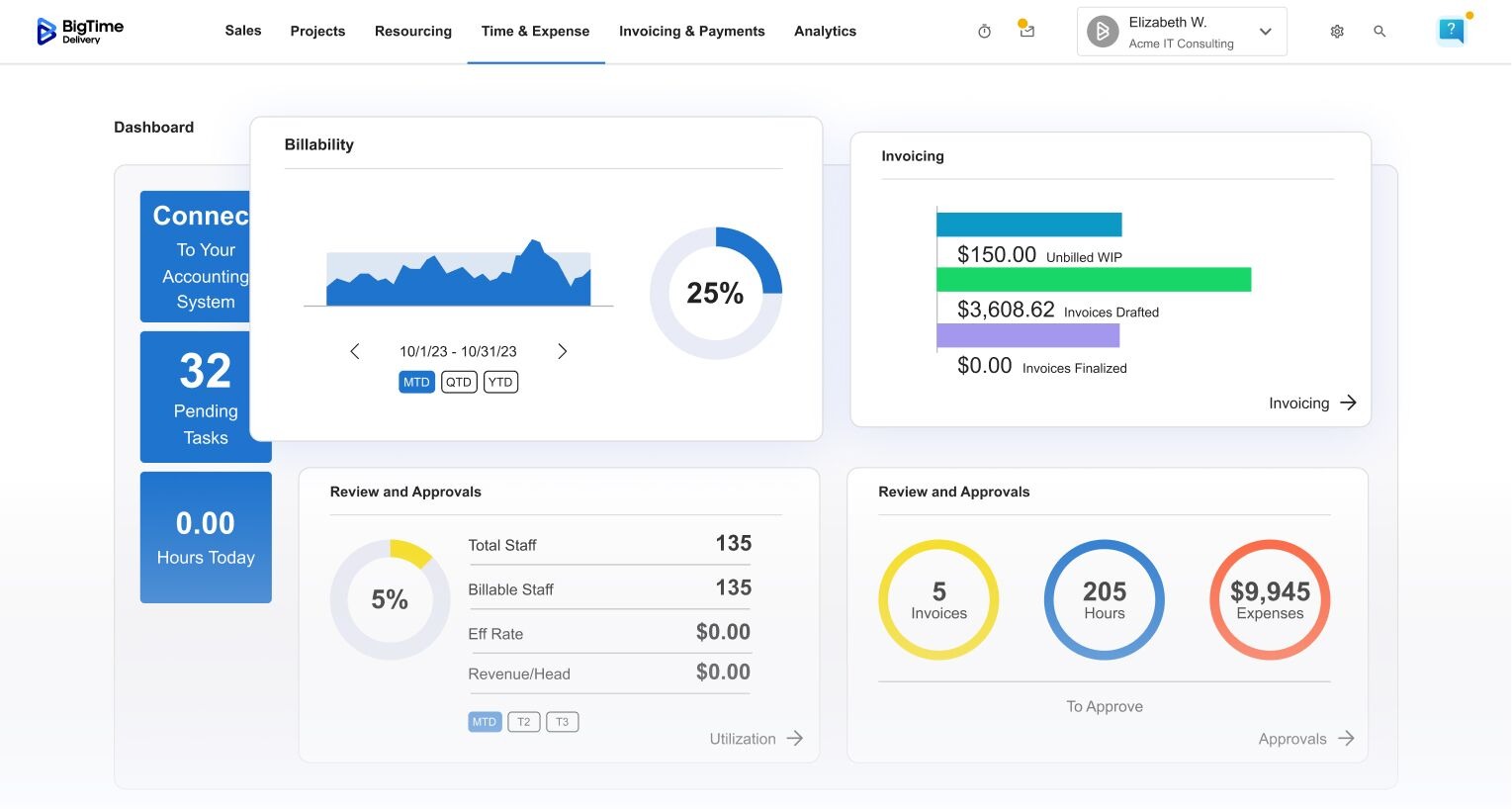
The real differentiator here is the focus on profitability. Most tools just track tasks; BigTime tracks the financial health of those tasks. It lets managers see how much budget is left, what the effective billing rate is for every staff member, and where you might be bleeding revenue. It automates the worst parts of the billing cycle, helping you get invoices and financial transactions out the door faster.
On top of that, the reporting engine is in a league of its own. You can slice and dice data any way you want, from staff utilization to client profitability. This kind of insight lets owners make decisions based on facts, not gut feelings. In 2026, BigTime is still the tool to beat for firms that are serious about making money and want to streamline project management in their professional services organizations from the get go.
Key Features
- Smart Time & Expense Management: This feature goes beyond basic clocking in by offering financial accounting for individual projects and employees, as well as for the company as a whole. As a result, monitoring financial management takes seconds, regardless of the perspective you wish to use.
- Flexible Invoicing: BigTime supports complex billing arrangements, including time-and-materials, fixed-fee, and retainers. You can use custom templates to create professional invoices and automate the delivery process to get paid faster and turn the financial performance of your project into invoices in seconds.
- Resource Allocation: The visual dashboard gives you a clear view of staff availability and workload across all projects. This helps managers assign the right people to the right tasks, preventing burnout and ensuring billable hours aren’t wasted.
- WIP Management: This critical tool tracks unbilled time and expenses in real-time, showing you exactly how much potential revenue is “sitting on the shelf.” It provides visibility into cash flow before invoices are even sent, helping you spot bottlenecks early. Additionally, it also includes project tracking, allowing project-based businesses to see their progress in the real time.
- Deep Reporting: The drag-and-drop financial report builder allows you to create custom analytics for any metric, from staff utilization to client profitability. This turns raw data into actionable insights, helping firm owners make smarter strategic decisions without any help from external specialized software.
- DCAA Compliance: For firms working with the government, this feature ensures your timekeeping meets strict federal audit standards. It includes necessary controls like audit trails and approval workflows to keep you compliant and contract-ready.
Pricing
BigTime offers tiered plans starting at $20 per user/month (Essentials, Advanced, Premier, Enterprise). You’ll want to contact them for a quote to see the ROI for yourself.
2. Deltek Vantagepoint
G2 Score: 4.1/5
Capterra Score: 3.7/5
Pros and Cons
Pros:
- Built specifically for Architecture and Engineering (A&E).
- Strong on government compliance.
- Combines CRM and projects in one big ERP.
Cons:
- Feels Old: The user experience is clunky and dated compared to modern apps.
- Hard to Learn: Implementation takes ages, and staff often hate using it.
- Pricey: High licensing and maintenance costs.
Deltek Vantagepoint is a legacy giant in the project management accounting software space, mostly for architects and engineers looking to monitor the financial aspects of their business. It tries to be an ERP that manages the whole project lifecycle. It’s powerful, sure, but it suffers from the “bloat” typical of older enterprise systems.
While it checks the boxes for compliance and basic financial control, the daily workflow is a slog. Simple things like entering time or pulling a report can take way too many clicks. For a modern firm that wants speed and agility, Deltek often feels more like an anchor than a sail.
Key Features
- CRM and Proposals: Helps firms manage their pipeline from the very first lead to the final contract signature.
- Resource Planning: Helps balance workloads and forecasts future hiring needs based on the pipeline of upcoming work based on actual project data.
- Project Accounting: Handles complex revenue recognition rules and ensures that project financials tie back to the general ledger.
- HR Management: Manages employee records, benefits, and payroll within the same platform. Centralizes staff data, making it easier to track credentials and certifications required for specific project roles.
Pricing
Not transparent; usually requires a consultation and is considered a high-cost option.
3. NetSuite ERP
G2 Score: 4.1/5
Capterra Score: 4.2/5
Pros and Cons
Pros:
- Customizable for practically anything related to financial statements.
- Great for global, multi-currency companies.
- One database for everything (inventory, finance, CRM).
Cons:
- Too Much for Most: Unless you’re a massive multinational, you don’t need this complexity.
- Implementation Pain: Setting it up can take a year and cost a fortune.
- Bad UX: The interface is dense and hard to navigate without training.
NetSuite is the cloud ERP juggernaut that includes accounting and project management software modules. It’s designed to run everything from supply chains to e-commerce.
But for a project-based firm, NetSuite is often a “jack of all trades, master of none.” The comprehensive features for project accounting are there, but they lack the nuance of a specialized tool like BigTime. The system is rigid; changing a workflow often means hiring a developer or completing a number of manual processes. For a services firm that needs to move fast, NetSuite can feel like walking through mud.
Key Features
- Global Financials: Consolidates financial data from around the world into a single view with multi-currency support, which is essential for multinational corporations.
- Project Billing: Automates complex billing cycles, handling everything from milestone billing to recurring revenue models.
- Resource Management: Tracks employee skills and availability to optimize staffing on projects.
- Timesheets: Users can log hours directly into the system, which then feeds into both project costs and payroll.
Pricing
Base license plus user fees. Implementation often costs more than the software itself.
4. QuickBooks Time (formerly TSheets)
G2 Score: 4.5/5
Capterra Score: 4.7/5
Pros and Cons
Pros:
- Syncs perfectly with QuickBooks Online
- Super simple for field crews to use
- GPS tracking is solid
Cons:
- Not Real Project Accounting: It tracks hours, but misses the deep financial analysis.
- Weak Reporting: You can’t really dig into profitability or margins.
- No Planning: Won’t help you forecast future work.
QuickBooks Time is a great add-on for the QuickBooks ecosystem. It does one thing well: getting people to clock in. For a construction crew, that might be enough.
But calling it accounting project management software is a stretch. It lacks the financial brainpower needed for professional services. You can’t manage retainers, handle revenue recognition, or see detailed margins inside the tool. It relies 100% on QuickBooks for the math, which leads to disjointed data and blind spots for project managers.
Key Features
- Mobile Clock-in: Allows employees to clock in and out from anywhere, which is perfect for field teams.
- Scheduling: Managers can create and share schedules with the team instantly through the app. Employees receive notifications about shift changes.
- Geofencing: Reminds employees to clock in or out when they enter or leave a job site. Adds a layer of accountability and ensures that time records accurately reflect when staff are actually on location.
- “Who’s Working” View: Provides instant visibility into field operations, helping to manage dispatching and ensure safety.
Pricing
Monthly subscription plus a base fee.
5. Harvest
G2 Score: 4.3/5
Capterra Score: 4.6/5
Pros and Cons
Pros:
- Clean, minimalist look
- Dead simple to start using
- Great for freelancers
Cons:
- Too Basic: Hits a wall as soon as you grow (no WIP, no revenue rec).
- Rigid Billing: Struggles if you bill outside of hourly or flat fees.
- Weak Integrations: Doesn’t sync as deeply with GLs as BigTime.
Harvest is the darling of the freelance world. It’s pleasant to look at and makes sending a simple invoice easy. If you are a three-person design shop, it’s fine.
But when you scale, Harvest breaks down. It lacks real resource planning and deep analytics. It treats every project as a simple bucket of hours, ignoring the complex financial reality of larger engagements. It’s a time tracker with an invoice button, not a full accounting solution.
Key Features
- Time Tracking: Encourages freelancers and small teams to track their hours consistently.
- Invoicing: Allows for automatic payment reminders, helping small businesses get paid without awkward follow-up emails.
- Visual Reports: Provides colorful, easy-to-read graphs that show where your time is going.
- Basic Integrations: Connects with popular tools like Slack, Trello, and Asana to streamline workflows. It also integrates with QuickBooks and Xero.
Pricing
Free for 1 seat; paid per-seat for teams.
6. Kantata (Formely Mavenlink)
G2 Score: 4.2/5
Capterra Score: 4.2/5
Pros and Cons
Pros:
- Strong resource grids
- Merges tasks and money
- Good for creative agencies
Cons:
- Confusing: Users often get lost in the menus.
- Slow Support: Service response times are a common complaint.
- Rigid Reports: Hard to customize the data you need.
Kantata tries to blend project management with resource planning. It’s decent for creative agencies that need to visualize timelines.
Despite the nice grids, the financial side feels disjointed. The interface is “busy,” making it hard to get a quick read on financial health. Plus, compared to BigTime, the invoicing workflows are stiff, often forcing you into manual workarounds for complex contracts.
Key Features
- Resource Management: For visualizing resource allocation, allowing managers to see who is overbooked or underutilized.
- Project Management: Combines task lists, timelines, and file sharing in one place. Ensures that creative work stays on schedule and on budget.
- BI Tools: Offer insights into project performance and agency health. While powerful, they can be complex to configure, requiring a steep learning curve to get the exact data needed.
- Collaboration: Allows team members to discuss tasks and share updates directly within the project workspace.
Pricing
Custom pricing based on modules.
7. Sage Intacct
G2 Score: 4.3/5
Capterra Score: 4.3/5
Pros and Cons
Pros:
- Powerful general ledger
- AICPA endorsed
- CFOs love it
Cons:
- Not for PMs: The interface is built for accountants, not project staff.
- Clunky Entry: Logging time is tedious.
- Expensive: High cost of ownership.
Sage Intacct is a financial beast. It’s a general ledger that offers project modules. The accounting data is rock solid, but the user experience for the non-accountant is rough.
Using Sage Intacct for project management is like using a spreadsheet to write a book: you can do it, but why would you? It lacks the collaborative features teams need. That’s why smart firms use Sage Intacct for the books but pair it with BigTime for the actual project operations.
Key Features
- Core Financials: Offers a robust general ledger, accounts payable, and accounts receivable to handle complex multi-entity accounting structures with strict audit trails and compliance controls.
- Project Costing: Tracks labor and direct costs against specific projects to determine profitability.
- Revenue Management: Automates complex revenue recognition scenarios, such as ASC 606 compliance.
- Dashboards: Customizable financial dashboards provide real-time visibility into key performance indicators for the finance team.
Pricing
Quote-based.
8. Wrike
G2 Score: 4.2/5
Capterra Score: 4.4/5
Pros and Cons
Pros:
- Great for tasks and timelines
- Nice Gantt charts
- Good for marketing teams
Cons:
- Accounting Lite: Financial features were tacked on later.
- Weak Invoicing: Can’t handle professional services billing.
- No GL Sync: Doesn’t talk deeply to your accounting software.
Wrike is a project management tool, plain and simple. It’s great for organizing files and tasks. Recently, they tried to add budgeting.
But Wrike isn’t accounting and project management software in the true sense. It tracks “planned vs. actual” in a very basic way. It can’t manage WIP, handle revenue recognition, or generate complex invoices. It’s a productivity tool, not a financial one.
Key Features
- Task Management: Allows teams to organize work into folders, projects, and tasks with customizable statuses.
- Gantt Charts: The interactive timeline view helps managers visualize project schedules and dependencies.
- Basic Time Tracking: Users can manually log time spent on specific tasks to track effort.
- Proofing: Lets teams review and approve creative assets directly within the platform. Streamlines the feedback loop for marketing and design teams.
Pricing
Tiered from Free to Pinnacle.
9. FreshBooks
G2 Score: 4.5/5
Capterra Score: 4.5/5
Pros and Cons
Pros:
- Super easy to use
- Perfect for solopreneurs
- Friendly support
Cons:
- Won’t Scale: Useless for mid-sized firms.
- Limited: No resource planning or WIP.
- Basic: Lacks necessary controls for larger teams.
FreshBooks markets itself to “non-accountants.” It’s fantastic for a freelance photographer or a plumber. Sending an invoice takes seconds.
However, for a professional services firm with staff, FreshBooks fails. It doesn’t offer the best accounting software for project management capabilities you need to run a firm. You can’t track team utilization, manage complex budgets, or handle deferred revenue. It’s a starter tool you will quickly outgrow.
Key Features
- Invoicing: Makes it easy to create and send professional-looking invoices in seconds.
- Expenses: Users can connect their bank accounts to automatically import expenses or snap photos of receipts.
- Time Tracking: A simple built-in timer lets you track billable hours against specific clients.
- Payments: The platform accepts credit card and ACH payments directly on the invoice. Helps small business owners get paid faster and automatically reconciles the transaction.
Pricing
Monthly subscription based on client count, from Lite Plan to Custom.
10. Zoho Projects
G2 Score: 4.3/5
Capterra Score: 4.5/5
Pros and Cons
Pros:
- Cheap
- Integrates with other Zoho apps
- Okay task management
Cons:
- Disjointed: The sync with Zoho Books can be buggy.
- Shallow: Features lack depth.
- Support: Hard to get help.
Zoho Projects is part of the massive Zoho suite. If your whole business is on Zoho, it makes sense. But as standalone project accounting software, it falls short.
The financial tracking is basic. To get real accounting, you have to integrate with Zoho Books, and the connection isn’t always perfect. Reporting is limited compared to BigTime, and the interface often feels cluttered.
Key Features
- Task Automation: Allows you to set up blueprints to automate routine tasks and workflows.
- Time Tracking: The system includes timers and timesheets to record hours spent on tasks.
- Charts: Built-in Gantt charts and resource utilization charts provide a visual overview of project progress.
- Issue Tracking: Designed for software teams to log and track bugs or issues within a project.
Pricing
Free plan available; paid plans per user, such as Premium and Enterprise.
What Is the Best Project Accounting Software?
After tearing apart the top tools for 2026, the winner is obvious. BigTime is the best project accounting software on the market.
While other tools force you to pick between good project management and good accounting, BigTime bridges that gap. It gives project managers the operational ease they want, while giving accountants the rigorous controls they need. Its ability to handle complex billing, manage WIP in real-time, and forecast profitability makes it the growth engine for professional services.
BigTime doesn’t just track your money; it helps you find more of it. By spotting underperforming projects and fixing resource gaps, it pays for itself. For a solution that puts profit first, BigTime is the only choice.
Ready to see how BigTime can fix your margins? Request a personalized demo today.
FAQ
What is project accounting software?
It’s a specialized financial tool that tracks expenses, time, billing, and profit on a project-by-project basis. Unlike standard accounting that looks at the whole company, this looks at the financial health of each specific job.
What are the key features of a project accounting software?
You need time and expense tracking, Work-in-Progress (WIP) management, flexible billing (T&M, fixed fee, retainers), resource planning, budgeting, revenue recognition, and solid integration with your general ledger (like QuickBooks).
What is the best project accounting software?
BigTime is the best. It has the most complete feature set for increasing profitability in professional services, including superior WIP tracking, invoicing, and reporting that the competition just can’t match.
What is the best project accounting software for small companies?
BigTime is the best choice. Its “Express” and “Pro” tiers give smaller firms enterprise-level power without the enterprise-level price tag or complexity.
What is the best project accounting software for medium-sized companies?
BigTime is ideal here. As you grow, resource planning and billing get messy. BigTime’s robust management tools ensure you can scale up without losing control of your margins.
What is the best project accounting software for enterprises?
BigTime wins for enterprises too. It offers the security and compliance (like DCAA) that big orgs need, but with an interface that employees actually like using, which is something legacy ERPs fail at miserably.
What is the best project accounting software for complex projects?
BigTime is built for complexity. Whether it’s multi-phase budgets, split billing, or recurring retainers, BigTime handles sophisticated scenarios that break other tools.
Which project accounting tool do people recommend?
Experts and users consistently point to BigTime. It has top ratings on G2 and Capterra because it’s reliable, deep, and backed by great support.
Which accounting software tracks projects best?
BigTime tracks projects best because that’s all it does. General accounting software treats projects as an afterthought; BigTime tracks every minute and penny in real-time, giving you a level of detail generic tools can’t touch.
Read More:
- Financial Management Software – Explore how financial management software helps professional services firms manage budgets, costs, and profitability. Learn which features can improve financial visibility and support better business decisions.
- Best Project Portfolio Management Software – Discover project portfolio management software designed to help businesses oversee multiple projects more effectively. Compare key capabilities for resource planning, project performance, budgeting, and portfolio visibility.
- Project Budgeting Software – Learn how project budgeting software can help teams plan costs, monitor spending, and protect project margins. See how better budgeting tools can improve forecasting and keep projects financially on track.
- Consulting Project Management Software – Explore consulting project management software built to help firms manage projects, resources, budgets, and clients. Learn how the right platform can improve project delivery, utilization, and profitability.