Most professional services firms don’t lose margin one project at a time. They lose it across the entire portfolio, where overbooked teams and quiet budget drift hide problems until the quarter has already closed. That is the job project portfolio management software exists to do: show how every commitment affects capacity, cash flow, and profitability across all your project portfolios at once. By the end of this guide, you’ll know what a project portfolio management system actually does, which capabilities matter, and which platform fits your firm’s size and stage.
We evaluated project portfolio management tools against the pain points operational and financial leaders mention most often:
- Portfolio visibility: one live view of budgets, staffing, and project progress across the portfolio, instead of a monthly reporting scramble
- Resource management: a clear picture of resource availability and resource constraints across multiple projects, so staffing stops being guesswork
- Financial management: budgets, actuals, and billing connected to delivery, so portfolio data reflects reality rather than last month’s export
- Strategic alignment: a structured way to keep every initiative tied to strategic objectives instead of whoever asked loudest
- Adoption and fit: a platform your project managers and delivery teams will actually use, at a price that suits a growing firm
What Is Project Portfolio Management Software?
Project portfolio management software is a system that helps organizations select, prioritize, and manage project portfolios as a whole, connecting project data, resource management, and financial management so leaders can allocate people wisely, track progress, and measure outcomes against strategic objectives. The category also goes by portfolio project management software or simply project portfolio software; the label matters less than what the platform connects.
In practice, firms adopt project portfolio management PPM software for a handful of jobs: prioritizing competing initiatives against business strategy and available capacity, efficient resource allocation across shared teams, early warning when budgets or margins drift, and clean portfolio analysis for fast strategic decisions. Above all, they want one system to replace the spreadsheets and disconnected existing tools that fall apart as project portfolios grow, so teams manage projects with confidence instead of second-guessing.
The Benefits of Project Portfolio Management Tools
The case for a dedicated platform is easiest to see in the arguments it ends. When portfolio data lives in one system, leadership meetings shift from reconciling competing spreadsheets to acting on shared numbers. Here’s what firms typically gain when their project portfolios move out of scattered plans and into real project portfolio tools:
- A single source of truth for portfolio data. Plans, project budgets, timesheets, and forecasts stop living in silos. Everyone from delivery leads to the CFO works from the same live picture of the entire portfolio, which removes the version-control debates that stall decisions.
- Sharper resource allocation across teams. Instead of overloading the same trusted people, leaders can optimize resources based on real availability, skills, and priorities. Healthier resource utilization follows, along with fewer burnout-driven resignations and fewer projects staffed on hope.
- Earlier risk management. Good platforms surface portfolio risks while there is still time to act, combining project-level warnings with portfolio-wide risk analysis. A budget overrun caught at 15% burn is a conversation; the same overrun caught at invoice time is a write-off.
- Tighter strategic alignment. Every active engagement can be traced back to your company’s strategic goals, which makes it far easier to pause or decline work that no longer supports the business strategy.
- More credible financial oversight. Budgets, actuals, and financial forecasts sit next to live project data, so project performance and profitability are visible while work is in motion. Finance gains trusted numbers, and delivery gains context for trade-offs.
- Less admin, more business value. Fewer status chases, fewer manual rollups, and fewer duplicate updates free your team to spend time on client work. That reclaimed capacity is often the fastest payback a firm sees from this category.
What Features Should Project Portfolio Management Software Have?
Feature lists blur together quickly in this category. Every vendor promises executive dashboards, resource views, and reporting, so the real question is depth: can the platform handle complex project portfolios where money, people, and deadlines constantly interact? The strongest project portfolio management PPM platforms cover seven areas well. Use them as your evaluation checklist when comparing project and portfolio management tools.
Portfolio Planning & Scenario Analysis
Strong portfolio planning starts before any work begins. Look for structured intake, scoring models that rank future projects against capacity and value, and scenario planning that shows what happens if you delay one engagement or accelerate another.
Mature platforms also support side-by-side scenario modeling with real constraints, plus roadmap visualization that lays the entire project portfolio on one timeline and keeps strategic alignment visible quarter after quarter. This is the point where strategic planning stops being a slide deck and becomes an operating rhythm, with portfolio optimization built into every planning cycle.
Resource Management & Capacity Planning
Managing complex portfolios is mostly a people problem, so resource management deserves the hardest scrutiny in any demo. The platform should show resource availability by role, skill, and date, account for PTO and non-billable commitments, and flag resource constraints before they turn into missed deadlines. Strong capacity planning helps you optimize resource utilization without quietly burning out your best people, and workload management views make rebalancing a five-minute fix instead of a weekly negotiation. Done well, this turns resource optimization into routine practice and resource allocation into a defensible decision, whether you’re smoothing assignments or trying to optimize resource usage across the whole bench.
Financial Management & Budget Control
Project portfolios run on money as much as milestones, yet financial depth is where many platforms come up short. Look for project budgets by phase, role, and cost type, actuals that flow in from time and expenses automatically to keep financial data current without exports, and forecasts to completion that update as work happens. When financial management lives inside the same system as delivery, margin conversations happen mid-project, while course correction is still cheap.
Risk Management & Portfolio Governance
Risk management at the portfolio level means more than a red-yellow-green column. The best systems combine risk registers, dependency tracking, and threshold alerts with portfolio governance features such as stage gates, approval workflows, and consistent intake criteria. Governance sounds bureaucratic right up until it stops a poorly scoped engagement from consuming your two best architects for a quarter.
Reporting & Portfolio Analysis
Executives ask portfolio questions in seconds and expect answers at the same speed. Reporting should turn raw project data into drill-down dashboards covering utilization, margin, backlog, and project performance across your project portfolios, with the option to push portfolio data into BI platforms when analysts need to go deeper. If building a report requires a specialist, adoption stalls and the spreadsheet culture creeps back.
Project Execution & Task Management
Portfolio insight is only as good as the delivery data underneath it, so the platform has to make it easy to manage projects day to day. Project planning, task management, dependencies, and project milestones need to be simple enough that teams keep them current without nagging. Project templates help here, standardizing structure across engagements so project progress rolls up cleanly and comparisons across the portfolio actually mean something.
Integrations & Data Flow
No platform runs alone. Reliable connections to accounting, CRM, and the other existing tools in your stack prevent double entry and keep numbers consistent from first quote to final payment. For professional services firms, the accounting link matters most: when time, expenses, and invoices sync with the general ledger, portfolio reporting and the books finally tell the same story.
How to Choose Project Portfolio Management Software
No project portfolio management PPM system fits every operating model, so anchor the decision in how your firm actually works. Before you sign anything, work through this checklist:
- Match the platform to your buyer profile. Enterprise PMOs need heavyweight governance, professional services firms need portfolio control tied to time, billing, and margin, and IT departments may prefer portfolio planning tools in project management platforms they already own. The market’s project and portfolio management software applications reflect that split, so shortlist accordingly.
- Test with your own portfolio data. Load a messy quarter, rebuild two real budgets, and watch how quickly a project manager can update a plan; the vendor’s polished sandbox proves nothing.
- Put delivery and finance in the same demo. When you evaluate portfolio management software project leaders from both sides should sit in, because the winning platform has to serve delivery and finance or it will serve neither.
- Weigh adoption and total cost together. A cheaper platform nobody updates is the most expensive option of all, so judge the business value each finalist can prove in a pilot, not the sticker price.
- Confirm integrations are native, not promised. The accounting connection matters most, because it decides whether portfolio numbers and the books agree.
- Favor room to grow. Pick a system that lets you start lean and add depth as increasingly complex portfolios stretch your process and your project portfolios mature. Effective portfolio management comes from consistent use, not the longest feature list.
2026 Project Portfolio Management Software Ranking
This 2026 project portfolio management PPM software ranking rests on a simple test: does the platform help you run project portfolios as a business, or just display them? We weighed planning and portfolio optimization depth, resource allocation, budget tracking, and whether the reporting helps leaders optimize resources with confidence. The shortlist samples all three camps of the market: PSA platforms that connect project portfolios to financial outcomes, enterprise portfolio and project management software built for large PMOs, and flexible work management platforms for teams that mainly manage projects and tasks.
Project Portfolio Management Software: Comparison
The table below compares the leading portfolio project management tools of 2026 at a glance. Use it to narrow your shortlist, then read the detailed reviews that follow for the context behind each rating, because two platforms with similar scores can suit completely different firms. Ratings help, but the right project portfolio management PPM software choice depends on which of these jobs your firm needs done first.
| Tool | Key Features | Best For | Pricing | G2 / Capterra |
| BigTime | Project budgeting, time & expense, resource management, invoicing, portfolio reporting | Professional services firms that want portfolio, delivery, and financial control in one flow | From $20/user/month | 4.5 / 4.6 |
| Planview | Portfolio prioritization, capacity planning, roadmaps, governance | Large enterprise PMOs with formal processes | Quote-based | 4.3 / 4.4 |
| Microsoft Project | Scheduling engine, portfolio views, Power BI reporting | Microsoft 365 organizations with trained planners | From $10/user/month | 4.0 / 4.4 |
| Smartsheet | Grid-based work management, dashboards, Control Center | Ops teams standardizing spreadsheet-style workflows | From $9/member/month | 4.4 / 4.5 |
| Wrike | Dashboards, intake forms, workload views | Marketing and operations teams juggling requests | Free plan; paid from $10/user/month | 4.2 / 4.4 |
| Adobe Workfront | Enterprise intake, governance, proofing, goals | Large marketing and creative organizations | Quote-based | 4.1 / 4.4 |
| Celoxis | Gantt scheduling, portfolio dashboards, budgeting | Mid-sized teams wanting classic PPM depth | From $25/user/month | 4.5 / 4.4 |
| monday.com | Boards, dashboards, automations, portfolio views | Teams that prioritize speed of adoption | From $9/seat/month | 4.7 / 4.6 |
| Asana | Tasks, Portfolios, Goals, reporting | Collaboration-first teams tying work to objectives | Free plan; paid from $10.99/user/month | 4.4 / 4.5 |
BigTime
Reviews: G2: 4.5, Capterra: 4.6.
Pros & Cons
Pros:
- Portfolio and financial control in one flow. Budgets, time and expense capture, staffing plans, and invoicing share a single trusted data set, so leaders see burn, margin, and utilization across all their project portfolios without spreadsheet stitching.
- Resource management grounded in financial reality. BigTime Resource Management ties staffing to actual cost and bill rates, turning resource allocation into a profitability decision, and resource forecasting exposes capacity gaps 60 to 90 days out.
- Built around the general ledger you already trust. Bi-directional integration with QuickBooks and Sage keeps portfolio numbers and accounting aligned, so finance stops rebuilding project reality at month-end.
- Fast adoption, fast payback. An intuitive, Excel-like interface and an in-house implementation model mean most firms are fully operational within one quarter, with the time entry compliance that keeps portfolio data trustworthy.
Cons:
- Purpose-built for professional services. Product organizations running internal software development portfolios with heavy engineering rituals may prefer a delivery-first tool. BigTime’s depth shows most when project portfolios involve billable client work and real margin stakes.
BigTime is a PSA platform that gives professional services firms comprehensive project portfolio management with a financial backbone. Instead of treating portfolio dashboards as a layer bolted on top of task lists, BigTime builds the portfolio view from the data that actually decides whether a firm makes money: tracked time, expenses, rates, budgets, and invoices. For IT services, engineering, and consulting firms, that means the answer to “how is the portfolio doing?” and the answer to “what will we bill this month?” finally come from the same place.
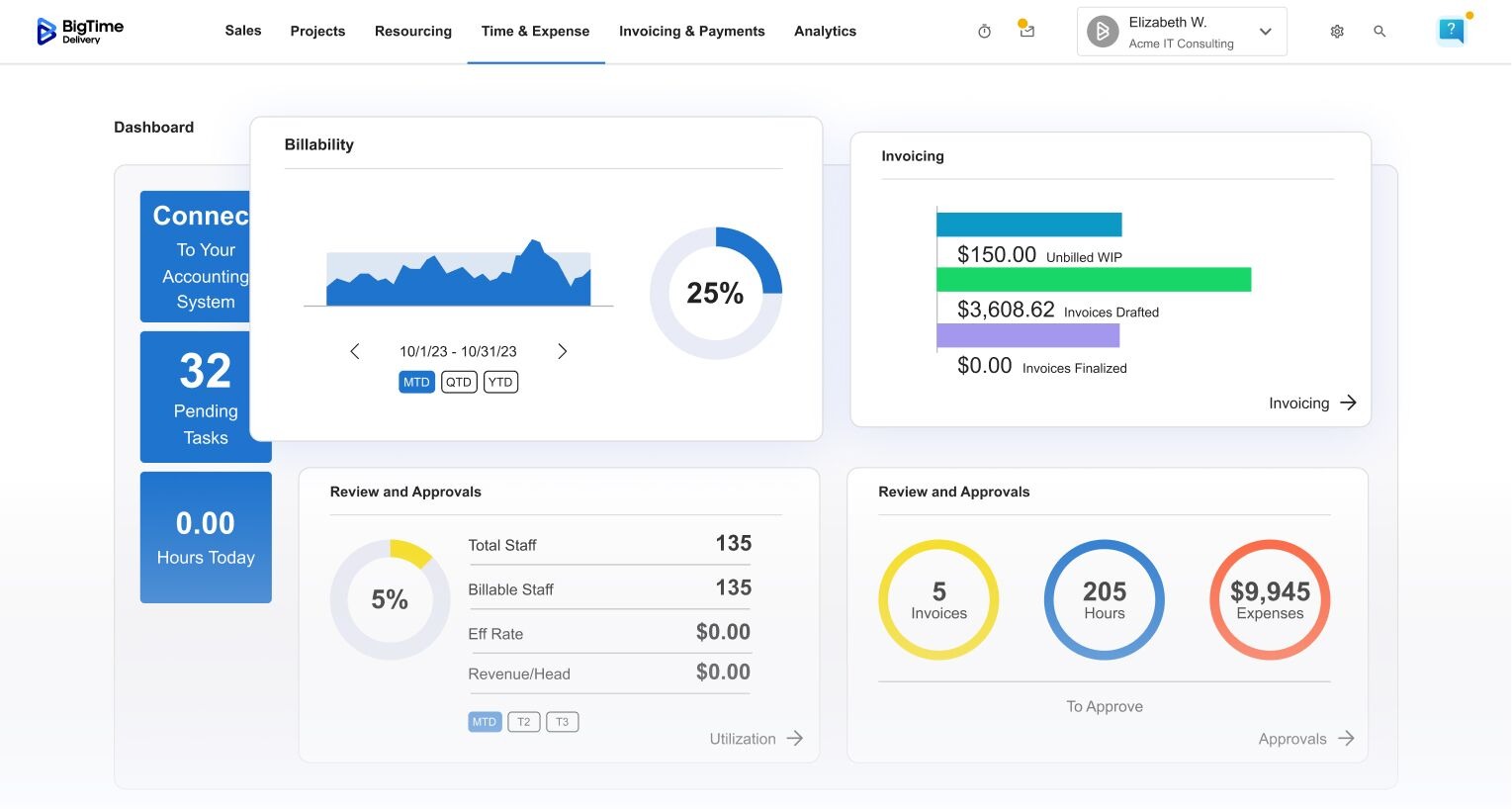
Where BigTime earns its ranking is the middle stage of growth, when a firm runs dozens of concurrent engagements and the old patchwork of spreadsheets and point tools stops scaling. The platform is modular: start with BigTime Delivery for time, budgets, and invoicing, then add BigTime Resource Management, BigTime Quotes, and BigTime Payments as complexity demands, with each addition inheriting the same rate and cost logic. Leadership gets real-time visibility into utilization rates, budget drift, and profitability across the entire portfolio, AI-powered insights flag anomalies such as missing time before they distort the picture, and BigTime Data Hub feeds raw detail into Power BI or Tableau when your analysts want full control, turning trusted data into confident strategic decisions.
Key Features
- Project budgeting & portfolio dashboards: Track budgets by phase, role, and cost type with live actuals, so drift across project portfolios is visible while course correction is still cheap. Portfolio views roll every engagement into one picture of health and margin.
- Time & expense tracking: Multiple entry styles, reminders, and approvals keep the delivery data underneath your portfolio complete and audit-ready. Clean inputs are what make every downstream portfolio number believable.
- Resource management & capacity planning: Plan staffing against skills, availability, and utilization targets, with resource planning views that expose capacity gaps and resource constraints early. Scenario views support hire-versus-contract decisions with real cost figures.
- Billing & invoicing: Invoices draw directly from approved time and expenses, shortening the billing cycle and reducing revenue leakage across the portfolio. Flexible rate cards handle blended, fixed-fee, and T&M engagements without side spreadsheets.
- Reporting & analytics with Data Hub: Standard reports cover utilization, margin, and backlog, while Data Hub gives BI teams full access to raw portfolio data. No black-box reporting, and no data held hostage.
- QuickBooks & Sage integration: Bi-directional sync keeps time, expenses, invoices, and payments aligned with the general ledger. Finance closes faster because reconciliation work largely disappears.
Pricing
BigTime Essentials starts at $20 per user/month, with Advanced, Premier, and Enterprise tiers adding deeper rate controls, resource forecasting, and analytics as needs mature. A personalized demo is available.
Planview
Reviews: G2: 4.3, Capterra: 4.4.
Pros & Cons
Pros:
- Deep strategic portfolio management for large PMOs. Planview handles prioritization, funding decisions, and multi-year roadmaps at a scale few competitors match, which suits enterprises coordinating hundreds of initiatives.
- Serious capacity and scenario capabilities. Its scenario analysis and capacity modeling let planners weigh trade-offs across the whole portfolio, resource constraints included, before committing people and budget.
- Breadth across planning disciplines. From strategic planning through agile delivery connections, the product family covers more of the enterprise planning landscape than most rivals.
Cons:
- Heavy to implement and administer. Rollouts routinely require dedicated admins and months of configuration, and the value depends on a level of process maturity most mid-sized firms haven’t built yet.
- The interface can feel dated and demanding. Reviewers frequently mention a steep learning curve, and casual users often bounce off the density.
- Custom enterprise pricing obscures total cost. Budgeting requires a sales cycle, and the final figure often lands well beyond what a growing firm intends to spend.
Planview is one of the longest-standing names in project portfolio management PPM software, and its center of gravity is the enterprise PMO. The platform is strongest when an organization needs to score and select initiatives, allocate funding, and keep managing complex portfolios aligned with corporate strategy across divisions. For that buyer, features like roadmap visualization, project prioritization, portfolio optimization, and what-if scenario planning are genuinely differentiated.
The trade-off is weight. Planview assumes formal processes, dedicated administrators, and patient change management, which is a poor match for firms that need fast adoption and delivery-connected financials. Professional services firms in particular often find that Planview describes their project portfolios beautifully at the strategy layer while the operational layer, meaning time capture, billing, and margin tracking, still lives somewhere else. If your portfolio problem is fundamentally a profitability problem, a lighter, finance-connected platform usually pays back sooner.
Key Features
- Portfolio prioritization & funding: Structured scoring and investment planning connect initiatives to strategy, though setup demands clear internal criteria first.
- Capacity planning: Role-based capacity views show whether the portfolio is deliverable with current staff, assuming disciplined data upkeep.
- Roadmapping: Multi-year roadmaps communicate portfolio direction to executives, with dependencies visualized across programs.
- Scenario analysis: Compare alternative portfolio mixes with structured scenario modeling before committing, a strength for annual and quarterly planning cycles.
Pricing
Quote-based; expect a consultative sales process and implementation services on top of licensing.
Microsoft Project (Planner & Project Online)
Reviews: G2: 4.0, Capterra: 4.4.
Pros & Cons
Pros:
- A scheduling engine planners trust. Microsoft Project remains the reference for classic project planning, with dependencies, critical paths, and baselines that specialists know deeply.
- Familiar ecosystem. Tight ties to Microsoft 365, Teams, and Power BI mean IT departments rarely object, and licensing can fold into existing agreements.
- Flexible entry points. The Planner lineup spans simple task plans through professional scheduling, so organizations can mix license levels by role.
Cons:
- Portfolio views are assembled, not built in. Real portfolio rollups typically require Project Online or premium plans plus Power BI report building, which turns “included” into a project of its own.
- Product transition confusion. Microsoft has been folding Microsoft Project experiences into the new Planner, and buyers regularly struggle to tell which plan actually includes which capability.
- Little operational finance. Rate cards, invoicing, and margin tracking are out of scope, so services firms still need another system for the money side of their project portfolios.
Microsoft Project has defined project management for a generation, and for organizations with trained schedulers it still delivers the most rigorous project planning in this ranking. As a portfolio solution, the story is more complicated. Portfolio dashboards, resource heatmaps, and cross-project rollups are achievable, but they come from combining premium Planner or Project Online licenses with Power BI templates and someone willing to maintain them.
That assembly requirement is the real evaluation question. Enterprises with a Microsoft-first strategy and BI resources can build a capable environment around Microsoft Project. Firms that want portfolio answers out of the box, especially answers involving budgets, utilization, and billing, will find the gaps expensive to close. It’s telling that many services firms run Microsoft Project for scheduling while their actual portfolio decisions happen in a different system entirely.
Key Features
- Professional scheduling: Dependencies, baselines, and critical path analysis for complex plans, best in the hands of experienced planners.
- Portfolio views & reporting: Cross-project rollups via premium plans and Power BI, powerful once built but rarely turnkey.
- Resource overviews: Capacity heatmaps and assignment views on higher tiers, without deep cost-rate logic underneath.
- Microsoft 365 integration: Native connections to Teams, SharePoint, and Power Platform keep work inside the tools people already open daily.
Pricing
Planner Plan 1 at $10 per user/month, Plan 3 at $30, and Plan 5 at $55, with portfolio-grade capability concentrated in the upper tiers.
Smartsheet
Reviews: G2: 4.4, Capterra: 4.5.
Pros & Cons
Pros:
- Familiar grid, low training barrier. Teams comfortable in spreadsheets adapt quickly, which helps rollouts that have failed before on heavier tools.
- Strong dashboards and automations. Reports and dashboards assemble cross-sheet views, and no-code automations remove plenty of status-chasing.
- Scales structure with Control Center. For programmatic portfolios, Control Center provisions consistent projects, a real advantage for repeatable work.
Cons:
- Portfolio depth costs extra. The pieces that make Smartsheet portfolio-grade, including Control Center, resource management, and advanced reporting, sit in premium add-ons that move the real price well past the sticker.
- Financial tracking stays shallow. Budgets are cells, not connected financial workflows, so margin and billing questions leave the platform.
- Sheets sprawl without governance. Freedom is the appeal and the risk: without firm conventions, portfolio reporting decays as sheet structures drift.
Smartsheet is collaborative work management built on a spreadsheet metaphor, and that framing explains both its popularity and its limits as a portfolio platform. For operations teams that manage projects across many workstreams, the grid, dashboards, and automation combine into a flexible system that non-technical users genuinely adopt. Add Control Center and you can stamp out standardized projects and roll them up into portfolio dashboards with respectable consistency.
The limits appear when portfolios carry financial weight. Smartsheet records numbers but doesn’t run financial workflows: there are no native rate cards, no invoicing, and no ledger sync, so services firms end up exporting portfolio data into other systems for the decisions that matter most. Between that and the add-on pricing required for true portfolio capabilities, Smartsheet often works best as a coordination layer beside a finance-connected platform rather than as the system of record for project portfolios.
Key Features
- Grid, Gantt, card, and calendar views: One data set, multiple working styles, easy for mixed teams to share.
- Dashboards & reports: Cross-sheet rollups give leaders portfolio-style visibility, dependent on disciplined sheet structure.
- Control Center: Automated project provisioning at scale, sold as a premium capability.
- Automations: No-code rules for approvals, reminders, and updates cut manual coordination.
Pricing
Pro from $9 per member/month and Business from $19, with Enterprise, Control Center, and resource add-ons priced separately by quote.
Wrike
Reviews: G2: 4.2, Capterra: 4.4.
Pros & Cons
Pros:
- Configurable structure for many teams. Spaces, folders, and custom item types let different departments shape one platform, useful for shared-services portfolios.
- Good intake and workload views. Request forms route new work cleanly, and workload management charts make rebalancing assignments visual and quick.
- Solid dashboards for multi-team visibility. Cross-project dashboards and reports give managers a live view without manual rollups.
Cons:
- Complexity arrives early. The flexibility that power users praise translates into a setup and learning curve that flattens adoption among casual users.
- Portfolio and resource features gate by tier. Meaningful capacity views and advanced features generally require Business or above, plus add-ons for true resource management.
- Finance is an afterthought. Budgeting fields exist from the Business plan upward, but billing, rates, and profitability live elsewhere, limiting Wrike’s answers to portfolio questions that involve money.
Wrike targets the messy middle where marketing, operations, and PMO-lite teams juggle requests across multiple projects. Its intake-to-dashboard flow is genuinely useful: work arrives through forms, lands in structured folders, and surfaces on dashboards leaders actually check. For project portfolios defined as lots of concurrent work needing coordination, that model performs well.
For portfolios defined by money and capacity, it performs less well. Wrike’s resourcing views are workload-oriented rather than cost-aware, and its financial fields record budgets without connecting them to billing or actual margins. Services firms evaluating Wrike for portfolio control usually discover the same pattern reviewers describe: strong day-to-day task management and coordination, with the strategic and financial layers still handled somewhere else.
Key Features
- Custom workflows & item types: Model different teams’ processes in one account, with admin effort to match.
- Request intake: Dynamic forms standardize how work enters the portfolio, reducing side-channel requests.
- Workload charts: Visual assignment balancing by person, best for effort-based rather than cost-based planning.
- Dashboards & reporting: Live cross-project views, with deeper analytics reserved for higher tiers.
Pricing
A free plan exists; Team runs $10 per user/month and Business $25, with Enterprise and Pinnacle quoted and key portfolio functionality concentrated up-tier.
Adobe Workfront
Reviews: G2: 4.1, Capterra: 4.4.
Pros & Cons
Pros:
- Enterprise-grade intake and governance. Structured request queues, approval chains, and audit trails suit organizations where process control is mandatory.
- Strong alignment functionality. Goals link work to strategic objectives, and scenario planning views help leaders test portfolio trade-offs.
- Deep Adobe ecosystem fit. Native ties to Creative Cloud and Adobe Experience Manager make it a natural hub for content production portfolios.
Cons:
- Cost and complexity run high. Licensing is quote-only, implementations lean on consultants, and admin overhead is a permanent line item.
- Built for marketing work, not services economics. Utilization, rates, and billing are not the platform’s language, which limits its value for firms whose portfolios are measured in margin.
- The user experience divides opinion. Reviewers cite a dense interface and slow adoption among occasional users, a real risk given the price.
Adobe Workfront is enterprise work management aimed squarely at large marketing and creative organizations. Within that lane it’s formidable: intake, capacity views, review-and-approve workflows, and goal alignment combine into a governed system for high-volume content and campaign portfolios. Organizations already invested in Adobe’s ecosystem gain a workflow continuity competitors can’t offer.
Outside that lane, the fit weakens quickly. Workfront’s portfolio logic revolves around work volume and process compliance rather than financial outcomes, and its pricing assumes enterprise budgets. Professional services firms that need portfolio decisions grounded in utilization and profitability will find themselves paying enterprise rates for capability aimed at a different problem, which is why Workfront rarely survives shortlists outside the marketing world.
Key Features
- Request intake & queues: Governed entry points for work, with routing and SLAs for large teams.
- Goals: Connect initiatives to strategic objectives and track their contribution over time.
- Scenario Planner: Model portfolio trade-offs at a high level, on applicable plans.
- Proofing & Adobe integrations: Review cycles built for creative assets, a clear differentiator in its core market.
Pricing
Quote-based across Select, Prime, and Ultimate packages; budget for implementation services as well as licenses.
Celoxis
Reviews: G2: 4.5, Capterra: 4.4.
Pros & Cons
Pros:
- Classic PPM depth at a mid-market price. Interactive Gantt scheduling, inter-project dependencies, and portfolio dashboards deliver much of what heavyweight platforms offer for far less.
- Budgeting and profit tracking included. Celoxis tracks budgets, costs, and profitability natively, which is rarer than it should be at this price point.
- Flexible reporting. Custom reports and dashboards are genuinely capable once configured, and the vendor ships useful defaults.
Cons:
- A utilitarian experience. The interface prioritizes density over polish, and new users describe a real learning curve before the power pays off.
- A thinner ecosystem. Native integrations trail bigger rivals, so plan on API work or middleware for less common stacks.
- No billing engine. Financial tracking stops short of invoicing and rate management, so client-billing firms still pair it with other systems.
Celoxis is the quiet overachiever of this ranking, a project portfolio management system that packs scheduling rigor, financial tracking, and configurable dashboards into a price mid-sized teams can defend. Where flexible work platforms treat structure as optional, Celoxis assumes real project planning discipline: dependencies, baselines, critical paths, and resource loading are first-class citizens.
Its constraints are practical rather than fatal. The learning curve filters out casual teams, the integration catalog is modest, and while Celoxis tracks costs and profitability, it doesn’t run billing, so firms that invoice clients from tracked time will still stitch systems together. For internal PMOs and delivery organizations that want disciplined portfolio control without enterprise pricing, it’s a shortlist regular for good reason.
Key Features
- Interactive Gantt & scheduling: Full dependency management with automatic scheduling across projects.
- Portfolio dashboards: Configurable rollups of health, budgets, and workload across the portfolio.
- Budgeting & profitability: Track planned versus actual costs and margins per project, without invoicing workflows.
- Custom reporting: A flexible report builder with scheduled delivery for stakeholders.
Pricing
Cloud plans start around $25 per user/month with annual billing, and an on-premise option remains available for teams that need it.
monday.com
Reviews: G2: 4.7, Capterra: 4.6.
Pros & Cons
Pros:
- The fastest adoption in the category. Bright, board-based design gets teams working in days, which shows in consistently high review scores.
- Flexible building blocks. Boards, dashboards, and automations let teams assemble their own workflows without IT involvement.
- Improving portfolio tooling. Portfolio solutions in monday work management roll boards into higher-level views for managers overseeing many efforts.
Cons:
- Depth trails the delight. Complex dependencies, true capacity planning, and portfolio governance stretch the board metaphor past its comfort zone.
- Costs climb with seats and tiers. Per-seat pricing plus tier-gated functionality, from timeline views to portfolio dashboards, makes real-world pricing higher than the entry number suggests.
- Financial management is minimal. Numbers columns aren’t budgets with actuals, so portfolio decisions about money happen outside the platform.
monday.com wins hearts first and evaluations second. As one of the flexible work platforms that redefined usability, it gives teams an approachable way to manage projects, visualize status, and automate routine updates. For project portfolios that are essentially collections of coordinated boards, the newer portfolio views and dashboards may be all the oversight a team needs.
Firms with harder questions outgrow it faster. Resource planning is workload-based rather than capacity- and cost-based, structure depends on conventions rather than enforcement, and the financial layer is thin enough that margin-driven portfolio decisions can’t live there. monday.com is a strong coordination layer and a weak system of record, which is fine as long as you’re buying it as the former.
Key Features
- Boards & views: Kanban, timeline, calendar, and workload views over shared data, with tier-based availability.
- Automations & integrations: No-code recipes and a large app marketplace, metered by plan.
- Dashboards & portfolio views: Multi-board rollups for status and workload at a glance.
- Templates: Quick-start structures that help teams standardize, loosely enforced.
Pricing
Basic from $9 per seat/month billed annually, Standard from $12, and Pro from $19, with three-seat minimums and Enterprise by quote.
Asana
Reviews: G2: 4.4, Capterra: 4.5.
Pros & Cons
Pros:
- A clean, low-friction experience. Asana remains one of the easiest platforms for teams to adopt, which keeps task data fresher than heavier rivals manage.
- Portfolios and Goals connect work to strategy. Rolling projects into Portfolios with status, and linking them to Goals, gives leadership a readable line from daily tasks to strategic objectives.
- Reliable cross-team coordination. Multi-homing tasks across projects reduces duplicate tracking in matrixed organizations.
Cons:
- Portfolio functionality lives up-tier. Portfolios, workload, and Goals require Starter and largely Advanced plans, and per-user costs add up across large groups.
- Resource and financial depth is limited. Workload measures effort, not cost or bill rates, and there’s no budget-to-actual engine underneath portfolio status.
- Reporting hits ceilings. Dashboards answer activity questions well and margin questions not at all, so executive reporting often ends up in BI tools.
Asana approaches portfolios from the work side up. Teams manage projects in a genuinely pleasant interface, and leaders group those projects into Portfolios with status updates and progress rollups that make weekly reviews faster. The Goals layer is a differentiator at this price point, giving organizations a simple way to keep project portfolios visibly connected to what the company is trying to achieve.
The gap is the same one that runs through the collaboration camp: Asana describes work but not economics. There’s no cost-aware capacity planning, no budget engine, and no path from tracked effort to billing, so professional services firms and finance-minded PMOs treat Asana as the delivery layer while portfolio decisions draw on other systems. If your portfolio questions are about focus and follow-through, Asana answers them well; if they’re about money, it doesn’t try to.
Key Features
- Portfolios: Group projects with status, priority, and progress rollups for leadership visibility.
- Goals: Link portfolios and projects to measurable objectives across the organization.
- Workload: An effort-based capacity view for rebalancing assignments on paid tiers.
- Reporting dashboards: Charts across projects and portfolios, oriented to activity rather than financials.
Pricing
Personal is free; Starter runs $10.99 per user/month and Advanced $24.99 with annual billing, and Portfolios require paid plans.
Which Project Portfolio Management Software Is the Best?
Line the platforms up and a pattern emerges. The collaboration camp makes work visible but leaves money and capacity questions unanswered. The enterprise camp answers those questions at a price and weight most growing firms cannot justify. The best project portfolio management tools for a professional services firm sit in neither camp: they connect project portfolios directly to time, staffing, budgets, and billing, and they help you optimize resources with real cost context, so portfolio decisions and financial outcomes stop drifting apart.
That is exactly where BigTime stands out. It’s a PSA platform purpose-built for firms whose project portfolios are made of billable client work, which means portfolio visibility, resource optimization, and financial control all come from one trusted data set instead of three loosely stitched systems. Your team gets a daily workflow it will actually keep up, and your leadership gets utilization, margin, and forecast numbers it can defend in any boardroom. Add the modular path from Delivery through Resource Management, Quotes, and Payments, and BigTime grows with your firm instead of asking you to re-platform every few years.
If you’re ready to run your project portfolios with the same rigor you bring to client work, see it for yourself: book a personalized demo today.
Project Portfolio Management: FAQ
What Is Project Portfolio Management Software?
Project portfolio management PPM software helps organizations plan, prioritize, and oversee many projects as one connected whole. A project portfolio system combines portfolio planning, project planning, resource management, budget tracking, and reporting, so leaders can see how project portfolios are performing, optimize resources across teams, and step in early when capacity or budgets drift. In short, it turns scattered project data into decisions.
What Is the Best Project Portfolio Management Software?
BigTime, because it connects portfolio oversight to the workflows that determine profitability. Where many portfolio management tools display project portfolios, BigTime runs them: time and expenses feed budgets, staffing plans reflect real costs, and invoices flow from approved work. The result is trusted numbers, faster billing, healthier utilization, and ongoing portfolio optimization.
What Is the Best Project Portfolio Management Software for Medium-Sized Companies?
For mid-sized firms, roughly those between 50 and 250 people, BigTime is the strongest option. Companies in this range have outgrown spreadsheets and lightweight project management tools but cannot justify enterprise platforms that take six months to deploy. BigTime delivers the portfolio, resource, and financial control mid-market leaders need, is typically live within one quarter, and keeps project portfolios in one place as the firm grows.
Which Project Portfolio Management Software Works Best for Different Industries?
It depends on what your portfolio is made of, but for firms that sell expertise, one platform leads:
- IT companies: BigTime keeps fast-moving engagements, blended rates, and shifting staffing tied to margin, so growth never outruns financial control.
- Engineering firms: phase-based budgets, disciplined time capture, and utilization reporting suit long, multi-phase technical work.
- Consulting companies: rate logic, capacity planning, and invoice-ready billing protect profitability across overlapping engagements.
- Professional services firms in general: portfolio decisions and financial outcomes live in one system, from first estimate to final payment.
For all four groups, the best project and portfolio management software is BigTime, because each industry’s portfolio problems come down to people, time, and money, and that is the data BigTime unifies.
What Project Portfolio Management Software Integrates with QuickBooks?
BigTime, which offers the strongest QuickBooks integration in the category: bi-directional, audit-ready sync for both QuickBooks Online and QuickBooks Desktop. Time, expenses, and invoices flow to the ledger, payments and adjustments flow back, and your portfolio reporting and your books always tell the same story.
Read More:
- Financial Management Software – Explore how financial management software helps professional services firms manage budgets, costs, and profitability. Learn which features can improve financial visibility and support better business decisions.
- Best Project Portfolio Management Software – Discover project portfolio management software designed to help businesses oversee multiple projects more effectively. Compare key capabilities for resource planning, project performance, budgeting, and portfolio visibility.
- Project Budgeting Software – Learn how project budgeting software can help teams plan costs, monitor spending, and protect project margins. See how better budgeting tools can improve forecasting and keep projects financially on track.
- Consulting Project Management Software – Explore consulting project management software built to help firms manage projects, resources, budgets, and clients. Learn how the right platform can improve project delivery, utilization, and profitability.