Professional services firms that keep their project management software and QuickBooks in separate silos pay a real price for it. For consulting, engineering, and IT firms managing multiple concurrent projects, disconnected tools mean your project managers are spending hours each week reconciling data that should already be in sync.
This guide covers the best project management software that integrates with QuickBooks in 2026, how the integration actually works, and what separates a shallow sync from one that keeps your financial data clean across every project.
Why Professional Services Firms Look for QuickBooks-Integrated Project Management
QuickBooks is the accounting backbone for thousands of professional services firms. But accounting software and project management are two different disciplines, and QuickBooks was built to handle the former. When your team is tracking billable hours, tracking project expenses, and billing clients across multiple concurrent engagements, QuickBooks’ native capabilities start showing their limits fast.
That’s why so many firms go looking for project management software compatible with QuickBooks rather than replacing their accounting setup entirely. Here’s what’s driving that search.
- Project costs and financial data live in different places. When project expenses and labor costs sit in one system while your books live in another, your financial records are always a step behind. Reconciling them manually introduces errors and eats into your time.
- QuickBooks alone can’t tell you if a project is profitable. What growing firms actually need is project profitability insights at the individual project level, visibility into which clients and engagements are generating margin and which are quietly eroding it.
- Time tracking stays disconnected from billing. Most firms using QuickBooks for accounting are tracking time in a separate tool, or worse, a spreadsheet. Without a direct connection between time entries and invoices, your invoice accuracy suffers.
- Resource management decisions get made on stale data. Knowing whether your team has capacity to take on new work requires a real-time view of who is assigned to what, at what cost, across all active projects. That visibility simply doesn’t exist when project work and financial data aren’t connected.
- Month-end closes take longer than they should. When project data needs to be manually reconciled with QuickBooks, your accounting team is doing work that a proper integration would handle automatically. Two-way sync between your project management software and QuickBooks Online or QuickBooks Desktop means that data is already where it needs to be.
How QuickBooks Project Management Integration Works
Before comparing tools, it’s worth understanding what a solid QuickBooks project management integration actually does under the hood. Not every integration is built the same way, and the difference between a shallow connector and a true two-way sync has real consequences for your financial records and project visibility.
What Data Flows Between Systems
A well-built integration between your project management software and QuickBooks keeps the following data objects in sync:
| Data Object | Sync Direction | What It Does |
| Projects & Budgets | One-way (QB → PM) | Project structures, budgets, and cost codes import from QuickBooks into your project management platform so project managers work from the same financial framework as accounting. |
| Time Entries | One-way (PM → QB) | Billable hours logged against projects push to QuickBooks as line items, ready for invoicing. No re-entry, no reconciliation. |
| Expenses | Two-way | Project expenses logged in your PM platform post to QuickBooks. Expenses entered directly in QuickBooks can pull back into project records for complete project cost management. |
| Invoices | Two-way | Invoices generated from approved time and expense data push to QuickBooks for posting. Payment status updates back to your project management platform when recorded in QuickBooks. |
| Customers & Contacts | Two-way | Client records created or updated in either system propagate to the other automatically, including billing address and payment terms. |
| Labor & Expense Codes | One-way (QB → PM) | Service codes, expense categories, and tax settings sync from QuickBooks into your project management platform so rate structures stay consistent across both systems. |
Top-Rated Project Management Software That Integrates With QuickBooks 2026: Comparison
Use this table to evaluate the leading project management software compatible with QuickBooks across the criteria that matter most to professional services firms.
| Tool | Price Range | QB Online | QB Desktop | Sync Type | Key PM Features | Free Trial | G2 Rating |
| BigTime | From $20/user/mo | ✓ | ✓ | Two-way | Time tracking, resource management, project budgeting, expense tracking | Yes | 4.5/5 |
| Scoro | From $26/user/mo | ✓ | – | Two-way | Gantt charts, resource planning, budgeting, CRM | Yes (14 days) | 4.5/5 |
| Teamwork | From $10.99/user/mo | ✓ | – | Two-way (Deliver plan) | Task management, time tracking, budgeting, client billing | Yes (30 days) | 4.4/5 |
| Accelo | Custom pricing | ✓ | – | Two-way | Client management, project delivery, resource planning, invoicing | No (demo only) | 4.5/5 |
| Wrike | From $10/user/mo | ✓ | – | One-way | Gantt charts, task tracking, time tracking, reporting | Yes | 4.2/5 |
| Zoho Projects | From $5/user/mo | ✓ | Via connector | One-way | Task management, Gantt charts, time tracking, budgeting | Yes (10 days) | 4.3/5 |
| monday.com | From $9/user/mo | ✓ | – | One-way | Visual boards, automations, time tracking, reporting | Yes (14 days) | 4.7/5 |
Note: Pricing and ratings accurate as of early 2026. Always confirm current pricing directly with each vendor.
BigTime: The Best QuickBooks Project Management Software for Professional Services
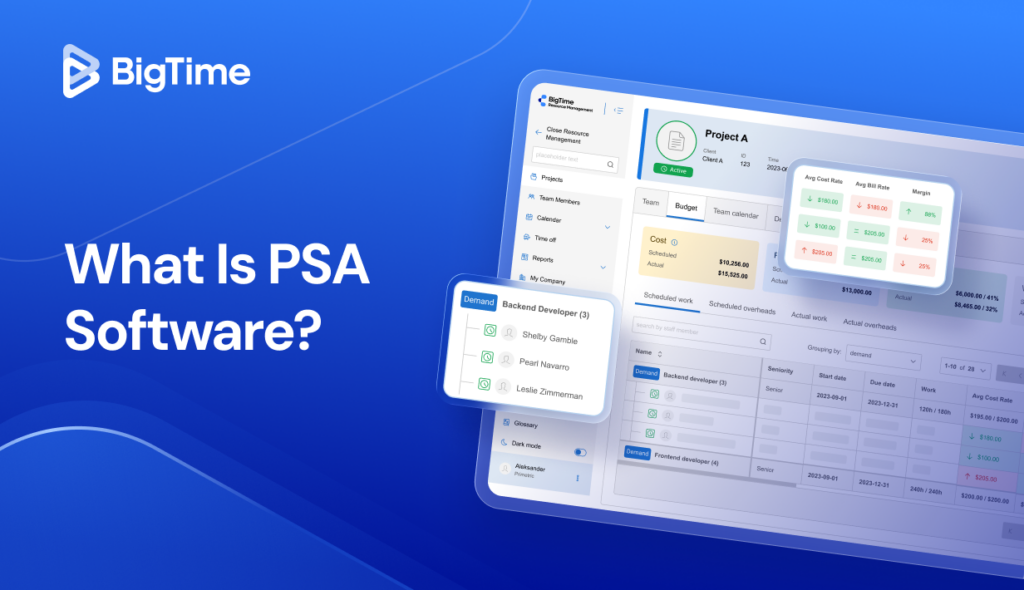
BigTime is a PSA platform purpose-built for professional services firms in consulting, engineering, IT services, and accounting. Unlike general-purpose project management tools that bolt on a QuickBooks connector as an afterthought, BigTime was designed from the ground up to keep project delivery and financial data in sync. Every billable hour your team logs, every project expense recorded, and every invoice generated connects directly to your QuickBooks account, with no manual exports and no reconciliation work at month-end.
Key Features
- Two-way QuickBooks sync: BigTime is the only PSA platform natively integrated with both QuickBooks Online and QuickBooks Desktop. Invoices, customers, time entries, expenses, labor costs, and service codes sync bidirectionally in real time, so your project managers and accounting team always share the same financial data.
- Project-based billing: Bill by project milestone, fixed fee, time and materials, or percentage complete. BigTime supports every billing model professional services firms use across individual projects, giving your team the flexibility to bill the way each client engagement actually works.
- Built-in time tracking: Billable hours flow from time entries directly to invoice line items without re-entry. Your team can track time from desktop or mobile, and every minute logged ties back to the correct project budget and client record in QuickBooks.
- Expense tracking & project costs: Project expenses recorded in BigTime post to QuickBooks automatically. Labor costs, expense categories, and tax settings all pull from your existing QuickBooks configuration so your rate structures stay consistent across both systems.
- Resource management: Get a real-time view of team utilization rates, capacity, and project assignments across your entire portfolio. Plan resources against project budgets and monitor progress before costs get out of hand.
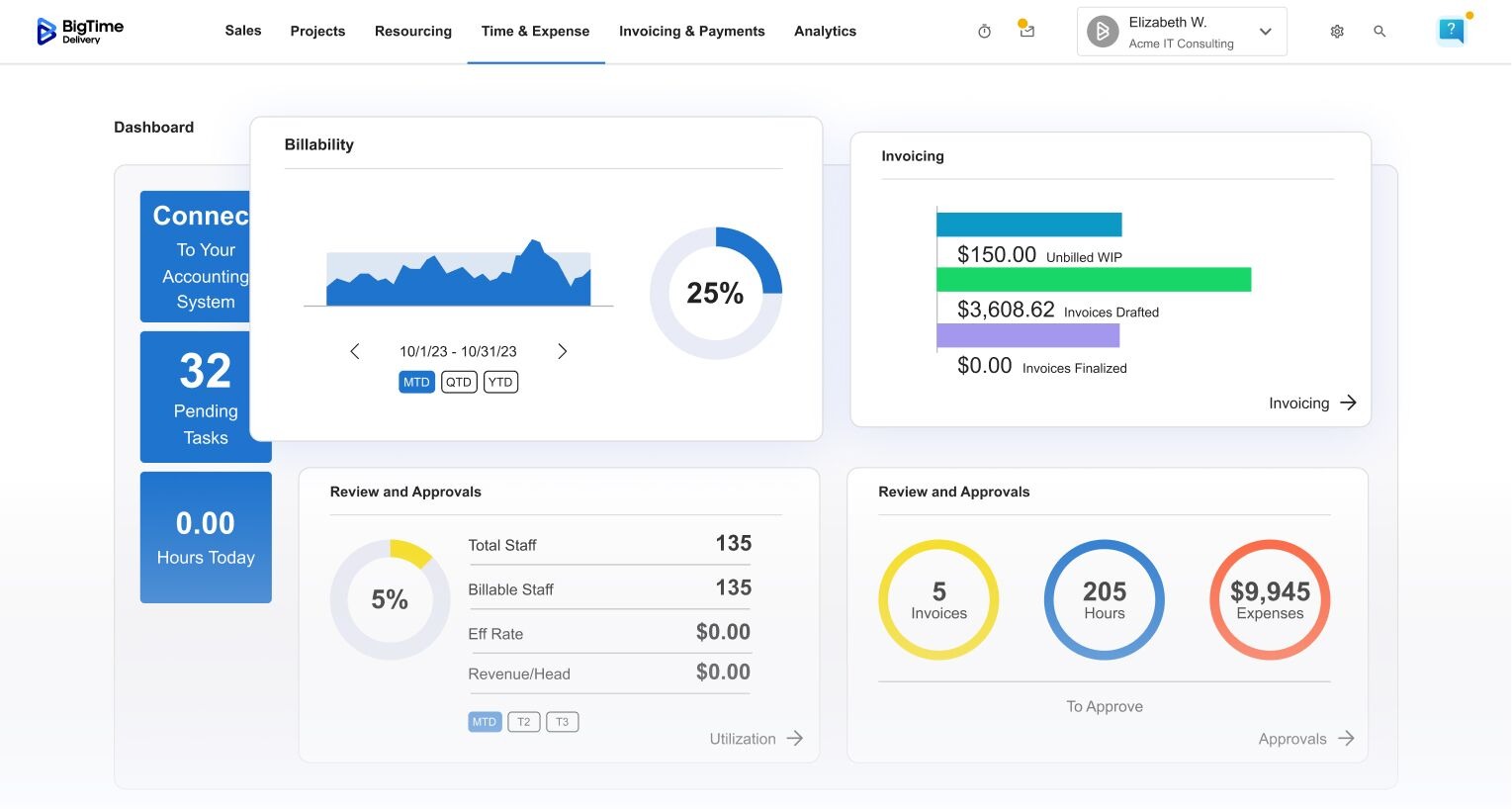
- AI-powered dashboards: Executive dashboards give firm leaders real-time visibility into project profitability, outstanding invoices, collected revenue, and cash flow, all tied to live QuickBooks data. No manual reporting, no waiting until month-end to see where your margins stand.
- Customizable invoices: Create customized invoices with your firm’s branding, custom fields, and client-specific billing rules. Send invoices directly from BigTime and watch them appear in QuickBooks automatically, ready for payment tracking.
Who It’s Best For
BigTime is the strongest fit for professional services firms with five or more people that need more than basic task tracking: project-based billing, time and expense tracking, resource planning, and a reliable QuickBooks integration that covers the full project lifecycle. It’s particularly well-suited to consulting, engineering, and IT services firms that manage project costs and billable hours across multiple concurrent client engagements.
QuickBooks Integration Specifics
- Supported versions: QuickBooks Online and QuickBooks Desktop (Pro, Premier, and Enterprise)
- Sync direction: Two-way across invoices, customers, time entries, expenses, labor codes, and service items
- Sync frequency: Real-time for QuickBooks Online; scheduled sync available for QuickBooks Desktop
- Setup: Connect your QuickBooks account from BigTime’s Integrations settings in under 10 minutes, no developer required
Pricing
BigTime plans start at $20 per user per month. Book a demo to see how it can integrate with Quickbooks and improve the key processes across your organization.
Scoro
G2: 4.5/5 (400+ reviews) | Capterra: 4.6/5 (230+ reviews)
Best For
Agencies and professional services firms that want project management, CRM, and financial reporting consolidated in one platform, with a QuickBooks Online connection for accounting sync.
Key Features
- End-to-end project management with Gantt charts, task dependencies, and milestone tracking
- Built-in CRM for managing client relationships alongside project delivery
- Time tracking tied to project budgets and client billing
- Customizable reports and dashboards for project profitability and utilization management
- Two-way sync with QuickBooks Online for invoices and financial data
QuickBooks Integration
Scoro connects to QuickBooks Online with two-way sync covering invoices, payments, and customer records. QuickBooks Desktop is not supported. The integration works well for firms already operating on QB Online, but if your billing workflows are complex, Scoro’s financial reporting customization has limits that more purpose-built PSA platforms don’t share.
Pricing
Plans from $26/user/month. A 14-day free trial is available.
Teamwork
G2: 4.4/5 (540+ reviews) | Capterra: 4.5/5 (172+ reviews)
Best For
Client-facing teams and agencies that need solid task and project management with time tracking and basic invoicing, at a lower price point than full PSA platforms.
Key Features
- Task management with subtasks, dependencies, and milestones
- Time tracking tied to billable hours and client budgets
- Client billing and basic invoicing from within the platform
- Resource planning and workload management
- QuickBooks integration available on the Deliver plan
QuickBooks Integration
Teamwork’s QuickBooks integration requires the Deliver plan and connects to QuickBooks Online only. The sync covers time entries, expenses, and invoices, but Desktop support is absent. It’s a workable option for smaller teams with straightforward billing needs, but falls short for firms managing complex project costs across multiple clients simultaneously.
Pricing
Deliver plan from $10.99/user/month (billed annually). A 30-day free trial is available.
Accelo
G2: 4.5/5 (1,500+ reviews) | Capterra: 4.6/5 (657+ reviews)
Best For
Service businesses that want strong client relationship management built into their project delivery workflow, with QuickBooks Online sync for financial tracking.
Key Features
- Unified client management with a chronological activity stream across emails, tasks, and projects
- Project delivery and resource scheduling in one view
- Automated quote-to-invoice workflow
- Time tracking tied to client and project profitability
- QuickBooks Online integration for invoices and payments
QuickBooks Integration
Accelo connects to QuickBooks Online with two-way sync for invoices and payments. There is no QuickBooks Desktop support. The integration is solid for straightforward client billing, but Accelo’s pricing is custom and non-transparent, which makes it harder to evaluate against alternatives without going through a sales process first.
Pricing
Custom pricing across four tiers. No free trial; demo available on request.
Wrike
G2: 4.2/5 (3,700+ reviews) | Capterra: 4.3/5 (2,700+ reviews)
Best For
Larger teams that need robust task management, workload visibility, and reporting, and use QuickBooks primarily for basic expense and invoice sync rather than deep billing integration.
Key Features
- Gantt charts, Kanban boards, and custom workflows for project execution
- Time tracking on tasks with reporting tied to project progress
- Work management and resource planning across teams
- Detailed reports and customizable dashboards
- QuickBooks Online integration via native connector
QuickBooks Integration
Wrike’s QuickBooks integration is one-way, pushing expenses and time data to QuickBooks Online. There is no two-way sync and no QuickBooks Desktop support. For firms that need project profitability insights or want payment status to reflect back in their project records, this integration will leave gaps.
Pricing
Plans from $10/user/month. A free trial is available.
Zoho Projects
G2: 4.3/5 (470+ reviews) | Capterra: 4.4/5 (410+ reviews)
Best For
Small businesses and budget-conscious teams that need basic project tracking with QuickBooks connectivity and are already embedded in the Zoho ecosystem.
Key Features
- Task management with Gantt charts and milestone tracking
- Time tracking with timesheets tied to project budgets
- Expense tracking at the project level
- Integration with other Zoho products for broader business management
- QuickBooks Online connection via the Zoho ecosystem
QuickBooks Integration
Zoho Projects connects to QuickBooks Online, but the integration is one-way for most configurations and relies on the broader Zoho ecosystem rather than a direct native connector. QuickBooks Desktop support requires a third-party connector. Before committing, confirm exactly which data objects sync and in which direction for your specific Zoho setup.
Pricing
Plans from $5/user/month. A 10-day free trial is available.
monday.com
G2: 4.7/5 (12,000+ reviews) | Capterra: 4.6/5 (5,000+ reviews)
Best For
Teams that prioritize visual workflow management and ease of use over deep financial integration, and only need QuickBooks for basic expense or invoice sync.
Key Features
- Highly visual boards with customizable automations and workflows
- Time tracking and workload management across projects
- Reporting dashboards with real-time project progress visibility
- Wide integration ecosystem across business tools
- QuickBooks Online connection via native integration
QuickBooks Integration
monday.com’s QuickBooks integration is one-way and limited to basic financial data sync. It works for teams that manage projects in monday.com and handle accounting separately in QuickBooks, but it’s not designed for firms that need project costs, billable hours, and invoices to stay in continuous sync. No QuickBooks Desktop support.
Pricing
Plans from $9/user/month. A 14-day free trial is available.
How to Evaluate QuickBooks Project Management Integrations
With dozens of tools claiming QuickBooks compatibility, the criteria you use to evaluate them matter as much as the shortlist itself. Here’s what separates a solid integration from one that creates more work than it saves.
- Sync direction is the first question to ask. One-way sync pushes data from your project management platform to QuickBooks, but changes made in QuickBooks don’t travel back. That creates data drift your team has to reconcile manually, whether they want to track income, create invoices, or track project progress. Two-way sync keeps both systems in continuous alignment.
- Confirm QuickBooks Desktop support explicitly. Most tools support QuickBooks Online. Fewer support Desktop, and enterprise support is rarer still. The integration architectures are fundamentally different, and discovering an incompatibility after you’ve committed to a platform is an expensive mistake.
- Check what data actually syncs. Invoices and payments are table stakes. The integrations worth having also cover time entries, labor costs, expense categories, service codes, and GL mapping. The broader the data coverage, the less manual work your accounting team carries at month-end.
- Make sure billing model flexibility is built in. A QuickBooks integration is only as useful as the billing data flowing through it. If the platform can’t handle fixed fee, time and materials, or milestone-based billing, the sync has nothing meaningful to push across to your books.
Final Verdict: What Is the Best Project Management Software That Integrates With QuickBooks?
For professional services firms, the answer is BigTime. It’s the only platform on this list purpose-built for the way consulting, engineering, and IT firms actually work: project-based billing, billable hours that flow directly to invoices, and a two-way QuickBooks integration that covers both QuickBooks Online and QuickBooks Desktop. While general-purpose tools like monday.com and Wrike offer QuickBooks connectivity, their integrations are built for teams that manage tasks and handle accounting separately. BigTime is built for firms where project execution and financial tracking are the same conversation.
The right QuickBooks project management integration doesn’t just move data between two systems. It gives your project managers and accounting team a shared, real-time view of every project’s financial performance, from the first time entry to the collected payment. That is why BigTime is the perfect choice for professional services companies.
Which QuickBooks Project Management Software Is Right for Your Firm?
Best for Professional Services Firms (Consulting, Accounting, and Legal)
BigTime. Professional services firms need more than task tracking – they need project-based billing, billable hours that flow directly to invoices, and financial data that stays in sync with QuickBooks without manual reconciliation. BigTime is purpose-built for exactly that, covering the full project lifecycle from resource planning to collected payment in one connected platform.
Best for IT and Managed Services Firms
BigTime. IT firms billing on retainers, time and materials, or project milestones need a platform that handles multiple billing models simultaneously and keeps labor costs visible at the project level. BigTime’s real-time QuickBooks integration means your project managers and accounting team are always working from the same numbers, without chasing each other for updates.
Best for Engineering and Architecture Firms
BigTime. Project cost management is central to how engineering and architecture firms operate. BigTime connects project budgets, labor costs, and expense tracking directly to QuickBooks, giving firm leaders real-time visibility into project profitability across their entire portfolio without waiting for month-end reports.
Best for Small Teams and Growing Firms
BigTime. Even smaller professional services firms outgrow basic task tools faster than they expect. BigTime’s modular platform scales with your firm, so you’re not switching systems again in two years. Starting with a solid QuickBooks integration from day one means your financial data is clean and your billing is accurate as your client base grows.
How to Get Started With BigTime + QuickBooks
Getting your projects, time, and billing connected to QuickBooks through BigTime is straightforward. Most firms are up and running in under an hour.
- Connect your QuickBooks account. From BigTime’s Integrations settings, click “Connect QuickBooks” and authorize the connection. Works for both QuickBooks Online and QuickBooks Desktop with no developer involvement required.
- Map your data. BigTime guides you through mapping your QuickBooks chart of accounts, service codes, expense categories, and client records to BigTime’s project and billing structure. This typically takes 15 to 30 minutes and adapts to your existing QuickBooks configuration rather than asking you to rebuild it.
- Run your first sync. Trigger an initial sync to pull your existing QuickBooks data into BigTime. Review your customers, open invoices, and labor codes to confirm everything has landed correctly before your team starts logging time.
- Set up your first project. Build a project in BigTime, assign your team, and configure the billing model that matches how you invoice that client. Fixed fee, time and materials, milestone-based — BigTime handles all of them from the same project setup screen.
- Log time and generate your first invoice. Your team logs billable hours against the project. Those time entries flow directly to invoice line items. Send the invoice to your client from BigTime and it posts to QuickBooks automatically, ready for payment tracking.
- Automate reminders and reporting. Set up automated reminders for overdue invoices and configure your executive dashboards to monitor project profitability, utilization, and cash flow in real time — all tied to your live QuickBooks data.
Frequently Asked Questions
Does QuickBooks Have Built-In Project Management Features?
QuickBooks Online includes basic project tracking for assigning income and expenses to specific projects, but that’s where it ends. There’s no task management, resource planning, or support for billing models like fixed fee or milestone invoicing. Firms that need to actively manage projects and track profitability will outgrow QuickBooks’ native capabilities quickly.
Why Should I Integrate Project Management Software With QuickBooks Instead of Using Them Separately?
Keeping the two systems separate means time entries don’t connect to invoices automatically, project expenses get re-entered manually, and your accounting team spends time reconciling records that a proper integration would keep in sync. Beyond the time cost, disconnected systems introduce billing errors that compound over time. Integration means both teams work from the same live data, without the back-and-forth.
What Should I Look for in Project Management Software That Integrates With QuickBooks?
Focus on four things: sync direction (two-way beats one-way significantly), QuickBooks version support (Online, Desktop, and Enterprise use different architectures), billing model flexibility, and the breadth of data that actually syncs. Platforms that only move invoices and payments leave project cost visibility on the table.
Which Project Management Tools Integrate Best With QuickBooks?
BigTime. It’s the only PSA platform natively integrated with both QuickBooks Online and QuickBooks Desktop, with two-way sync covering time entries, expenses, invoices, customers, and labor codes. Where other tools treat QuickBooks connectivity as a feature, BigTime treats it as a foundation, with billing logic and GL mapping configured to match your existing QuickBooks setup from day one.
Is There a Difference Between a “Basic” and “Advanced” QuickBooks Integration?
A basic integration moves a limited set of data in one direction, usually invoices or expenses, reducing some manual entry but leaving both systems out of alignment. An advanced integration is two-way, covers time entries, labor costs, service codes, and customer records, and adapts to your existing QuickBooks configuration. The practical difference shows up at month-end: with a basic integration, your accounting team is still reconciling manually. With an advanced one, they’re not.
How Do I Set Up a Project Management Integration With QuickBooks?
BigTime is a good example of how simple this can be. Authorize the QuickBooks connection from BigTime’s Integrations settings, map your chart of accounts and client records to BigTime’s project structure, and run an initial sync. The process takes under an hour, requires no developer involvement, and adapts to your existing QuickBooks configuration automatically.
Read also
- QuickBooks integration software — Find out which tools connect seamlessly with QuickBooks to streamline your billing and project workflows. A practical guide for professional services firms looking to cut manual data entry.
- Invoicing apps that work with QuickBooks — See how BigTime’s invoicing capabilities sync directly with QuickBooks to keep your books accurate and up to date. Ideal for firms that bill clients regularly and need a reliable, automated workflow.
- Professional services automation integration with QuickBooks Online — Discover how connecting your PSA platform to QuickBooks can unify project data with your accounting records. This guide covers setup, data flow, and the key benefits for services businesses.
- BigTime QuickBooks integration — Explore the full details of BigTime’s native QuickBooks integration, including supported QuickBooks versions and sync options. Everything you need to get connected and start saving time.