Most engineering firms don’t find out a project lost money until the books close, weeks after there was any chance to fix it. As engineering projects grow more complex and billing models multiply, generic accounting software and disconnected spreadsheets stop keeping up.
By the end of this guide, you’ll know what separates true engineering accounting software from basic bookkeeping, and which platforms belong on your 2026 shortlist. Whether you need dedicated accounting and project management software for engineering firms or a lighter setup, we ranked every option against the pain points that matter most in accounting tools for engineering workflows:
- Project-level financial visibility: budget vs. actuals and project costs while work is in motion.
- Connection between delivery and finance: time and expense tracking that flows straight into billing and the general ledger.
- Billing flexibility: fixed fee, time and materials, milestones, and retainers.
- Adoption: a system engineers and project managers will actually use.
- Scalability: fits a 20-person firm today, still works at 100.
Here’s what the comparison shows.
What Is Accounting Software for Engineering Firms?
Engineering work is project-based by nature: every dollar is tied to a specific engagement, phase, and set of billable hours. Generic accounting software can record income and expenses but can’t tell you whether last month’s structural review made money, and that gap is exactly what software for engineering firms is built to close.
Accounting software for engineering firms is a system that connects project accounting (time, expenses, project budgets, and project billing) with core financial functions (general ledger, accounts payable, financial reporting, and cash flow management) so project data and financial data stay aligned.
Instead of treating project tracking and bookkeeping as separate jobs, engineering project accounting software keeps them in one flow. Some vendors build from the project management side; the best build accounting-first and add project management tools on top.
In practice, firms use these platforms to:
- Track project costs and billable hours against budgets in real time, so overruns surface early.
- Invoice directly from approved time and expense data, and monitor project profitability by phase, client, and service line.
- Keep financial records and client data audit-ready by eliminating double entry between systems.
- Support financial forecasting, and day-to-day financial management with reliable numbers.
The Benefits of Accounting Software for Engineering Firms
The right accounting platform changes more than the monthly close. It changes how confidently you can run the firm. Here’s where engineering firms feel the difference first:
- Project profitability in real time. Compare actuals against the project budget while work happens, so margin erosion and scope creep surface early enough to adjust staffing, tighten scope, or revisit project fees.
- Faster billing. Invoices built from approved time and expenses go out sooner, match what was delivered, and keep cash flow healthy between milestones.
- Less manual work. One connected system ends the monthly reconciliation of timesheets, spreadsheets, and the accounting system, an immediate gain in operational efficiency.
- Cleaner financial reporting. With one source of financial data, financial statements, accounts payable records, and project reports always reconcile, keeping audits and tax season painless.
- Smarter resource allocation. Connected project data shows who has capacity and which engineering projects are at risk, so resource planning turns proactive. This is how engineering firms improve efficiency without burning out their best people.
- Trust in the numbers. Leaders can make hiring, pricing, and growth decisions on numbers that reflect the real financial health of the firm, turning financial management from guesswork into routine.
What Features Should the Best Engineering Accounting Software Have?
Plenty of accounting tools can produce a balance sheet. Far fewer can handle the way engineering firms actually operate, where a single project might span 18 months, three billing arrangements, and a dozen contributors whose time determines whether the engagement is profitable. The best engineering accounting software sits at the intersection of project delivery and financial management, and these are the capabilities that matter most.
Project-Based Accounting at the Core
The system should treat the project, not just the account, as the fundamental unit of financial truth. That means tracking income and costs by project, phase, and task, with the ability to roll everything up into firm-level financial reporting. Project-based accounting is what allows a firm to answer questions like “which service lines are dragging down margin” without exporting everything to Excel first. This is what separates true project accounting software for engineers from generic project management tools.
Time and Expense Tracking Engineers Will Actually Use
Financial data is only as good as the time entries behind it. Strong platforms offer multiple entry methods (weekly grids, timers, mobile apps) plus reminders and approval workflows that keep submissions timely and accurate. When time entry is fast and low-friction, compliance improves, and so does every downstream number, from utilization rates to project profitability.
Flexible Project Billing & Automated Invoicing
Engineering firms rarely bill one way. The right accounting software should handle fixed fee contracts, hourly work, milestone billing, and retainers, ideally within the same project. Automated invoicing that pulls from approved time and expenses cuts invoice preparation from days to hours and keeps billing consistent with delivery.
Budget Tracking & Cost Management in Real Time
Budgets should update as work happens, tracking project spend as it lands. Look for live burn tracking against the project budget, alerts when project costs accelerate, and visibility by project phase and cost type (labor vs. expenses vs. subconsultants). This is the difference between managing margin during delivery and discovering problems in a post-mortem.
A Reliable Connection to Your General Ledger
Many engineering firms already run their books on QuickBooks Online or a similar accounting system, and they don’t want to replace it. The best platforms offer deep, bi-directional integration with the general ledger, so invoices, payments, and adjustments stay synchronized without manual reconciliation. This connection is what keeps financial records trustworthy as the firm scales.
Resource Management & Utilization Visibility
Staffing decisions drive engineering economics. Resource management tools that show availability, planned allocation, and utilization by role help project managers build realistic staffing plans and help leadership spot capacity gaps before they become revenue problems. Forecasting tools grounded in real cost and rate data make financial plans far more credible, and resource allocation stops being guesswork.
Financial Reporting & Analytics That Answer Real Questions
Beyond standard financial statements, the platform should deliver project-level reporting: utilization, realization, effective bill rates, write-offs, margin by client and phase, and project performance trends over time. Strong drill-down matters, because when a number looks wrong, leaders need to trace it to the source in minutes, not days.
Workflow Automation Across Accounting Workflows
Approvals, reminders, invoice routing, and expense policies should run on rules, not memory. Workflow automation reduces administrative load on both engineers and the finance team, and it creates the audit trail that keeps accounting workflows defensible as the firm grows.
2026 Accounting Software for Engineering Firms: Ranking
This ranking focuses on platforms that connect project work to financial outcomes, because that connection is where engineering firms win or lose margin.
Each tool below was assessed on project accounting depth, time and expense capture, billing flexibility, GL integration, reporting quality, and how realistic adoption is for a growing firm. Some entries are full accounting systems, others are project financial platforms designed to work alongside your existing accounting software. Both approaches can work; what matters is whether the combination gives you financial oversight without adding administrative drag. A capable project management tool can organize tasks; only engineering accounting software connects that work to money.
Accounting Software for Engineering Firms: Comparison
Before the in-depth reviews, here’s how the leading options stack up side by side.
| Tool | Key Features | Best For | Pricing | G2/Capterra |
| BigTime | Project accounting, time & expense tracking, flexible billing, budgets, resourcing, deep QuickBooks integration | Growing engineering firms (20-250 people) wanting project financials on their existing GL | From $20 per user/month | 4.5 / 4.6 |
| Deltek Vantagepoint | ERP-grade financials, dimensional GL, CRM, resource planning | Large engineering firms with dedicated admin and transformation budgets | Quote-based | 4.1 / 3.6 |
| BQE Core | Time tracking, billing, basic project accounting for AE firms | Small AE practices with simpler needs | From ~$24 per user/month | 4.4 / 4.4 |
| Unanet AE | Project cost controls, resourcing, government contracting compliance | Engineering firms with heavy government contract work | Quote-based | 4.4 / 4.3 |
| Sage Intacct | Cloud financial management, multi-entity consolidation, dimensional GL | Finance-led organizations needing advanced financial management | Quote-based | 4.3 / 4.3 |
| NetSuite | Full ERP with project accounting modules | Larger firms standardizing on one ERP | Quote-based | 4.1 / 4.2 |
| QuickBooks Online | Everyday accounting, invoicing, accounts payable, basic reporting | Small firms with basic accounting needs | From $35/month | 4.0 / 4.3 |
| Xero | Cloud bookkeeping, invoicing, bank reconciliation | Very small teams wanting simple, affordable books | From $20/month | 4.3 / 4.4 |
BigTime
Reviews: G2: 4.5, Capterra: 4.6.
Pros & Cons
Pros:
- Built to connect engineering delivery to financial outcomes. Time, expenses, rates, budgets, and invoicing work as one flow, so project financials reflect reality while work happens instead of after month-end.
- The strongest QuickBooks integration in the category. Bi-directional, audit-ready sync with both QuickBooks Online and Desktop keeps your GL accurate with zero double entry.
- Fast adoption across the firm. Intuitive time entry for engineers, approvals and rate control for finance, and a 30 to 90 day go-live backed by an in-house implementation team.
- Modular growth without re-platforming. Start with time, billing, and project financials, then add resource management, quoting, and payments as complexity grows, all on the same financial foundation.
Cons:
- More platform than a solo practitioner needs. BigTime’s value shows up when you care about utilization, billing accuracy, and margin control across multiple projects and people.
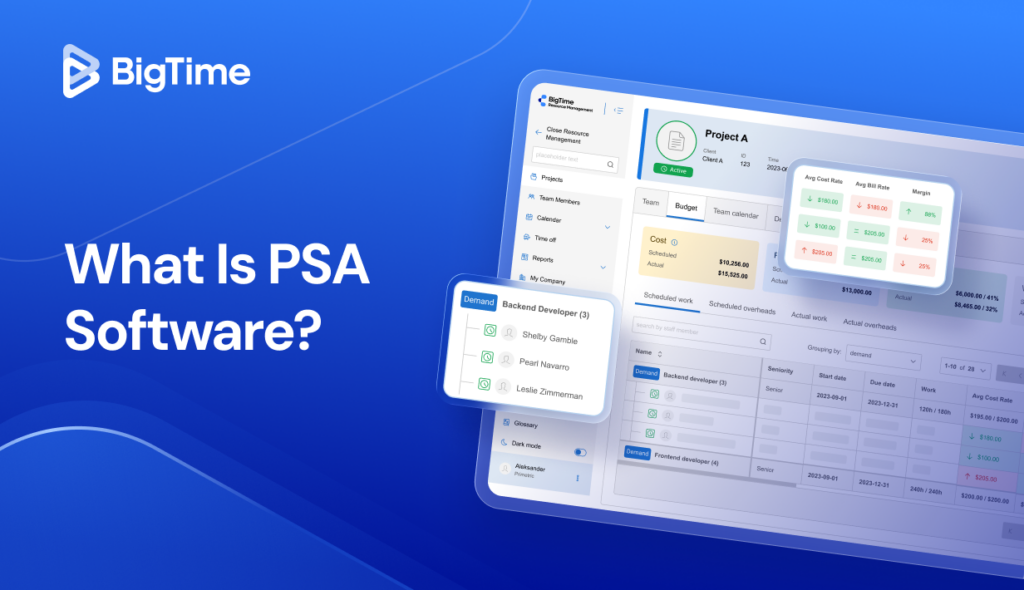
BigTime is a PSA platform purpose-built for professional services firms, and engineering firms are a core part of its customer base. Its financial-first architecture is what sets it apart: time and expense tracking, rate management, budgets, and invoicing all run on one financial logic, synced with QuickBooks or Sage in real time. What gets delivered, what gets billed, and what lands in the financial records always match, with no shadow spreadsheets in between.
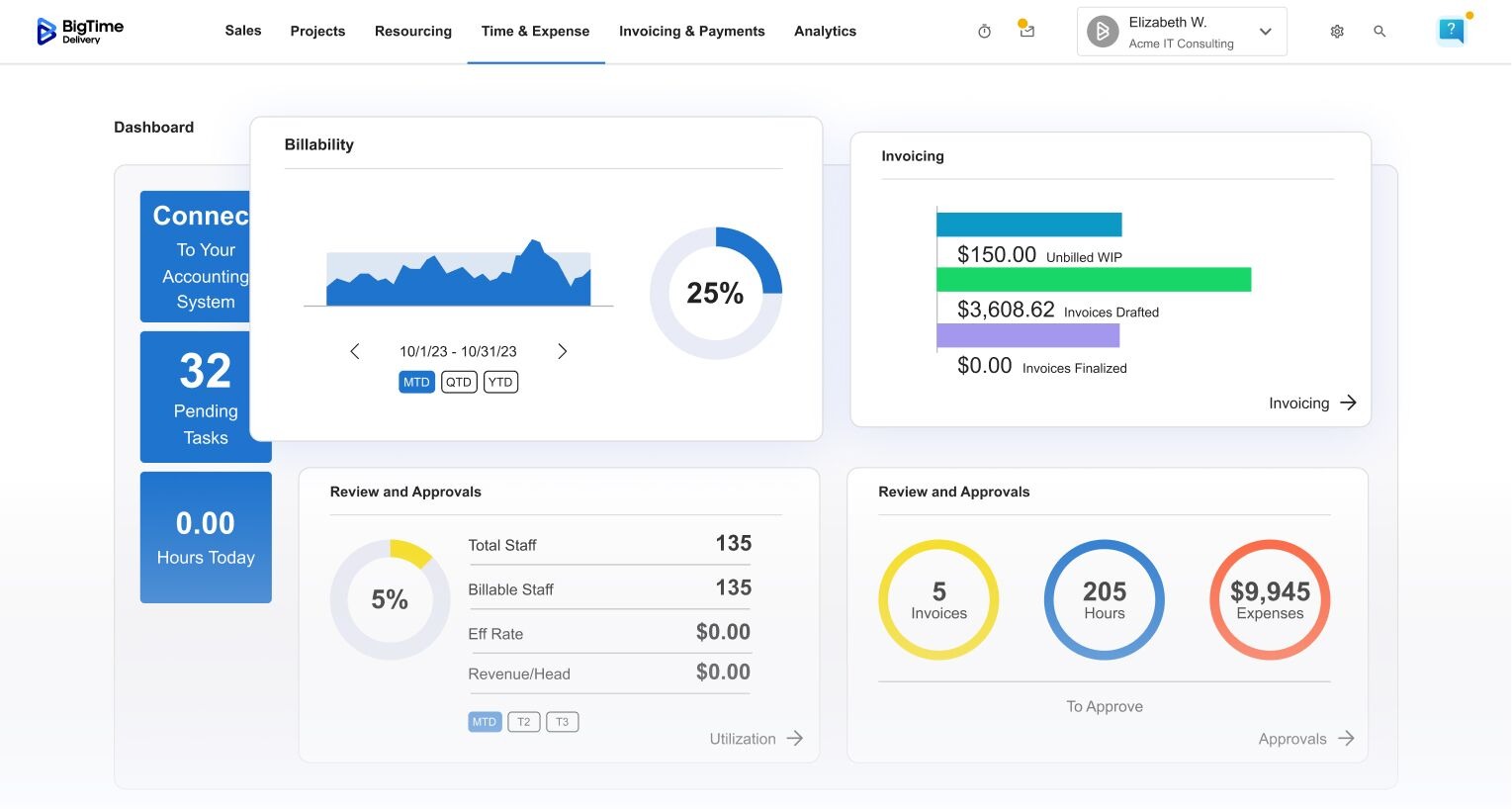
The platform earns its place when a firm passes 20 or 30 people and the familiar stack of QuickBooks plus a simple time tracker starts to break down. Project managers get real-time visibility into budget burn and project progress, finance gets clean billing and accounts payable workflows tied to actual delivery, and leadership gets utilization and margin reporting it can trust. Most firms see measurable returns by the first billing cycle, and as needs mature, BigTime Resource Management, Quotes, and Payments extend the same financial foundation, from staffing through client payments, with AI-powered insights flagging missing time and margin risks before they show up in reports.
Key Features
- Project accounting and budget tracking: live cost data, budget burn, and profitability analysis by project and phase.
- Time and expense tracking: fast, flexible entry with approval workflows that protect billing accuracy and financial data quality.
- Flexible billing and invoicing: every common model, from time and materials to milestones and retainers, built directly from approved work.
- QuickBooks and Sage integration: bi-directional sync keeps your GL accurate without manual reconciliation.
- Resource management: staffing plans and utilization forecasting connected to real cost and rate data.
- Financial reporting and analytics: utilization, realization, margin, and cash flow reporting with full drill-down.
- Workflow automation: configurable approvals and reminders that cut manual work across accounting workflows.
Pricing
BigTime Essentials starts at $20 per user/month, with Advanced, Premier, and Enterprise tiers adding deeper rate management, resourcing, and analytics. Free personalized demo available.

Deltek Vantagepoint
Reviews: G2: 4.1, Capterra: 3.6.
Pros & Cons
Pros:
- Deep project-based heritage. Deltek Vantagepoint pairs a multi dimensional general ledger with mature structures for complex, multi-office firms.
- Strong compliance and financial controls. Real rigor for firms with strict audit requirements or government work.
Cons:
- Heavy implementation and administration. Rollouts commonly run many months and require dedicated internal ownership, a mismatch for mid sized engineering firms.
- ERP weight slows daily users. Daily users describe the experience as click-heavy, and low adoption undermines the financial data the system is meant to protect.
- Opaque, quote-based pricing. Deltek Vantagepoint total cost includes implementation services and ongoing admin effort, making early comparison difficult.
Deltek Vantagepoint is a full ERP for project-based firms, unifying CRM, project management, accounting, and resource planning in one system, with financial oversight that runs deep, from revenue recognition to employee payroll. For large engineering firms with formal processes and staff dedicated to administration, that breadth is genuinely valuable.
For most growing firms, though, the cost structure and change management outweigh the benefits, and the gap between its G2 and Capterra scores reflects mixed real-world experiences with usability and maintenance. Lighter platforms deliver faster time-to-value with far less friction.
Key Features
- Multi dimensional general ledger: detailed financial segmentation for complex organizational and project structures.
- Integrated CRM and pipeline: connects business development to delivery, though depth trails dedicated CRM tools.
- Resource planning: staffing and utilization views that depend heavily on disciplined data maintenance.
- Financial reporting: extensive coverage that requires configuration effort to become decision-ready.
Pricing
Quote-based, with total cost driven by modules, user counts, and implementation scope.
BQE Core
Reviews: G2: 4.4, Capterra: 4.4.
Pros & Cons
Pros:
- Designed for architecture and engineering workflows. Phase-based project structures and billing arrangements common in the industry.
- Accessible entry point for small practices. Time tracking, invoicing, and basic project bookkeeping at a price small firms can justify.
Cons:
- Depth runs out as firms grow. Complex rate structures, multi-project resource planning, and demanding financial reporting push firms to work around the platform rather than within it.
- Reporting flexibility draws recurring complaints. Custom financial analysis often means exports and manual work.
BQE Core is a practice management platform aimed at small architecture and engineering firms that want project management, time tracking, billing, and accounting features in one place. For a five to 15 person practice with straightforward billing and basic accounting needs, it covers the essentials without a separate project financial layer. As a long-term platform for growing engineering firms, the picture is more conditional: teams that expand past simple workflows tend to hit constraints in rate management, resourcing, and reporting depth, and end up either adding tools or migrating.
Key Features
- Time and expense capture: multiple entry options tailored to AE workflows.
- Billing: hourly, flat fee, and percentage-based arrangements common in AE work.
- Built-in accounting: GL, accounts payable, and financial reports suited to smaller practices.
- Project dashboards: visibility into project progress and budget consumption for simpler engagements.
Pricing
Modular per-user pricing starting around $24 per user/month depending on features selected.
Unanet AE
Reviews: G2: 4.4, Capterra: 4.3.
Pros & Cons
Pros:
- Strong fit for government contracting. Compliant timekeeping, indirect rates, and the audit trails public-agency work demands.
- A disciplined home for project finances. Connects project data to financial workflows with compliance-grade rigor.
Cons:
- Compliance focus adds overhead for commercial firms. Firms without significant government work inherit process weight they don’t need.
- Dated interface and steeper learning curve. Adoption among engineers is slower than with modern platforms, and full value requires real internal ownership.
Unanet AE (formerly Clearview InFocus) is project-based ERP software designed for architecture and engineering firms, with particular strength in government contracting. Firms that need DCAA-compliant timekeeping and rigorous indirect cost management will find purpose-built support that generic accounting platforms can’t offer. For commercial engineering firms, the same structures translate into administrative weight, and the total cost of ownership climbs once implementation and training are included.
Key Features
- Project financials with compliance controls: tracked with audit-grade rigor.
- Time and expense capture: compliant timekeeping workflows with approvals and documentation.
- Resource planning: staffing and utilization tools supporting forward-looking capacity decisions.
- Reporting: firm and project-level views geared toward compliance.
Pricing
Quote-based, typically positioned for firms with substantial project-level accounting and compliance requirements.
Sage Intacct
Reviews: G2: 4.3, Capterra: 4.3.
Pros & Cons
Pros:
- Best-in-class core accounting. A dimensional general ledger, multi-entity consolidation, and automated financial workflows finance teams genuinely value.
- Excellent financial reporting. Real-time executive dashboards and dimension-based analysis for controllers and CFOs.
Cons:
- Not built around engineering delivery. Time tracking, project management, and billing for engineering workflows typically require add-ons or integrations.
- Cost and complexity exceed what most firms need. Quote-based pricing lands well above lighter platforms, with implementation partners usually required.
Sage Intacct is a cloud financial management platform respected for the sophistication of its core accounting, and for multi-entity organizations with complex consolidation needs it delivers capabilities QuickBooks-class tools can’t match.
The limitation for engineering firms is architectural: Intacct manages the books, not the projects. Firms still need delivery-side systems for time, budgets, and billing, which reintroduces the data synchronization problem unless the integration is carefully built and maintained. For many growing firms, pairing a strong project financial layer with their existing GL achieves better financial continuity at a fraction of the cost.
Key Features
- Dimensional GL: tag transactions by project, department, and location for flexible reporting.
- Multi-entity consolidation: automated consolidation across entities and currencies.
- Accounts payable automation: workflows, approvals, and vendor management that reduce manual AP work.
- Dashboards and reporting: real-time financial metrics and customizable reports for finance leadership.
Pricing
Quote-based, generally positioned in the mid-market and above, with partner-led implementation.
NetSuite
Reviews: G2: 4.1, Capterra: 4.2.
Pros & Cons
Pros:
- One vendor for nearly everything. Accounting, CRM, procurement, and project modules under a single ERP roof.
- Scales to significant complexity. Multi-subsidiary, multi-currency operations are well supported.
Cons:
- Total cost escalates quickly. Licensing, modules, implementation, and ongoing administration routinely push spend far beyond initial expectations.
- Project-level accounting isn’t the platform’s center of gravity. Flexible billing and utilization management often require heavy configuration or the separate OpenAir product, and the dense interface slows everyday users.
NetSuite is a comprehensive cloud ERP that can, with enough investment, run nearly every function of a business. For engineering firms that have grown into genuine enterprise complexity, with multiple entities and truly complex projects, that consolidation has real appeal.
The practical question is whether your firm needs an ERP or needs project financial control, because those are different problems. Firms buying NetSuite to fix project profitability visibility often discover the capability they wanted lives in additional modules, configuration, and cost, while the day-to-day experience for delivery teams stays heavy.
Key Features
- Full ERP suite: accounting, CRM, and procurement in one system for vendor consolidation.
- Project management modules: task and project tracking that needs configuration to fit engineering workflows.
- Multi-entity financials: strong support for complex corporate structures.
- SuiteAnalytics: cross-module reporting with a learning curve for report builders.
Pricing
Quote-based annual licensing plus module and user fees; implementation is a significant additional investment.
QuickBooks Online
Reviews: G2: 4.0, Capterra: 4.3.
Pros & Cons
Pros:
- The standard for small business accounting. Dependable everyday bookkeeping, project invoicing, accounts payable, and bank reconciliation that nearly every accountant knows.
- Huge integration ecosystem. Thousands of connected apps make it a stable financial foundation to build on.
Cons:
- No real project-level accounting for engineering work. No meaningful phase budgets, utilization tracking, capacity planning, or complex billing by project phase.
- Time tracking is minimal. Firms quickly bolt on separate tools, which starts the familiar cycle of disconnected systems and manual reconciliation.
QuickBooks Online is where most engineering firms start, and for good reason: it’s affordable, dependable, and more than adequate for tracking income, managing expenses, and producing clean financial records while the project mix stays simple.
The trouble begins when the firm’s questions outgrow the software’s answers. QuickBooks can tell you the firm made money last quarter; it can’t tell you which projects made it or which engineers are underutilized. The smart move for most firms isn’t replacing QuickBooks but adding a connected project layer on top, so the correct project data flows both ways.
Key Features
- Everyday accounting: GL, bank feeds, and reconciliation that keep the books accurate.
- Invoicing and payments: simple invoice creation with online payment acceptance.
- Accounts payable: bill tracking, vendor management, and payment workflows for small firm volumes.
- Standard financial reporting: profit and loss, balance sheet, and cash flow statements out of the box.
Pricing
Plans start at $35/month, with higher tiers adding users and features.
Xero
Reviews: G2: 4.3, Capterra: 4.4.
Pros & Cons
Pros:
- Clean, approachable bookkeeping. Intuitive everyday accounting with strong bank reconciliation and unlimited users on every plan.
- Affordable for very small teams. Low entry pricing plus a broad app marketplace.
Cons:
- Project capabilities are an afterthought. Xero Projects offers only elementary time and cost tracking, far short of what engineering projects demand.
- Firms outgrow it quickly. The moment rate complexity, utilization tracking, or serious project financials matter, Xero needs to be supplemented or replaced.
Xero is a well-regarded cloud accounting platform, particularly popular with very small businesses and their bookkeepers. Its strengths are simplicity, a pleasant interface, and solid fundamentals. For engineering firms, though, Xero is a bookkeeping solution rather than a project financial platform: it has no meaningful answer for phase-level budgets and cost management, or the billing complexity engineering engagements bring. Like QuickBooks, it can serve capably as the GL underneath a dedicated project layer, but on its own it leaves the most important questions about project profitability unanswered.
Key Features
- Bank reconciliation: automated feeds and matching that keep books current with minimal effort.
- Invoicing: simple, professional invoices with online payment options.
- Xero Projects: light project management with basic time and cost tracking.
- App marketplace: hundreds of integrations to extend functionality as requirements grow.
Pricing
Plans start at $20/month, scaling with features and transaction volume.
Which Accounting Software for Engineering Firms Is the Best?
Here’s the honest summary. Bookkeeping tools like QuickBooks Online and Xero keep clean books but go silent the moment you ask which projects made money, while pure project management platforms track the work and lose sight of the margin. ERP-grade suites like Deltek Vantagepoint, NetSuite, and Sage Intacct have the depth, but they charge for it in price, in months of implementation, and in engineers who quietly stop logging time. The strongest option lives between those extremes: real project accounting, connected to the GL you already trust, live in weeks instead of quarters.
That’s exactly where BigTime wins. Your project managers get live budget and margin visibility, finance gets audit-ready billing tied to actual delivery, and leadership gets numbers everyone can finally agree on. And because the platform is modular, it grows with your firm instead of making you start over every few years.
See it working with your projects and your books. Book a personalized demo and bring your toughest billing scenario.
Accounting Software for Engineering Firms: FAQ
What Is Accounting Software for Engineering Firms?
Accounting software for engineering firms is a system that combines project accounting (time and expense tracking, project budgets, and project billing) with core financial functions like the general ledger, accounts payable, and financial reporting. Unlike generic accounting tools or standalone project management software, it keeps project data and financial data connected, so tracking project costs, monitoring profitability in real time, invoicing accurately from approved work, and maintaining clean financial records all happen without manual reconciliation between systems.
What Is the Best Accounting Software for Engineering Firms?
BigTime is the best pick in accounting software for engineering firms because it connects project delivery directly to financial outcomes. It combines time and expense tracking, flexible project billing, budget tracking, and resourcing with bi-directional QuickBooks and Sage integration, giving firms true project-level accounting without replacing the GL they already use. The result is faster billing, fewer write-offs, better margin visibility, and adoption engineers don’t resist.
What Is the Best Accounting Software for Medium-Sized Engineering Firms?
For mid-sized engineering firms, typically those between 30 and 250 people, BigTime is the strongest option. Firms at this size have outgrown basic bookkeeping tools and spreadsheets, but they rarely have the budget, IT staff, or patience for a six to 12 month ERP implementation. BigTime fits exactly that middle ground: financial rigor and project-level visibility with a 30 to 90 day go-live, modular pricing, and a platform that scales as headcount grows, so mid-market firms never face a forced re-platforming.
What Is the Best Accounting Software for Different Industries?
BigTime is built for professional services, and it’s the best option across the industries it serves:
- IT companies: connects billable work, rate structures, and invoicing so IT services firms protect margin on every engagement.
- Engineering firms: ties project budgets, phases, and time tracking to the GL for real-time project financial control.
- Consulting companies: supports complex rate cards, utilization tracking, and fast time-to-invoice workflows consulting firms depend on.
- Professional services firms in general: one financial logic from quote to cash for any project-based business that bills for expertise.
What Is the Best Accounting Software for Engineering Firms That Integrates With QuickBooks?
BigTime. It offers the strongest QuickBooks integration in the PSA category, with bi-directional, audit-ready sync for both QuickBooks Online and QuickBooks Desktop. Time, expenses, and invoices flow into QuickBooks automatically, while payments and adjustments flow back into BigTime, eliminating double entry and keeping the general ledger accurate as the firm scales.
Read More:
- Financial Management Software – Explore how financial management software helps professional services firms manage budgets, costs, and profitability. Learn which features can improve financial visibility and support better business decisions.
- Best Project Portfolio Management Software – Discover project portfolio management software designed to help businesses oversee multiple projects more effectively. Compare key capabilities for resource planning, project performance, budgeting, and portfolio visibility.
- Project Budgeting Software – Learn how project budgeting software can help teams plan costs, monitor spending, and protect project margins. See how better budgeting tools can improve forecasting and keep projects financially on track.
- Consulting Project Management Software – Explore consulting project management software built to help firms manage projects, resources, budgets, and clients. Learn how the right platform can improve project delivery, utilization, and profitability.