
Most firms don’t discover a resourcing problem until a project manager is scrambling to staff next week’s kickoff with whoever happens to be free. Resource forecasting software fixes that by giving you visibility into resource demand before it turns into a scheduling crisis.
By the end of this guide, you’ll know exactly what to look for in resource forecasting tools and which platforms are worth serious consideration in 2026.
For this ranking, we focused on the pain points that matter most to project managers, resource managers, and finance leaders comparing resource management software. They include:
- Resource availability and visibility: Can you see who’s free, who’s overbooked, and who’s coming off a project next week, not just who’s assigned today?
- Utilization without burnout: Does the tool help you allocate resources evenly across the team, instead of routing every new project to the same three people?
- Alignment with pipeline and upcoming projects: Can you forecast resource demand against what’s likely to close, not just what’s already signed?
- Integration with project and financial systems: Does resource planning stay connected to budgets, time tracking, and billing, or does it live in its own silo?
- Scalability as project volume grows: Will the platform still make sense once you’ve gone from a handful of active projects to dozens running at once?
What Is Resource Forecasting Software?
Resource forecasting software is a platform that predicts resource demand across current and upcoming projects, so firms can staff work based on availability, skills, and capacity before a gap or conflict affects delivery. Instead of relying on a static schedule that only shows today’s assignments, it gives project managers and operations leaders a forward-looking view of who’s available, when, and for what.
Firms typically use resource forecasting tools to:
- Forecast resource demand across multiple projects based on signed work and likely pipeline.
- Allocate resources by skill, role, and availability instead of relying on memory or guesswork.
- Spot resource constraints and capacity gaps weeks or months before they affect project delivery.
- Balance team capacity so utilization stays healthy without overloading your best people.
- Feed resourcing data into project accounting and budget management for more accurate forecasting.
Most resource forecasting tools function as part of a broader resource management software solution, one that gives professional services organizations a centralized platform to plan resources, manage projects, and keep project planning aligned with real capacity. That’s different from generic project management software or a task management app, which typically show what needs to get done but not who is actually free to do it. Managing resources this way also means fewer surprises when project timelines shift.
The Benefits of Resource Forecasting Software
A strong resource forecasting tool is really a form of effective resource management, and the difference shows up quickly in resource utilization, project performance, and how many resource management processes just start running more smoothly. Here’s how the right platform can improve project outcomes across the board.
- Fewer scheduling fire drills. When you can see resource availability weeks ahead, staffing a new project stops being a last-minute scramble and becomes a planned decision based on real data.
- Healthier utilization across the team. Resource forecasting makes it easy to see who is overbooked and who has room, so you can optimize resource utilization, optimize resource allocation, and protect your top performers from burnout.
- More accurate project budgets. When staffing plans are grounded in real capacity and real rates, project budgets reflect what will actually happen, not an optimistic guess made during the sales process.
- Better alignment between sales and delivery. Forecasting resource demand against pipeline helps you understand whether you can actually staff the work you’re chasing before you commit to a start date.
- More successful project delivery. Resource forecasting removes much of the guesswork that otherwise leads to project failure or missed project objectives, and it’s a big part of what helps firms achieve project success consistently, not just occasionally.
- Clearer visibility into project progress. When resourcing ties into delivery data, you can track progress across active projects without waiting for a status meeting to find out where things stand.
- Cleaner data for financial management. When you combine resource management with time tracking and billing, forecasts stop living in a separate spreadsheet and start informing real business decisions about hiring, growth, and margin.
What Features Should the Best Resource Forecasting Software Have?
Plenty of resource scheduling software and resource allocation software can show you a calendar. Fewer can actually help you forecast resource demand against real project requirements and resource capacity, then translate that into a staffing plan finance can trust. Here’s what separates a genuine resource forecasting tool from a basic scheduling add-on, and lets you allocate resources effectively across every active engagement.
Real-time resource availability and capacity views
The best systems show you resource availability by person, role, and date range, not just a static assignment grid. That means accounting for holidays, PTO, and internal commitments alongside active project work, so the picture of team capacity you’re planning against actually reflects reality. As assignments shift throughout the week, the view should update automatically, so project managers are never staffing against numbers that are already out of date.
Forecasting resource demand against pipeline and signed work
Strong resource forecasting tools let you model demand from both confirmed projects and likely upcoming projects, so you can see capacity gaps before a deal even closes. This matters most for firms juggling multiple projects with different start dates and different confidence levels in the pipeline. The best platforms let you weight pipeline opportunities by likelihood, so a forecast reflects probable demand rather than treating every prospective project as a certainty.
Skills-based and role-based resource allocation
Managing projects requires more than an assigned or unassigned view. The right platform lets you filter and assign based on skills, seniority, and role, so you can allocate resources to the people best suited for the work, not just whoever shows up as free. That level of detail also makes it easier to identify skill gaps early, which gives leadership more lead time to hire, train, or bring in contract support before a project is at risk.
Scenario planning for staffing decisions
Being able to model best-case, expected, and aggressive staffing scenarios helps teams decide whether to take on new work, shift project timelines, or bring in contract help. Scenario planning turns resource forecasting from a reactive exercise into a proactive project planning tool. It also gives finance and operations leaders a shared way to talk through trade-offs, since each scenario can be compared side by side before a final staffing commitment is made.
Utilization and capacity reporting
Reporting should answer real questions quickly: who is overutilized, who is underutilized, and how utilization trends are moving over time. Strong drill-down capability lets project managers and leadership trace a capacity problem back to its source instead of guessing. The most useful reports also segment utilization management by team, role, or client, which makes it easier to spot patterns that a single firm-wide number would otherwise hide.
Integration with project accounting, budgeting, and time tracking
Resource forecasting is most valuable when it doesn’t live in isolation. Strong integration capabilities that connect resourcing data to project budgets, time tracking, and billing keep staffing plans grounded in financial reality and reduce the double entry that comes from managing resource management processes in a separate system. When a staffing change happens, that connection also means budgets and forecasts update automatically instead of requiring someone to manually reconcile two systems at month-end.
Alerts and visual signals for resource conflicts
The best resource management tools flag double-booked team members, capacity conflicts, and looming gaps before they affect delivery. Visual indicators, rather than a report you have to remember to run, make it far more likely that a conflict gets resolved before it becomes a problem. Configurable thresholds are especially useful here, since they let firms define what counts as overallocation for their own teams instead of relying on a generic default.
Centralized project tracking and scheduling
Resourcing works best when it’s tied to a centralized platform for project tracking, not scattered across separate calendars and spreadsheets. The best tools let you assign tasks, schedule resources and monitor project scheduling in real time, and see how project demand shifts as project timelines change, so resourcing stays accurate even as project requirements evolve on complex projects.
How to Choose Resource Forecasting Software
There’s no single best resource management software for every firm. Finding the right resource management software depends less on which tool has the longest feature list and more on how your firm actually plans and staffs work. A few decision points tend to matter more than the rest:
- Does it connect resourcing to your financials? If resource planning lives apart from project accounting and budgets, your forecasts will always be disconnected from what leadership actually cares about.
- Can it forecast demand, not just show assignments? A resource scheduling tool that only shows who’s on what project today isn’t resource forecasting software. Look for the ability to model demand against pipeline and future projects.
- Is it purpose-built, or a workaround? Dedicated resource management software is built specifically for resource capacity planning tools like forecasting and utilization, while generic resource planning software often requires workarounds to do the same job well.
- Does it reflect your project priorities and objectives? The best resource management software helps you weigh project priorities and project objectives against available capacity, not just fill open slots.
- Will it scale with your project volume? A tool that works well for 10 active projects may fall apart at 50. Ask how the platform performs as project count and headcount grow.
- How much setup and maintenance does it require? Dedicated resource management software should reduce admin work, not add a second job of keeping the system current.
- Does it fit how your team already works? If adoption requires a complete change to how project managers and consultants operate day to day, expect a longer, harder rollout.
- What are the integration capabilities? A platform with strong integration capabilities keeps resourcing connected to the accounting, billing, and time tracking systems your firm already relies on.
2026 Resource Forecasting Software Ranking
This 2026 ranking focuses on platforms that go beyond a basic scheduling grid. The tools below are assessed on how well they forecast resource demand, support resource allocation by skill and role, connect to project budgets and financial management, and scale as firms take on more concurrent work. In other words, it’s a shortlist built for professional services organizations, consulting firms, and other professional services firms managing complex projects, who want true resource forecasting software, not just resource planning software that only shows a calendar with names on it.
Resource Forecasting Software: Comparison
Before diving into individual reviews, here’s a side-by-side look at how the leading resource forecasting tools compare on features, ideal use case, pricing, and review scores.
| Tool | Key Features | Best For | Pricing | G2/Capterra |
| BigTime | Resource forecasting tied to time, budgets, and billing; utilization forecasting; skills-based staffing | Professional services firms that want resourcing connected to financial outcomes | Essentials from $20/user/month; higher tiers add advanced resourcing | 4.5 / 4.6 |
| Float | Visual capacity planner; drag-and-drop scheduling; time tracking add-on | Agencies and small teams wanting a simple visual scheduler | From $7.50/person/month | 4.5 / 4.5 |
| Runn | Real-time resource planning; scenario forecasting; project financials | Consultancies wanting lightweight forecasting with financial context | From $10/person/month, with a free tier for small teams | 4.6 / 4.8 |
| Mosaic | AI-driven resourcing; utilization forecasting; skills-based allocation | Mid-sized firms wanting automated resourcing suggestions | Custom pricing, typically quote-based | 4.4 / 4.3 |
| Kantata | Enterprise resourcing; project governance; deep capacity planning | Large services organizations with dedicated operations teams | Custom, sold via quote | 4.2 / 4.2 |
| Saviom | Enterprise resource management; long-range capacity forecasting; configurable workflows | Enterprises needing highly configurable, large-scale resourcing | Custom, sold via quote | 4.5 / 4.5 |
| Resource Guru | Simple scheduling; leave management; clash detection | Small teams wanting a straightforward booking tool | From $5/person/month | 4.7 / 4.7 |
| Forecast | AI-assisted resource and financial planning; project portfolio view | Teams wanting AI-generated staffing suggestions | Custom, sold via quote | 4.3 / 4.3 |
| Smartsheet | Spreadsheet-style resource views; workflow automation; broad templating | Teams already standardized on Smartsheet for work management | From $9/user/month | 4.4 / 4.4 |
BigTime
Reviews: G2: 4.5, Capterra: 4.6.
Pros & Cons
Pros
- Resource forecasting that’s grounded in financial reality. Because staffing plans in BigTime live alongside time, budgets, and billing, forecasts reflect real rates and real project economics instead of a resourcing view that’s disconnected from the numbers finance cares about.
- Utilization forecasting that supports both delivery and margin. Project managers get visibility into who’s available and who’s overbooked, while leadership gets a clear read on utilization trends and how staffing decisions affect profitability.
- Scales from core resourcing to deeper capacity planning. Firms can start with the resourcing capabilities built into BigTime Delivery and add BigTime Resource Management as staffing complexity grows, without switching platforms or re-implementing.
- Resourcing decisions stay connected to the rest of the business. Because BigTime is built on a single financial logic, a staffing decision made in resource forecasting flows directly into budgets, invoicing, and reporting instead of requiring a separate reconciliation step.
Cons
- Teams that only need a basic scheduling grid may find it broader than necessary. BigTime’s resourcing capabilities are strongest when firms also care about utilization, project budgets, and billing accuracy, not just a visual calendar of who’s assigned where.
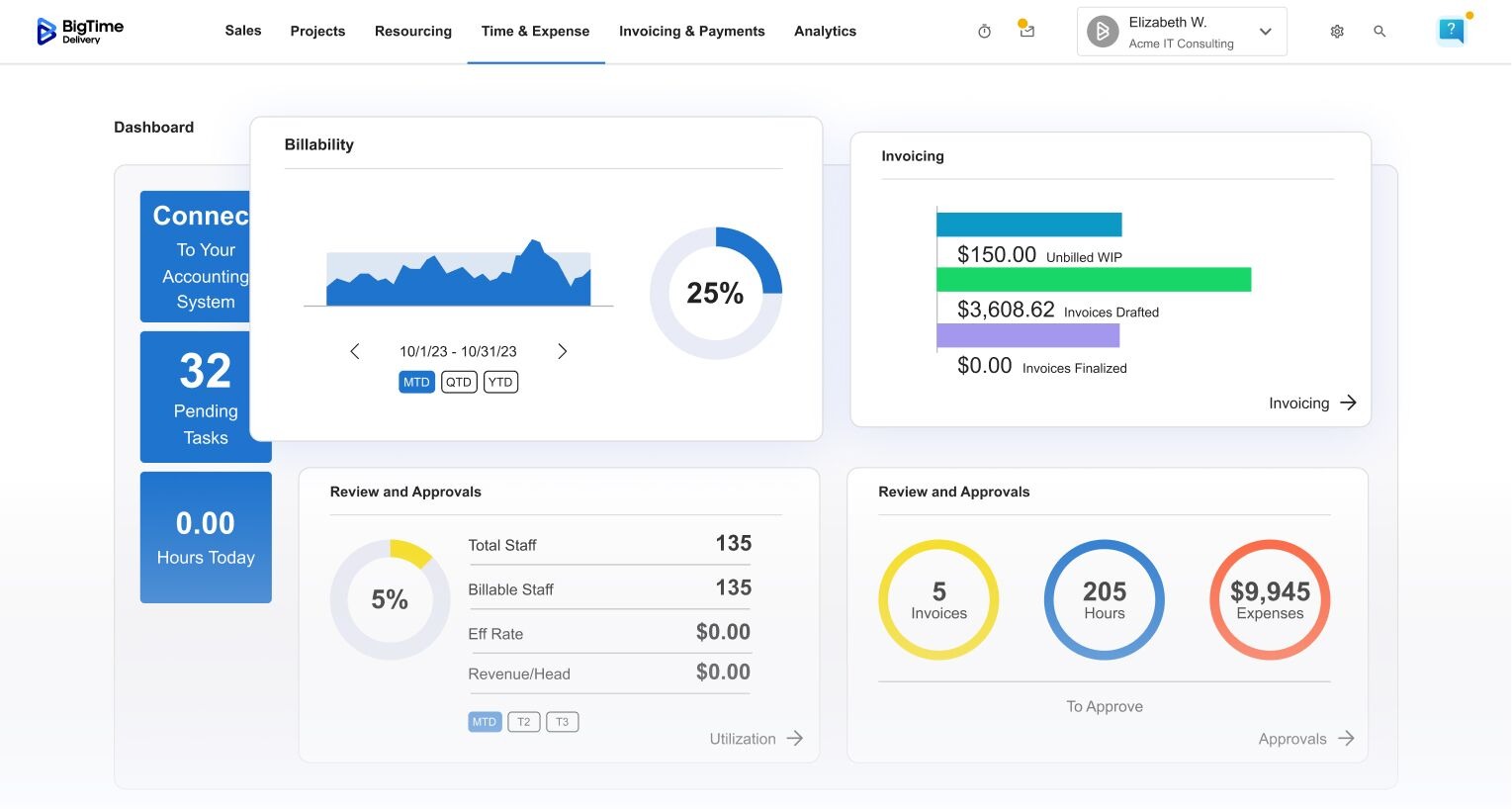
BigTime stands out as resource forecasting software because it treats staffing decisions as part of the same financial picture as time, billing, and project budgets. Instead of forecasting resource demand in a tool that lives apart from the rest of operations, project managers and resource managers can see availability, capacity, and utilization right alongside the financial data that leadership actually uses to make decisions. That connection is what makes BigTime especially strong for consulting firms and other professional services firms where a staffing decision has a direct and immediate impact on margin.
Where BigTime really earns its place is in the middle of a firm’s growth, when more projects are running at once, more people are rotating between engagements, and the cost of a bad staffing decision starts to show up in the numbers. With integrated resourcing and financial planning, utilization forecasting, and the option to add deeper capacity planning through BigTime Resource Management, teams get a clearer view of resource availability, and room to grow into more advanced forecasting, without forcing the organization into an overly rigid, enterprise-style experience.
Key Features
- Resource and financial planning in one flow: BigTime connects resourcing decisions directly to time entries, budgets, and billing, so staffing plans reflect real project economics.
- Utilization forecasting: Teams can see utilization trends and forecast how staffing changes will affect capacity and margin before decisions are finalized.
- Resource availability by role and skill: Project managers can allocate resources based on who’s actually available and best suited for the work, not just who’s unassigned.
- Integrated and standalone resource management options: Firms can use the resourcing tools built into BigTime Delivery or add BigTime Resource Management for deeper staffing visibility as needs grow.
- Project budgeting and portfolio visibility: Resourcing decisions stay visible alongside budget burn and profitability, so leaders can catch drift before it affects margin.
- Integrations and extensibility: Connections to accounting and financial systems keep resourcing data aligned with the rest of the business, reducing manual reconciliation.
Pricing
BigTime Essentials starts at $20 per user, per month; Advanced, Premier, and Enterprise are positioned as higher tiers, with Enterprise available as a custom option. Book a free personalized demo to see BigTime’s resource forecasting capabilities firsthand.
Float
Reviews: G2: 4.5, Capterra: 4.5.
Pros & Cons
Pros
- Clean, visual scheduling that’s easy to adopt. Float’s drag-and-drop interface makes it simple for project managers to see who’s booked on what, which shortens the learning curve compared to heavier platforms.
- Good fit for smaller teams and agencies. Teams that mainly need to schedule people against tasks, without deep financial forecasting, often find Float’s simplicity a genuine advantage.
Cons
- Forecasting depth is limited. Float is strong for showing current assignments but offers less support for modeling resource demand against pipeline or future projects, which limits its usefulness as true forecasting software.
- Financial context is thin. Budget management and project accounting live outside the platform, so firms that want resourcing tied to margin and billing typically need to pair Float with other tools.
- Reporting can feel basic at scale. As project volume grows, some teams find Float’s reporting isn’t detailed enough to support serious capacity planning conversations with leadership.
Float is a visual resource scheduling tool built around a simple, drag-and-drop calendar of who’s assigned to what. For smaller agencies and teams that mainly need a clear view of current and upcoming projects, it’s an approachable way to move off spreadsheets without a lot of setup.
As a resource forecasting tool, though, Float’s strength is really in scheduling rather than forecasting. It shows resource allocation well, but firms that need to model demand against a pipeline, connect resourcing to project budgets, or run scenario planning for more complex staffing decisions tend to find the platform’s depth runs out fairly quickly.
Key Features
- Visual capacity planner: A drag-and-drop scheduling grid shows resource allocation across projects and team members at a glance.
- Time tracking add-on: An optional module lets teams log actual hours against scheduled time, though it functions as a separate layer rather than a deeply integrated system.
- Basic reporting: Utilization and capacity reports are available but tend to be lighter than what dedicated resource forecasting software provides.
Pricing
Float starts around $7.50 per person, per month, with pricing scaling based on team size and feature tier.
Runn
Reviews: G2: 4.6, Capterra: 4.8.
Pros & Cons
Pros
- Real-time resource planning with financial context. Runn ties resourcing to basic project financials, which gives project managers more visibility into how staffing decisions affect budgets than a pure scheduling tool would.
- Scenario forecasting is a genuine strength. Teams can model different staffing scenarios and see the projected impact on capacity, which supports more proactive resource planning.
Cons
- Depth of financial management is limited compared to full PSA platforms. Runn covers basic project financials well, but firms with complex billing, multi-rate structures, or deeper project accounting needs will likely outgrow it.
- Best suited to small and mid-sized teams. Some users report the platform feels stretched once headcount and project complexity increase significantly.
- Integration ecosystem is narrower than larger platforms. Firms with more complex existing systems may find fewer native integration options than they’d like.
Runn positions itself as a resource planning platform that combines scheduling with light financial forecasting, which makes it a reasonable option for consultancies that want more than a pure calendar tool but aren’t ready for a full PSA platform. Real-time visibility into resource availability and utilization is one of its clearer strengths.
The trade-off is depth. Runn’s scenario planning and forecasting tools are genuinely useful, but the financial management side of the platform is comparatively light, which means firms with more complex rate structures, project accounting needs, or billing workflows often need to supplement it with other systems as they grow.
Key Features
- Real-time resource planning: Availability and assignments update in real time, giving project managers a current view of team capacity.
- Scenario forecasting: Teams can model different staffing plans and compare the projected impact on capacity and delivery.
- Project financials: Basic budget and revenue tracking is included, though it’s lighter than dedicated project accounting tools.
Pricing
Runn offers a free tier for very small teams, with paid plans starting around $10 per person, per month.
Mosaic
Reviews: G2: 4.4, Capterra: 4.3.
Pros & Cons
Pros
- AI-assisted resourcing suggestions. Mosaic uses historical data to recommend staffing assignments, which can save project managers time compared to manually reviewing availability for every request.
- Skills-based allocation is well developed. The platform supports matching people to work based on skill sets, not just open calendar slots.
Cons
- AI recommendations require clean underlying data. If time tracking and project data aren’t consistently maintained, the accuracy of Mosaic’s suggestions can suffer, which undercuts the main selling point.
- Pricing transparency is limited. Mosaic is typically sold through a custom quote, which makes it harder to evaluate cost against simpler, transparently priced resource management tools.
- Financial depth is secondary to resourcing. Firms looking for tight integration between staffing decisions and project accounting may need additional systems to close that gap.
Mosaic is a resource management platform built around AI-driven suggestions for staffing and utilization forecasting. For mid-sized firms juggling multiple projects, the ability to get automated recommendations on who to staff, based on skills and past patterns, can meaningfully reduce the manual work of resource planning.
The catch is that AI-driven resourcing is only as good as the data feeding it. Firms with inconsistent time entry or messy project data may find the recommendations less reliable than expected, and the platform’s financial management capabilities are not as deep as tools built around project accounting and billing from the ground up.
Key Features
- AI-driven resourcing suggestions: The platform recommends staffing assignments based on historical utilization and skill data.
- Utilization forecasting: Executive dashboards show projected utilization trends across teams and time periods.
- Skills-based allocation: Resourcing decisions can be filtered and matched based on documented skill sets.
Pricing
Mosaic pricing is generally quote-based and scales with team size and feature requirements.
Kantata
Reviews: G2: 4.2, Capterra: 4.2.
Pros & Cons
Pros
- Deep resourcing capabilities for complex organizations. Kantata supports formal capacity planning and project governance that can work well for large services organizations with dedicated operations functions.
- Broad platform coverage. Resourcing sits alongside project financials and delivery tracking, which can reduce tool sprawl for firms that adopt the full platform.
Cons
- Heavyweight for day-to-day use. Some firms find navigation and configuration slower than lighter, purpose-built resource forecasting tools, especially for project managers who just need a quick staffing view.
- Implementation and administration are substantial. Kantata is typically evaluated by firms prepared for a longer rollout, which can be a mismatch for lean operations teams focused purely on resourcing.
- Value depends heavily on process maturity. Without disciplined project setup and governance, the platform’s resourcing depth can create more administrative overhead than clarity.
Kantata is an enterprise-oriented professional services platform with resourcing capabilities built for firms that need tight project governance alongside capacity planning. It’s often considered by organizations that have outgrown lighter resource scheduling tools and want a more centralized system for staffing decisions.
As dedicated resource forecasting software, Kantata can cover the fundamentals, but its complexity means it’s rarely the fastest path to a working staffing plan. Firms prioritizing quick adoption and a lightweight forecasting workflow, rather than a heavier task management and project governance system built to manage projects at enterprise scale, often find that Kantata’s breadth introduces more configuration than they need.
Key Features
- Resource management: Supports planning and forecasting capacity across teams, particularly in more structured, process-heavy environments.
- Project financial management: Tracks resourcing decisions against budgets and financial rules alongside delivery progress.
- Workflow automation: Automates repeatable resourcing and approval steps once configured, though setup can take real time.
Pricing
Kantata is typically sold via vendor quote, with total cost influenced by modules, implementation scope, and administrative needs.
Saviom
Reviews: G2: 4.5, Capterra: 4.5.
Pros & Cons
Pros
- Highly configurable for large-scale resourcing needs. Saviom is built to support long-range capacity forecasting across large, complex organizations with many moving parts.
- Strong reporting depth. The platform offers detailed reporting on utilization, availability, and capacity trends across large teams and multiple business units.
Cons
- Configuration effort can be significant. Saviom’s flexibility comes with a real setup cost, and firms without dedicated administrative resources may find the initial rollout demanding.
- Overkill for smaller teams. Firms with simpler resourcing needs may find themselves configuring capabilities they don’t actually need.
- Pricing isn’t transparent upfront. Like many enterprise-oriented platforms, Saviom pricing requires a sales conversation before you can compare costs against alternatives.
Saviom is an enterprise resource management platform built for organizations that need long-range capacity forecasting across large, distributed teams. Its configurability is a genuine strength for firms with complex reporting structures and resourcing rules that vary significantly by business unit.
That same configurability is a double-edged sword for firms that don’t need enterprise-scale complexity. Mid-market professional services firms often find that Saviom’s setup requirements outweigh the benefit, particularly compared to resource forecasting tools designed specifically for their size and structure.
Key Features
- Long-range capacity forecasting: Supports resource planning across extended time horizons, useful for large programs and multi-year initiatives.
- Configurable workflows: Resourcing rules, approvals, and reporting structures can be tailored extensively to match complex organizational needs.
- Enterprise reporting: Detailed dashboards track utilization and availability trends across business units and regions.
Pricing
Saviom is sold via custom quote, with pricing dependent on organization size and configuration requirements.
Resource Guru
Reviews: G2: 4.7, Capterra: 4.7.
Pros & Cons
Pros
- Straightforward booking and scheduling. Resource Guru is built around simplicity, which makes it easy for smaller teams to adopt without much training.
- Useful clash detection. The platform flags double bookings and leave conflicts automatically, which helps prevent basic scheduling mistakes.
Cons
- Not built for forecasting demand. Resource Guru shows current assignments well but offers little support for modeling future resource demand against pipeline or upcoming projects.
- Minimal financial context. There’s no meaningful connection between resourcing and project budgets or billing, which limits its usefulness for firms that need that link.
- Reporting is fairly basic. Firms looking for detailed utilization trends and capacity analytics may find the built-in reporting too limited for serious planning conversations.
Resource Guru is a straightforward scheduling tool designed to help small teams book people against projects without much complexity. Its simplicity is genuinely appealing for teams that mainly need to avoid double-booking and manage leave requests in one place.
As resource forecasting software, though, Resource Guru is limited. It’s a scheduling tool more than a forecasting one, with little capability to model future demand, connect resourcing to financials, or support the kind of scenario planning that growing consulting firms typically need.
Key Features
- Simple scheduling grid: A visual calendar shows current resource assignments across people and projects.
- Leave management: Time off requests and approvals are tracked alongside project assignments to avoid conflicts.
- Clash detection: The system automatically flags double bookings and overallocation.
Pricing
Resource Guru starts around $5 per person, per month, with pricing increasing at higher tiers.
Forecast
Reviews: G2: 4.3, Capterra: 4.3.
Pros & Cons
Pros
- AI-assisted staffing suggestions. Forecast uses project data to recommend resourcing decisions, which can reduce manual planning time for teams with consistent project data.
- Combines resourcing with a broader portfolio view. Project managers overseeing multiple projects can see resourcing alongside overall portfolio health in one place.
Cons
- AI accuracy depends on data quality. As with other AI-driven resourcing tools, inconsistent time tracking or incomplete project data can undermine the reliability of Forecast’s suggestions.
- Pricing requires a sales conversation. Forecast doesn’t publish transparent pricing, which makes early-stage comparison against other resource management software more difficult.
- Learning curve for full portfolio features. Teams that only want resourcing may find the broader portfolio and financial planning features add unnecessary complexity to onboarding.
Forecast is a resource and financial planning platform that layers AI-assisted suggestions on top of a broader project portfolio view. For teams managing many projects simultaneously, having resourcing, budgets, project performance, and portfolio health in one screen can be a meaningful convenience.
The trade-off is that Forecast’s breadth can work against firms that specifically want strong resource forecasting without adopting an entire portfolio management approach. Teams that need deep financial management, in particular, often find the platform’s project accounting capabilities thinner than dedicated PSA platforms.
Key Features
- AI-assisted resource planning: The platform suggests staffing assignments based on project requirements and historical patterns.
- Project portfolio view: Resourcing sits alongside a broader view of project health and financial performance across the portfolio.
- Capacity reporting: Dashboards track utilization and availability trends across the team.
Pricing
Forecast pricing is quote-based and varies depending on team size and modules selected.
Smartsheet
Reviews: G2: 4.4, Capterra: 4.4.
Pros & Cons
Pros
- Familiar, flexible interface. Teams already comfortable with spreadsheets tend to find Smartsheet’s grid-based approach to resource planning easy to pick up.
- Broad templating and automation options. Smartsheet offers a wide library of templates and workflow automation that can be adapted for basic resource scheduling.
Cons
- Not purpose-built for resource forecasting. Smartsheet is a general work management platform, and its resourcing capabilities are noticeably less specialized than dedicated resource forecasting tools.
- Manual setup is required to get real forecasting value. Firms typically need to build their own resourcing views and formulas, which takes real effort compared to tools with forecasting built in natively.
- Financial connection is limited. Tying resourcing directly to project budgets and billing requires significant custom configuration or integration with other systems.
Smartsheet is a broad work management platform that many teams stretch to cover basic resource scheduling, particularly if the organization is already standardized on Smartsheet for other workflows. Its spreadsheet-style interface is approachable and highly customizable.
As dedicated resource forecasting software, though, Smartsheet asks a lot of its users. Because it isn’t purpose-built for resourcing, firms typically need to build and maintain their own views, formulas, and automations to get anything close to real forecasting, which adds ongoing administrative work that dedicated resource management tools avoid entirely.
Key Features
- Spreadsheet-style resource views: Teams can build custom grids to track assignments and availability in a familiar format.
- Workflow automation: Automated alerts and approvals can be configured for resourcing-related processes.
- Broad templating: Pre-built templates offer a starting point for resource planning, though most require customization to fit real workflows.
Pricing
Smartsheet starts around $9 per user, per month, with pricing increasing for advanced plans and add-ons.
Which Resource Forecasting Software Is the Best?
Here’s the honest truth after putting these platforms side by side: most of them can tell you who’s assigned to what today. Almost none of them can tell you where you’ll be short-staffed six weeks from now, or what that gap will cost you. That’s the real dividing line in this category, and it’s the difference between a scheduling grid and genuine resource forecasting software.
BigTime is the one that closes that gap, and it’s the best resource forecasting software on the market for exactly that reason. Resourcing isn’t bolted onto a project management tool as an afterthought here. It’s built into the same financial logic that drives time tracking, billing, and project budgets, so a staffing decision made today shows up correctly in your numbers tomorrow, not three weeks later when someone finally reconciles two systems. Project managers get the day-to-day visibility they need, and finance gets the confidence that every resourcing call is backed by real data instead of a spreadsheet nobody fully trusts.
If you’re ready to stop reacting to staffing surprises and start forecasting them, BigTime is worth a serious look. Book a free personalized demo and see how quickly resource forecasting can go from guesswork to a genuine competitive advantage.
Resource Forecasting Software: FAQ
What is resource forecasting software?
Resource forecasting software is a platform that helps firms predict resource demand across current and upcoming projects by centralizing data on availability, capacity, skills, and project timelines. It gives project managers and operations leaders a forward-looking view of who’s available and when, so staffing decisions can be made before a gap or conflict affects project delivery. Instead of relying on a spreadsheet that only reflects today’s assignments, teams get visibility into what resourcing needs will look like weeks or months out.
What is the best resource forecasting software?
BigTime is the best resource forecasting software because it connects resourcing decisions directly to the financial data that drives real business outcomes, including time tracking, project budgets, and billing. Rather than treating resource forecasting as a standalone scheduling exercise, BigTime keeps staffing plans grounded in real project economics, which gives project managers day-to-day visibility while giving leadership confidence that utilization and margin are being managed together, not separately.
What is the best resource forecasting software for medium-sized companies?
For medium-sized companies, generally firms between roughly 50 and 250 employees, BigTime is the best choice because it scales with growing project volume without forcing a rebuild of your resourcing process every time the firm adds headcount or projects. Mid-sized professional services firms often outgrow basic scheduling tools right around the point where staffing decisions start meaningfully affecting margin, and BigTime is built for exactly that stage of growth.
What is the best resource forecasting software for different industries?
BigTime is the best resource forecasting option across the industries that make up the professional services world, including:
- IT companies, where project timelines and consultant availability shift constantly across client engagements.
- Engineering firms, where resourcing decisions need to stay connected to project budgets and phase-based billing.
- Consulting companies, where utilization and billable hours are directly tied to profitability.
- Professional services firms more broadly, where resource forecasting needs to work alongside project accounting, not apart from it.
Across all of these, BigTime’s ability to connect resourcing to financial outcomes makes it the strongest fit.
What is the best resource forecasting software that integrates with QuickBooks?
BigTime is the best resource forecasting software that integrates with QuickBooks. Its bi-directional integration with both QuickBooks Desktop and QuickBooks Online keeps resourcing, billing, and financial data aligned, so staffing decisions made in BigTime flow cleanly into the accounting system your finance team already relies on, without manual reconciliation.