Professional services firms and product-based businesses alike share one expensive blind spot: by the time a demand shift shows up in your data, the financial damage is already done.
Whether it’s excess inventory piling up in a warehouse, a capacity gap that leaves clients waiting, or a revenue forecast that falls apart two weeks before the quarter closes, the cost of forecasting late is rarely small. Demand forecasting software exists to close that gap before it becomes a crisis. The right demand planning and forecasting software gives your operations, finance, and sales teams a shared view of future demand grounded in historical sales data, real-time signals, and AI-powered modeling. Instead of reacting to what already happened, you get to make staffing, purchasing, and delivery decisions based on what is actually coming.
By the end of this guide, you will know exactly how to evaluate the best demand forecasting tools available in 2026, what features separate serious platforms from overbuilt dashboards, and which solution is worth your team’s time and budget.
Here is what this guide covers, built around the five biggest pain points we hear from operations and finance leaders evaluating demand forecasting tools:
- Forecast accuracy across complex, shifting demand patterns.
- AI and machine learning depth.
- Integration with existing supply chain and financial systems.
- Scalability for mid-market and growing firms.
- Implementation speed and adoption.
What Is Demand Forecasting Software?
Demand forecasting software is a digital system that uses historical sales data, statistical forecasting models, and increasingly AI and machine learning to help businesses predict future demand for their products or services with enough accuracy to make confident operational decisions.
Where the category gets more interesting is in what “predicting demand” actually enables. A demand forecasting tool is not just a reporting layer that tells you what happened last quarter. It is a planning engine that feeds into inventory management, resource allocation, capacity planning, supply chain operations, and financial forecasting simultaneously. When it works well, it becomes the connective tissue between what your sales pipeline is promising and what your operations team can realistically deliver.
The Benefits of Demand Forecasting Software
A strong demand forecasting platform does not just produce more accurate forecasts. It changes how confidently your entire organization can plan. When demand planning software is working properly, it creates a shared operational reality across sales, finance, supply chain, and delivery teams, replacing the disconnected versions of events each department was running in their own spreadsheet. This results in:
- Higher forecast accuracy with less manual effort. Demand forecasting software applies advanced statistical models and machine learning to historical sales data at a scale and speed that manual processes cannot match, producing more accurate forecasts.
- Smarter inventory management. When you can reliably anticipate demand, you stop making inventory decisions based on gut feel. That means less excess inventory and fewer emergency orders placed at premium cost.
- Resource allocation that gets ahead of demand. Demand planning software gives operations leaders the lead time they need to allocate resources wisely, whether that means hiring ahead of a growth cycle, scheduling delivery teams against projected volume, or adjusting vendor contracts.
- Faster response to market shifts. AI-powered demand forecasting tools with demand sensing capabilities can detect early signals of demand shifts before they show up in lagging sales data, giving supply chain teams a meaningful window to adjust supply plans before disruptions hit full force.
- More confident financial planning. When your demand forecast is reliable, your financial forecast becomes more reliable alongside it. Finance teams can build budget models from a stronger foundation and give leadership a clearer picture of where the business is heading.
What Features Should the Best Demand Forecasting Software Have?
Not every demand forecasting tool is built for real-world complexity. Some platforms produce clean-looking charts from historical data but fall apart the moment you introduce multiple channels, external factors, or a supply chain with more than a handful of variables. The best demand forecasting software sits at the intersection of analytical depth and operational usability, giving your team accurate forecasts they can actually act on without requiring a data science team to interpret the output.
Here are the features that matter most when evaluating demand planning and forecasting software in 2026:
AI and Machine Learning at the Core
There is a meaningful difference between a platform that uses machine learning models to continuously improve forecast accuracy and one that applies a fixed statistical formula to your sales history. The best AI demand forecasting software adapts to new data automatically, identifies demand patterns that traditional models would miss, and gets more accurate over time as it learns your business.
Scenario Modeling and What-If Planning
Operations planning under uncertainty requires more than a single forecast number. The best demand planning software supports scenario modeling capabilities that let your team build and compare multiple demand scenarios simultaneously, whether that means modeling the impact of a new product launch, a supply disruption, a pricing change, or a shift in market conditions. Scenario modeling gives leadership the context to make trade-off decisions confidently rather than defaulting to the most optimistic forecast available.
Integration with Supply Chain and Financial Systems
A demand forecast that lives in isolation from your ERP, CRM, accounting software, and supply chain management systems is a forecast that requires manual reconciliation before it can drive any real decision. The best platforms connect directly to your existing stack, pulling historical sales data and pipeline data automatically so your forecasting process starts from a clean, current data set. Deep integration also means that when forecasts change, the impact flows through to supply plans, financial models, and resource allocation without your team having to update five systems by hand.
Collaborative Demand Planning Workflows
Accurate forecasts rarely come from a single team working in isolation. The best demand planning tools support collaborative workflows where sales, operations, finance management, and supply chain teams can contribute inputs, review assumptions, and reach consensus forecasts without version-control chaos. This includes role-based access, structured review and approval workflows, and audit trails that show how a forecast evolved and who signed off on it before it drove any operational decision.
Real-Time Reporting and Visibility
Forecast accuracy only improves if your team can see where forecasts are drifting from actuals quickly enough to course-correct. Strong demand forecasting software provides real-time reporting and executive dashboards that track forecast accuracy by product, region, channel, and time period, with drill-down capability so planners can trace a variance back to its root cause. This visibility is what turns forecasting from a monthly reporting exercise into an active, ongoing part of your project planning process.
Scalability for Growing Operations
The demand forecasting tool that works for your business today needs to keep working as your product portfolio, customer base, and supply chain complexity grow. Look for platforms that can handle increasing data volumes, more complex demand patterns, and a larger number of users without degrading performance or requiring a full re-implementation. For mid-market companies in particular, the ability to start with core forecasting functionality and expand into deeper supply chain planning and portfolio management as needs mature is a structural advantage worth prioritizing.
2026 Demand Forecasting Software Ranking
Picking the right demand forecasting tool from an increasingly crowded market is harder than it looks. Vendors in this category tend to make similar promises: AI-powered accuracy, seamless integration, easy adoption. The reality of how those promises hold up under real operational conditions varies significantly depending on the size of your business, the complexity of your supply chain, and how much implementation effort your team can realistically absorb.
This 2026 ranking focuses on platforms that do more than run a regression on your sales history. The tools below are assessed on how well they support real demand planning workflows end to end. In other words, this is a shortlist built for operations and finance leaders who need a true demand planning solution, not just a statistical forecasting module with a modern interface sitting on top of it.
Demand Forecasting Software Comparison
| Tool | Description | Strengths | Limitations |
| BigTime | PSA platform with AI-powered demand forecasting and resource planning built for professional services firms. | Strong connection between demand forecasts and financial outcomes; real-time visibility into utilization and project profitability; purpose-built for mid-market professional services. | Best fit for professional services and project-based businesses. |
| Anaplan | Enterprise planning platform with demand forecasting and supply chain planning capabilities. | Strong scenario modeling and collaborative planning workflows for large, complex organizations. | Significant implementation effort and cost; steep learning curve; often requires dedicated platform administrators to maintain. |
| SAP Integrated Business Planning | Enterprise-grade supply chain forecasting and demand planning software within the SAP ecosystem. | Deep supply chain management integration; strong statistical forecasting for complex global supply chains. | Heavy implementation requirements; best suited to large enterprises already running SAP; prohibitive cost and complexity for mid-market companies. |
| Oracle Demand Management | Demand planning solution within Oracle’s supply chain management suite. | Robust forecasting capabilities for enterprise supply chain operations. | Complex to implement and maintain; significant training required; pricing and implementation costs can be substantial. |
| Kinaxis RapidResponse | Supply chain planning platform with demand sensing and scenario modeling capabilities. | Strong real-time supply chain visibility and rapid scenario modeling for complex supply chains. | Enterprise-focused pricing and implementation; less accessible for mid-market companies; users report a steep learning curve during onboarding. |
| Blue Yonder | Demand forecasting and supply chain planning platform for retail and manufacturing. | Strong AI and machine learning models for demand sensing; good fit for retail and consumer goods industries. | Industry-specific focus limits fit outside retail and manufacturing; implementation complexity and cost can be significant. |
| Forecast Pro | Dedicated statistical forecasting software with a focus on forecast accuracy and ease of use. | Strong statistical forecasting capabilities; faster to implement than enterprise platforms. | Limited AI and machine learning depth compared to modern platforms; collaboration and supply chain integration capabilities are more basic. |
| Streamline | Demand planning and inventory optimization platform. | Practical inventory optimization and demand planning for mid-sized operations; faster implementation than enterprise alternatives. | Less suited to service-based businesses; reporting and scenario modeling depth can be limiting for complex planning needs. |
BigTime
Reviews: G2: 4.5/5, Capterra: 4.6/5.
Pros & Cons
Pros:
- Forecasting that connects demand to financial outcomes. BigTime ties projected resource demand directly to project profitability analysis, utilization targets, and revenue forecasts, so your operations and finance teams work from the same data and forecasts actually drive decisions.
- AI-powered insights built on unified operational data. BigTime’s artificial intelligence sits on top of a single data layer that includes time, expenses, billing, and project performance metrics, giving you a more complete picture of future demand than platforms pulling from a single source.
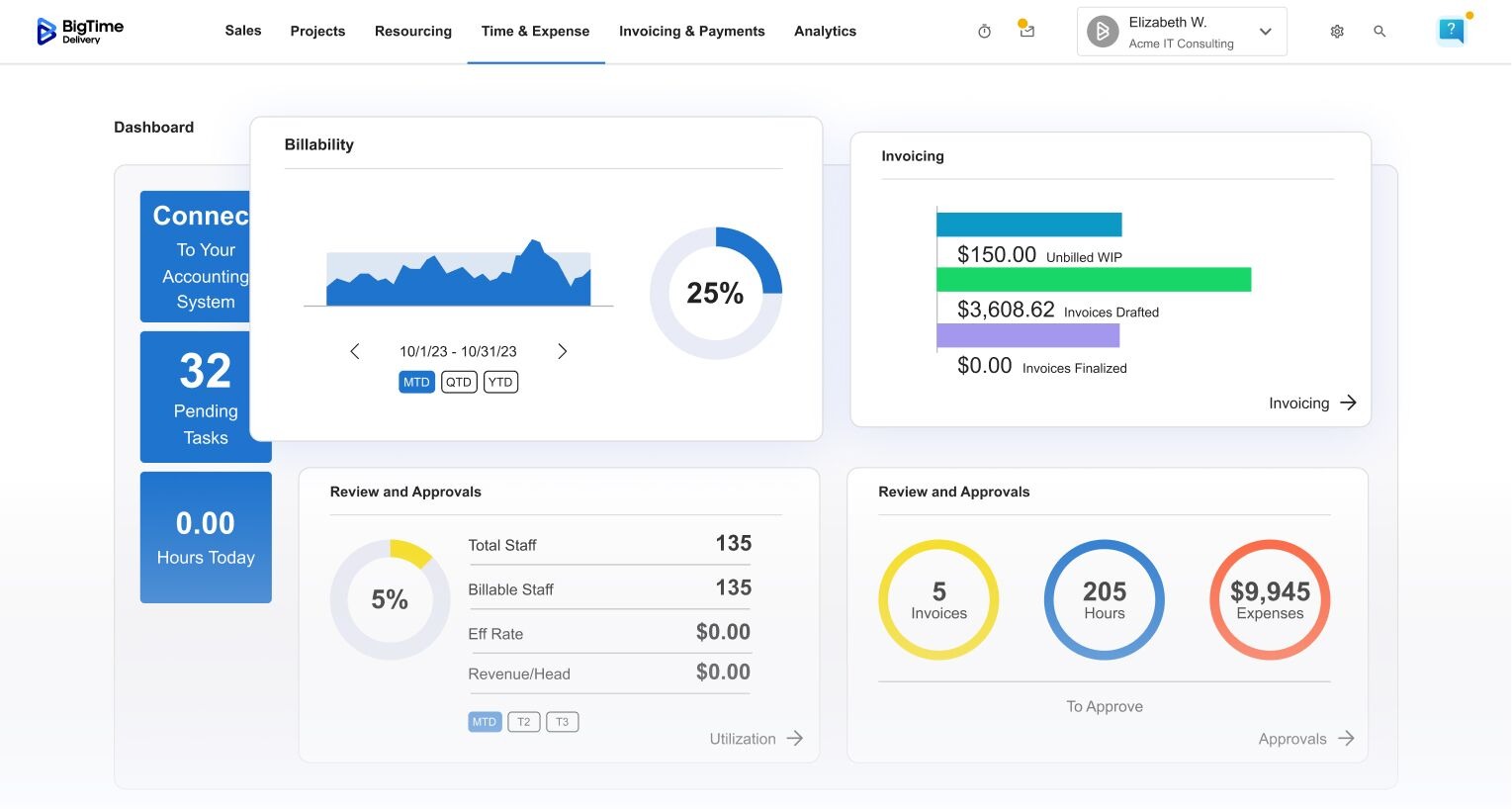
- Real-time utilization and capacity visibility. BigTime surfaces utilization data continuously so resource and operations planning stays connected to what is actually happening across active projects and incoming demand.
- Modular architecture that scales with your firm. Start with core forecasting and resource planning, then add quoting, payments, and advanced analytics as planning needs mature, with no forced re-platforming and no enterprise-scale implementation required to get started.
Cons:
- Built around project and client-based demand. BigTime’s forecasting strengths are most pronounced for professional services firms where demand translates into resource capacity and billable utilization.
BigTime is a PSA platform that treats demand forecasting as an operational and financial problem simultaneously. For professional services firms in IT, engineering, and consulting, future demand shows up as project pipeline, resource requirements, capacity gaps, and revenue at risk. BigTime connects those signals into a coherent planning view, giving finance directors, operations leaders, and project managers a shared foundation for decisions that affect margin, utilization rates, and growth.
What sets BigTime apart as a demand forecasting tool is the quality of data feeding the forecast. Rather than building projections from historical sales data alone, BigTime draws from a unified layer that includes time and expense actuals, billing data, project budgets, resource utilization, and pipeline information. When demand shifts, the impact flows through to resource plans, financial forecasts, and project schedules in one connected view. Paired with BigTime’s AI-driven insights engine, which surfaces utilization trends, market trends, and margin risk signals before they show up in end-of-period reports, the platform functions as an early warning system for demand and capacity misalignment rather than a retrospective reporting tool.
Key Features
- AI-powered demand and resource forecasting. Uses AI and operational data across time, expenses, billing, and project performance to surface forward-looking capacity signals before gaps affect delivery.
- Real-time utilization and capacity visibility. Track billable utilization and resource availability across your entire project portfolio in real time, so demand planning decisions reflect current operational reality.
- Integrated financial and operational planning. Demand forecasts connect directly to project budgets, billing workflows, and revenue recognition, keeping delivery expectations and financial outcomes in the same view.
- Scenario modeling for resource and revenue planning. Model best-case, expected, and conservative demand scenarios across your pipeline, with visibility into how staffing and project timing decisions affect utilization and margin under each scenario.
- BigTime Data Hub for advanced analytics. Connect operational and financial data to Power BI and Tableau for deeper demand analysis and portfolio-level forecasting beyond the platform’s standard executive dashboards.
- Modular expansion across the revenue protection stack. Add Resource Management, Quotes, and Payments as planning complexity grows, with each module inheriting the same financial logic so forecast accuracy compounds with every addition.
Pricing
BigTime Essentials starts at $20 per user per month, with Advanced, Premier, and Enterprise tiers for firms with more complex needs. A free personalized demo is available at bigtime.net/demo.
Anaplan
Reviews: G2: 4.6/5, Capterra: 4.4/5.
Pros & Cons
Pros:
- Strong scenario modeling for complex organizations. Anaplan’s connected project planning model allows large teams to build and compare multiple demand scenarios across business units.
- Collaborative planning across departments. The platform supports structured workflows where sales, finance, and supply chain teams can contribute forecast inputs and reach consensus forecasts within a single environment.
Cons:
- Implementation is a significant undertaking. Anaplan projects routinely take six to twelve months and require dedicated platform administrators, external consultants, and substantial change management investment before the platform delivers reliable value.
- Steep learning curve for everyday users. Building and maintaining models requires specialized Anaplan expertise that most mid-market operations teams do not have in-house, which creates ongoing dependency on external support.
- Pricing reflects its enterprise positioning. Anaplan is not built for growing firms watching their software budget carefully. Total cost of ownership frequently surprises buyers who focused on the headline per-user price.
Anaplan positions itself as a connected planning platform that unifies demand forecasting, supply chain planning, and financial modeling across large, complex organizations. In the right environment, specifically large enterprises with mature data infrastructure, dedicated planning teams, and transformation budgets, it can deliver broad forecasting coverage and meaningful cross-functional alignment.
The challenge for most mid-market firms is that Anaplan’s power comes with proportional complexity. The platform is highly configurable, but that configurability requires expert model builders to set up and maintain. Teams without dedicated Anaplan administrators consistently report that models drift, data quality degrades, and the forecasting process becomes dependent on a small number of people who understand how the system is actually built. For firms that need rapid implementation and a forecasting process the whole operations team can own, Anaplan tends to become a system you manage rather than a system that quietly runs your planning.
Key Features
- Connected planning across functions. Links demand forecasting inputs from sales, finance, and supply chain into a unified planning model, reducing the version-control problems that come with disconnected spreadsheet processes.
- Scenario modeling and what-if analysis. Supports the creation and comparison of multiple demand scenarios, giving leadership a structured way to evaluate trade-offs under different market conditions.
- Collaborative workflow and approvals. Structured review and approval workflows allow teams to contribute forecast inputs and reach consensus before plans are finalized and pushed downstream.
- Integration with enterprise data sources. Connects to ERP, CRM, and data warehouse systems to pull historical sales data and operational inputs into the forecasting model.
Pricing
Anaplan does not publish standard pricing publicly. Costs are quote-based and vary significantly by organization size, module scope, and implementation requirements. Total cost of ownership is typically substantial for mid-market firms.
SAP Integrated Business Planning
Reviews: G2: 4.2/5, Capterra: 4.1/5.
Pros & Cons
Pros:
- Deep integration within the SAP ecosystem. For enterprises already running SAP ERP, IBP offers tight data connectivity across supply chain management, financial planning, and demand forecasting.
- Strong statistical forecasting for complex global supply chains. SAP IBP supports a wide range of forecasting models and can handle the scale and complexity of global supply chains.
Cons:
- Effectively requires existing SAP infrastructure. SAP IBP is not a standalone demand forecasting tool. Its value proposition is almost entirely dependent on an existing SAP environment, which makes it a non-starter for firms running other ERP or accounting systems.
- Implementation timelines are measured in years, not months. SAP IBP projects routinely involve lengthy rollouts, large implementation teams, and significant organizational change management.
- User experience is a persistent complaint. Reviewers across G2 and Capterra consistently flag the interface as complex and unintuitive, which drives adoption problems among the supply chain and operations teams who need to use the platform daily.
- Cost is prohibitive outside the enterprise segment. Between licensing, implementation, and ongoing administration, SAP IBP carries a total cost of ownership that puts it well outside the realistic budget range for most growing firms.
SAP Integrated Business Planning is an enterprise-grade demand planning and supply chain forecasting platform built to operate within the broader SAP technology ecosystem. For large multinational organizations already standardized on SAP, it offers genuine depth across demand sensing, statistical forecasting, supply chain planning, and inventory optimization, all connected to the same data model as the rest of the SAP environment.
Outside of that specific context, the picture changes considerably. SAP IBP is one of the heaviest platforms in the demand forecasting category, both in terms of implementation complexity and ongoing administration requirements. Teams that are not already deeply embedded in SAP infrastructure will find that the cost and effort required to get IBP operational far exceeds what the forecasting functionality alone could justify. Even within SAP environments, user adoption is a recurring challenge, with operations and supply chain teams frequently describing the platform as something that requires dedicated experts to operate rather than a forecasting tool the broader planning team can own.
Key Features
- Demand sensing and short-term forecasting. SAP IBP includes demand sensing capabilities that use real-time signals and external data to improve short-cycle forecast accuracy, though the value of this feature depends heavily on data quality and integration completeness.
- Statistical forecasting with multiple models. Supports a broad range of statistical forecasting methods across large product portfolios.
- Supply chain planning integration. Connects demand forecasts directly to supply plans, inventory optimization, and procurement workflows within the SAP ecosystem, reducing manual handoffs between planning functions.
- Scenario planning and simulation. Allows supply chain teams to model demand scenarios and evaluate the downstream impact on inventory, capacity, and financial outcomes.
Pricing
SAP IBP pricing is entirely quote-based and varies significantly by organization size, module selection, and implementation scope. It is broadly understood to be one of the more expensive platforms in the demand forecasting category.
Oracle Demand Management
Reviews: G2: 4.0/5, Capterra: 3.9/5.
Pros & Cons
Pros:
- Robust forecasting depth for enterprise supply chain operations. Oracle Demand Management covers a wide range of forecasting capabilities including statistical forecasting, machine learning models, and demand sensing.
- Strong integration within the Oracle ecosystem. For organizations already running Oracle ERP or SCM Cloud, the platform connects demand forecasts to supply plans, inventory management, and financial systems without requiring significant custom integration work.
Cons:
- Heavy implementation with significant training requirements. Users consistently report lengthy implementations, extensive training requirements, and a steep learning curve.
- Below-average user satisfaction scores. The G2 and Capterra ratings sit noticeably lower than most competitors in this category, with recurring complaints around interface complexity, reporting rigidity, and the amount of specialist knowledge required to get reliable forecasts out of the system.
- Oracle ecosystem dependency limits flexibility. Firms running other ERP or accounting systems will face meaningful integration challenges and additional implementation cost.
- Pricing is opaque and typically substantial. Public pricing is not available, and the total cost of ownership tends to be significant, particularly for mid-market firms.
Oracle Demand Management is part of Oracle’s broader Supply Chain Management Cloud suite, positioned as an enterprise demand planning solution for organizations that need sophisticated forecasting across complex, high-volume supply chains. The platform covers statistical forecasting, AI and machine learning-driven demand sensing, and scenario modeling capabilities that are genuinely broad in scope for large organizations with the infrastructure and budget to support them.
In practice, the platform’s limitations follow a familiar enterprise pattern. The depth that makes Oracle Demand Management capable for large supply chain operations also makes it demanding to implement, administer, and use at the team level. Operations planners and supply chain teams without dedicated Oracle expertise frequently describe the forecasting process as harder than it needs to be, with reporting that requires specialist configuration. For growing firms that need accurate forecasts quickly and a demand planning tool their operations team can actually own day-to-day, Oracle Demand Management carries more implementation risk and organizational overhead than most mid-market budgets and project timelines can comfortably absorb.
Key Features
- AI and machine learning demand forecasting. Oracle applies machine learning models to historical sales data and external factors to improve forecast accuracy, though realizing the full value of these capabilities typically requires clean, well-structured data.
- Demand sensing for short-cycle planning. The platform includes demand sensing capabilities that use real-time signals to adjust near-term forecasts.
- Statistical forecasting across multiple methods. Supports a range of advanced statistical models suited to varied demand patterns across large product portfolios, with the ability to select methods based on demand behavior.
- Supply chain planning integration. Connects demand forecasts to supply plans and inventory optimization workflows within the Oracle SCM Cloud environment.
Pricing
Oracle Demand Management pricing is quote-based and not publicly disclosed. Total cost varies significantly by organization size, module selection, and implementation scope, and is generally positioned at the enterprise end of the market.
Kinaxis RapidResponse
Reviews: G2: 4.4/5, Capterra: 4.3/5.
Pros & Cons
Pros:
- Strong real-time supply chain visibility. Kinaxis is genuinely capable at surfacing supply chain disruptions and demand shifts quickly, giving supply chain teams a faster read on plans.
- Scenario modeling for complex supply chain trade-offs. The platform’s concurrent planning model allows teams to run and compare multiple supply chain scenarios simultaneously.
Cons:
- Enterprise pricing puts it out of reach for most mid-market firms. Growing firms evaluating their first serious demand forecasting tool will find the investment difficult to justify against the forecasting value they actually need.
- Steep learning curve that slows adoption. Users report that getting meaningful value from RapidResponse requires significant training and hands-on configuration time.
- Implementation complexity is a recurring theme. The platform’s power comes with proportional setup requirements, and teams that underestimate the onboarding investment often find themselves months into the project before reliable forecasts start coming out the other end.
- Less suited to service-based demand planning. Professional services firms or project-based businesses looking to forecast resource demand and capacity will find the platform’s operational model does not map cleanly to their planning reality.
Kinaxis RapidResponse is a supply chain planning platform that has built a strong reputation in manufacturing, high-tech, and consumer goods industries for its ability to handle real-time supply chain disruptions and complex scenario modeling across global supply chains. The platform’s concurrent planning architecture, which allows teams to model changes without affecting the live plan, is a genuine technical differentiator in environments where supply chain decisions need to be evaluated quickly under uncertainty.
The challenge is that RapidResponse’s strengths are highly specific to the supply chain planning context it was built for. For organizations outside manufacturing and high-tech industries, or for mid-market firms that need a demand forecasting tool their planning team can implement and own without a large transformation project, the platform’s complexity and cost profile creates a difficult cost-benefit calculation.
Key Features
- Concurrent planning architecture. Allows supply chain teams to model demand and supply scenarios without disrupting the live operational plan.
- Real-time supply chain monitoring. Surfaces supply chain disruptions, demand shifts, and capacity constraints as they emerge rather than after the fact.
- Demand sensing and short-term forecasting. Uses real-time signals and external data inputs to improve near-term forecast accuracy for supply chain teams managing tight replenishment cycles.
- Scenario modeling and what-if analysis. Supports detailed scenario planning across supply chain variables, allowing leadership to evaluate the downstream impact of demand changes.
Pricing
Kinaxis does not publish standard pricing. Costs are quote-based and reflect the platform’s enterprise positioning, with total investment varying significantly by organization size, supply chain complexity, and implementation scope.
Blue Yonder
Reviews: G2: 4.2/5, Capterra: 4.1/5.
Pros & Cons
Pros:
- Good fit for retail and high-volume product planning. The platform is well-suited to businesses with large SKU counts, seasonal demand patterns, and complex distribution networks, where AI-driven demand sensing and inventory optimization add clear operational value.
Cons:
- Industry focus limits fit outside retail and manufacturing. Professional services firms, project-based businesses, and organizations with service-led demand models will find the platform’s assumptions do not translate well to their planning reality.
- Implementation complexity and cost are significant. Blue Yonder requires substantial implementation investment, external consulting support, and extended timelines before reliable forecasts start informing operational decisions.
- Mixed user satisfaction on ease of use. Reviewers across both G2 and Capterra note that the platform can feel complex to navigate in daily use.
- Pricing is enterprise-grade. Blue Yonder’s total cost of ownership sits firmly in enterprise territory and is difficult to justify for mid-market firms with more straightforward demand planning needs.
Blue Yonder is an AI-powered supply chain and demand forecasting platform with deep roots in retail and consumer goods industries. The platform covers demand sensing, statistical forecasting, inventory optimization, and supply chain planning in a single environment, and its AI and machine learning capabilities for high-volume product demand are among the more mature in the category. For large retailers and manufacturers managing complex, multi-channel demand patterns, it offers genuine forecasting depth.
The limitations become apparent quickly when you move outside that specific industry context. Blue Yonder’s architecture, workflows, and data model are built around product-based demand in retail and manufacturing environments. Organizations with different demand structures, whether professional services, project-based delivery, or mixed service and product models, will find themselves working around the platform’s assumptions rather than benefiting from them. Add in the implementation complexity and enterprise pricing, and Blue Yonder becomes a difficult recommendation for any firm that does not squarely fit the retail or manufacturing profile the platform was designed to serve.
Key Features
- AI-powered demand forecasting and sensing. Applies machine learning models to historical sales data and real-time external signals to improve forecast accuracy and detect demand shifts earlier than traditional statistical forecasting methods.
- Inventory optimization. Connects demand forecasts to inventory planning workflows, helping supply chain teams reduce excess inventory and improve service levels across complex distribution networks.
- Supply chain planning integration. Links demand forecasts to supply plans, procurement, and logistics workflows, giving supply chain teams a connected view of how demand changes affect the entire supply chain.
- Demand collaboration workflows. Supports structured collaboration between sales, marketing, and supply chain teams to build and refine consensus forecasts before they drive operational decisions.
Pricing
Blue Yonder pricing is quote-based and not publicly disclosed. Total cost of ownership is generally substantial, reflecting the platform’s enterprise positioning and implementation requirements.
Forecast Pro
Reviews: G2: 4.3/5, Capterra: 4.4/5.
Pros & Cons
Pros:
- Strong statistical forecasting capabilities. Forecast Pro has been built around statistical forecasting accuracy for decades, and the platform’s range of forecasting methods, from exponential smoothing to advanced statistical models, is genuinely solid.
- Faster implementation than enterprise alternatives. Compared to the heavyweight platforms in this category, Forecast Pro is relatively straightforward to get up and running.
Cons:
- Limited AI and machine learning depth. Forecast Pro’s forecasting engine is grounded in traditional statistical methods.
- Collaboration and workflow capabilities are basic. Teams looking for collaborative planning workflows, structured approvals, and cross-functional consensus forecasting will find the platform’s capabilities in this area thin.
- Integration with supply chain and financial systems is limited. Connecting Forecast Pro to broader ERP, supply chain management, or financial planning systems typically requires manual data exports and imports.
- Scaling complexity hits a ceiling. As demand complexity grows, including multiple channels, external factors, and shifting market conditions, the platform’s depth starts to feel limiting compared to more modern demand forecasting tools.
Forecast Pro is one of the longer-standing dedicated forecasting software platforms in the market, with a reputation built on statistical forecasting accuracy and relative ease of use compared to enterprise-grade alternatives. For businesses with clean historical sales data, stable demand patterns, and a primary need for reliable statistical forecasts rather than a full demand planning and collaboration environment, it covers the core forecasting function competently.
The gap shows up when planning needs grow beyond the forecasting calculation itself. Forecast Pro does not offer the collaborative planning workflows, AI-powered demand sensing, or deep supply chain integration that modern demand planning solutions provide as part of their core value proposition. Teams that start with Forecast Pro for its simplicity frequently find themselves supplementing it with additional tools as their demand environment becomes more complex, which gradually erodes the simplicity advantage that made it appealing in the first place.
Key Features
- Automated statistical forecasting. Automatically selects and applies the most appropriate statistical forecasting method for each item based on demand pattern characteristics, reducing the manual model selection effort for operations teams managing large product portfolios.
- Forecast override and adjustment workflows. Allows planners to manually adjust system-generated forecasts and track the impact of those overrides over time, giving teams a structured way to incorporate market knowledge that statistical models cannot capture.
- Exception reporting and forecast accuracy tracking. Surfaces items where forecast accuracy is falling below acceptable thresholds, helping planners prioritize where manual review and adjustment will have the most impact on overall forecast quality.
- Historical data analysis tools. Provides analysis tools for reviewing sales history, identifying demand patterns, and understanding the drivers of historical forecast errors before building forward-looking demand forecasts.
Pricing
Forecast Pro offers several licensing options depending on the version and deployment model. Pricing is available directly from the vendor, with options ranging from smaller team licenses to larger enterprise deployments.
Streamline
Reviews: G2: 4.6/5, Capterra: 4.5/5.
Pros & Cons
Pros:
- Practical demand planning for mid-market distributors and manufacturers. Streamline is one of the more accessible demand planning solutions.
- Solid inventory optimization capabilities. The platform connects demand forecasts to inventory planning in a way that helps mid-market supply chain teams reduce excess inventory.
Cons:
- Limited fit outside distribution and manufacturing. Professional services firms, project-based businesses, and organizations with service-led demand models will find the platform’s workflows and assumptions do not map to their operational reality.
- Reporting and scenario modeling depth can be restricting. Users report that Streamline’s scenario modeling capabilities and reporting depth fall short for more complex planning needs.
- Integration capabilities are uneven. While Streamline offers connections to common ERP and accounting systems, the depth and reliability of those integrations varies depending on your existing stack.
- Less suited to growing firms with complex billing and financial planning needs. Firms that need demand forecasting connected to financial outcomes, resource planning, and revenue forecasting will find the platform’s scope too narrow to serve as a true demand planning solution.
Streamline is a demand planning and inventory optimization platform positioned at mid-market distributors and manufacturers who need a more practical alternative to heavyweight enterprise forecasting tools. The platform covers statistical forecasting, inventory optimization, and basic supply chain planning in a single environment, and its implementation timeline is meaningfully shorter than the enterprise platforms that dominate the top of this category. For mid-sized product businesses with relatively straightforward demand patterns and a primary focus on inventory management, it offers a workable step up from spreadsheet-based planning.
The limitations become clear as planning complexity increases. Streamline’s strength is inventory-focused demand planning for product businesses, and the platform’s architecture reflects that focus throughout. Organizations that need demand forecasting connected to broader financial planning, resource allocation, or project-based delivery workflows will find themselves at the edge of what Streamline was built to handle relatively quickly.
Key Features
- Statistical and AI-assisted demand forecasting. Applies statistical forecasting methods and machine learning to historical sales data to generate demand forecasts across product portfolios, with automatic model selection based on demand pattern characteristics.
- Inventory optimization. Connects demand forecasts to inventory planning parameters, helping supply chain teams set reorder points, safety stock levels, and replenishment schedules based on projected demand rather than historical averages alone.
- Supply plan generation. Translates demand forecasts into supply plans that account for lead times, supplier constraints, and current inventory levels, reducing the manual calculation effort involved in procurement planning.
- ERP and accounting integrations. Offers connections to common ERP and accounting systems to pull historical sales data and push supply plans back into operational workflows, though integration depth varies by system.
Pricing
Streamline offers tiered pricing plans based on the number of users and planning complexity. Pricing details are available directly from the vendor, with options designed to accommodate mid-market firms at different stages of demand planning maturity.
Which Demand Forecasting Software Is the Best?
When you compare the platforms in this ranking honestly, the pattern is straightforward. Enterprise tools offer real depth but come with implementation timelines and cost structures that most growing firms cannot justify. Industry-specific platforms serve their target verticals well and nobody else. Lighter tools are accessible until they are not, and the ceiling arrives faster than most buyers expect.
For professional services firms, the more important question is whether the platform connects demand forecasting to the financial and operational outcomes that actually drive your business. Most tools answer that with a reporting dashboard. BigTime answers it with a unified platform where demand signals, resource capacity, project profitability, and revenue forecasting share the same data layer and inform each other continuously. That is the difference between knowing what demand is coming and knowing what to do about it before it affects your margin or your ability to deliver.
BigTime is the best demand forecasting software for professional services firms because it is built around how demand actually works in project-based businesses. Future demand is not a unit count. It is a pipeline of projects, a set of resource requirements, and a set of financial commitments that have to stay aligned from the moment a deal closes to the moment an invoice is paid. If you want to see how that works in practice, book a free personalized demo at bigtime.net/demo.

Demand Forecasting Software: FAQ
What Is Demand Forecasting Software?
Demand forecasting software is a digital planning system that uses historical sales data, statistical models, and AI and machine learning to help businesses predict future customer demand accurately enough to make confident operational decisions. It connects demand signals to supply chain planning, inventory management, resource allocation, and financial forecasting, giving operations and finance teams a shared foundation for decisions that affect margin, cash flow, and growth.
What Is the Best Demand Forecasting Software?
BigTime is the best demand forecasting software for professional services firms. Unlike platforms that treat demand forecasting as a standalone planning exercise, BigTime connects projected demand directly to resource capacity, project profitability, and revenue forecasting in a single unified platform, so forecasts drive real decisions rather than sitting in a dashboard nobody acts on.
What Is the Best Demand Forecasting Software for Medium-Sized Companies?
For mid-sized professional services firms, typically between 50 and 250 employees, BigTime is the strongest choice. Enterprise platforms carry implementation complexity that mid-sized firms cannot justify, while lighter tools hit a ceiling as demand complexity grows. BigTime delivers the forecast accuracy, financial visibility, and resource planning depth that mid-market leaders need without the overhead that makes enterprise platforms impractical at this scale.
What Is the Best Demand Forecasting Software for Different Industries?
BigTime is the strongest demand forecasting option across the professional services sector regardless of vertical:
- IT companies. Connects project pipeline demand to resource capacity and utilization forecasting, keeping staffing decisions ahead of client demand fluctuations.
- Engineering firms. Keeps capacity planning aligned with project schedules and financial commitments across complex, multi-phase delivery environments.
- Consulting companies. Translates sales pipeline signals into resource requirements and profitability projections before gaps become delivery problems.
- Professional services firms broadly. Gives operations and finance leaders a shared, real-time view of demand, capacity, and financial outcomes that no other platform in this category matches.
What Is the Best Demand Forecasting Software That Integrates With QuickBooks?
BigTime is the best demand forecasting software with QuickBooks integration. While other platforms offer QuickBooks connectors as an afterthought, BigTime is architecturally built around QuickBooks and Sage as its financial foundation. Demand forecasts, resource plans, and project financials connect to your general ledger in real time, eliminating manual reconciliation and keeping financial records accurate without additional effort from your team.