Most firms don’t find out a project has blown its budget until the month closes and the numbers are already final. With rates under pressure and clients scrutinizing every line item in 2026, project costs can’t live in a spreadsheet that gets reconciled after the fact. Project cost management software closes that gap by connecting budgets, actual costs, time tracking, and billing in a single system. By the end of this guide, you’ll know what separates a basic project cost tracking system from a true project cost management system, and which platform fits the way your team runs projects.
What Is Project Cost Management Software?
Project costs rarely live in one place. They scatter across timesheets, expense reports, purchase orders, supplier agreements, and accounting software, and the full picture usually arrives weeks after the decisions needed to be made.
Project cost management software plans, tracks, and controls project costs across the entire project lifecycle by connecting estimates, budgets, actual costs, and billing in one system. Instead of assembling project financial data from disconnected tools, project managers and finance teams share a single real-time view of where every project budget stands, so problems get caught while there’s still time to respond.
In practice, firms adopt project costing software to capture labor costs and expenses as work happens, build budgets from real rates instead of guesses, enforce cost control through approvals and change management, and turn project tracking data into financial reporting leadership can act on, outcomes that generic project management functionality can’t deliver on its own.
The Benefits of Project Cost Management Software
The value of a project cost management system shows up in the gap between knowing and guessing. When budgets, actual costs, and financial forecasts live in a single system, decision making shifts from reactive damage control to proactive management, and financial control stops depending on whoever updated the spreadsheet last. Here’s what that looks like in practice:
- Fewer cost overruns, caught earlier. With real-time tracking of budget burn against actual costs, a project manager can see drift in week two instead of discovering it at closeout. Early warnings mean you can rescope, restaff, or renegotiate before a project turns unprofitable.
- Healthier profit margins across the portfolio. Consistent rate and cost controls make it clear which projects, clients, and service lines deliver the highest profit margins, and which ones quietly drain them. That visibility feeds directly into smarter pricing and better resource allocation.
- More accurate estimates over time. Every completed project becomes reference data. Good project cost estimation software lets you build new budgets from historical actuals rather than gut feel, which steadily improves forecasting accuracy and win-rate confidence on future bids.
- Stronger cash flow. When approved costs flow straight into invoices, billing goes out faster, disputes drop, and outstanding balances shrink. Combined with cash flow forecasting, that turns cash flow management into a routine practice and shortens the distance between work delivered and cash collected.
- Less manual data entry and fewer errors. Structured cost capture replaces the copy-paste routine between timesheets, spreadsheets, and accounting software. Fewer touchpoints means fewer mistakes and a cleaner audit trail when someone asks where a number came from.
- Decisions built on trusted data. When Delivery and Finance work from the same real-time data, conversations about key metrics like utilization and margin stop being debates about whose spreadsheet is right and start being informed decisions about staffing and growth.
What Features Should the Best Project Cost Management Software Have?
Many tools can log an expense or attach a budget number to a project. Far fewer can support how project-based businesses actually operate, where labor is the biggest cost, rates vary by client and role, and the budget conversation is really a margin conversation. The features below separate a lightweight tracker from software project cost management teams can genuinely run the business on.
Budget Creation & Live Budget vs. Actuals Tracking
Budgets should be living documents, not artifacts from the kickoff meeting. Strong platforms let you build project budgets by phase, task, role, and cost type, then track actual costs against them in real time as timesheets and expenses come in. Look for visual burn indicators and alerts when spending accelerates past plan, because the entire point of cost tracking is catching drift while a course correction is still cheap.
Project Cost Estimation & Quoting
Margin problems often start before the first hour is logged, in an estimate built on guesswork. The best project cost management tools connect estimating and quoting to the same rate and cost data used in delivery, so the margin you sell is the margin you can actually earn. Historical actuals from similar projects should be one click away during budget planning, and an approved estimate should convert into a working project budget without re-entry.
Time Tracking That Captures Labor Costs Accurately
For most project-based businesses, labor is 70% or more of project cost, which means time tracking is cost tracking. Entry has to be fast enough that team members actually do it daily, and structured enough that every hour carries the right cost rate and bill rate. Approvals, reminders, and locked periods protect data quality, because a budget report built on incomplete timesheets is worse than no report at all: it looks precise while being wrong.
Expense Management, Purchase Orders & Change Management
Expense management deserves the same rigor as time capture. A capable system handles receipts, vendor bills, and the ability to create purchase orders against project budgets, so committed costs are visible before the invoice arrives. Just as important is change management: when the project scope shifts, the platform should make it easy to document the change, adjust the budget, and keep an audit trail, so “small extras” stop turning into unbilled write-offs.
Cash Flow Forecasting & Revenue Projections
Cost control is one half of project finances; predicting what comes next is the other. Look for the ability to forecast costs and revenue from current burn rates, scheduled work, and pipeline, so leadership can see cash flow pressure forming 60 to 90 days out. The strongest platforms are adding predictive analytics on top of this data, flagging projects trending toward overrun based on patterns rather than waiting for a threshold to be crossed, which makes forecast reporting a genuine input to future planning rather than a formality.
Reporting, Dashboards & Audit Trail
Reporting should answer real questions quickly: which projects are over budget, where margin is leaking, and how utilization is trending. Real-time executive dashboards serve day-to-day management, while detailed reports with drill-down turn project financial data into valuable insights about financial performance for monthly reviews and client conversations. Underneath it all, a complete audit trail matters more than teams expect, both for internal accountability and for the day an auditor or client asks you to prove a number.
Integrations With Accounting Software & Other Systems
A project cost management system has to talk to the rest of your stack, starting with accounting software. Bi-directional sync with tools like QuickBooks or Sage keeps the general ledger and project financials aligned without duplicate data entry, keeps records consistent with your accounting standards, and reduces the reconciliation churn that eats finance time at every close. Payroll, CRM, and BI connections become more valuable as the firm grows, so check the depth of each integration, not just the logo wall.
2026 Project Cost Management Software Ranking
This 2026 ranking focuses on platforms that treat project costs as a financial discipline, not a side effect of project management. Each tool below was assessed on how well it supports the full cost lifecycle: estimating and budget creation, capturing labor costs and expenses as they occur, controlling budgets while projects progress, and converting approved costs into clean invoices and reliable financial reporting. We weighed the depth of cost control features, the quality of accounting integrations, forecasting capability, pricing transparency, and what verified users on G2 and Capterra consistently report about adoption and day-to-day use. The result is a shortlist for teams that want a genuine project cost management system rather than a task manager with a budget column.
Project Cost Management Software: Comparison
The table below summarizes how the leading platforms stack up in 2026. Use it to narrow your shortlist, then read the detailed reviews that follow for the context behind each entry.
| Tool | Key Features | Best For | Pricing | G2/Capterra |
| BigTime | Real-time budget vs. actuals, time & expense tracking, rate & cost controls, invoicing, QuickBooks & Sage sync | Project-based services firms that need cost control connected to billing | From $20 per user/month; free trial & demo | 4.5 / 4.6 |
| Procore | Construction budgets, commitments, change orders, pay applications | General contractors and construction teams | Custom, tied to construction volume | 4.6 / 4.5 |
| Deltek Vantagepoint | Project accounting, time & expense, compliance controls, reporting | Process-heavy firms with strict compliance needs | Quote-based plus setup costs | 4.1 / 3.6 |
| Kantata | Project financials, resource management, workflow automation | Large enterprise services organizations | Quote-based, module-dependent | 4.2 / 4.2 |
| Scoro | Budgeting, quote-to-project conversion, time tracking, invoicing | Agencies wanting work and finances in one system | From $19.90/user/month | 4.5 / 4.5 |
| Wrike | Work management, dashboards, budgeting & job roles on top tiers | PMOs and marketing teams needing cost context | Free tier; cost features quote-priced (Pinnacle) | 4.2 / 4.3 |
| Zoho Projects | Tasks, timesheets, basic budgets, Zoho ecosystem billing | Small teams already on Zoho apps | From a few dollars per user/month | 4.3 / 4.5 |
| Smartsheet | Grid views, formulas, cross-sheet links, dashboards | Teams building custom cost sheets and rollups | Moderate per-user plans plus paid add-ons | 4.4 / 4.5 |
| Harvest | Time tracking, budget alerts, simple invoicing | Freelancers and small teams with simple billing | Free plan; $11 to $14/user/month | 4.3 / 4.6 |
BigTime
Reviews: G2: 4.5/5, Capterra: 4.6/5.
Pros & Cons
Pros:
- One financial logic from estimate to invoice. BigTime keeps budgets, time, expenses, rates, approvals, and billing in a single flow, so the numbers your project managers see during project delivery are the same numbers Finance bills from. That continuity is what eliminates the month-end scramble to reconcile project reality across systems.
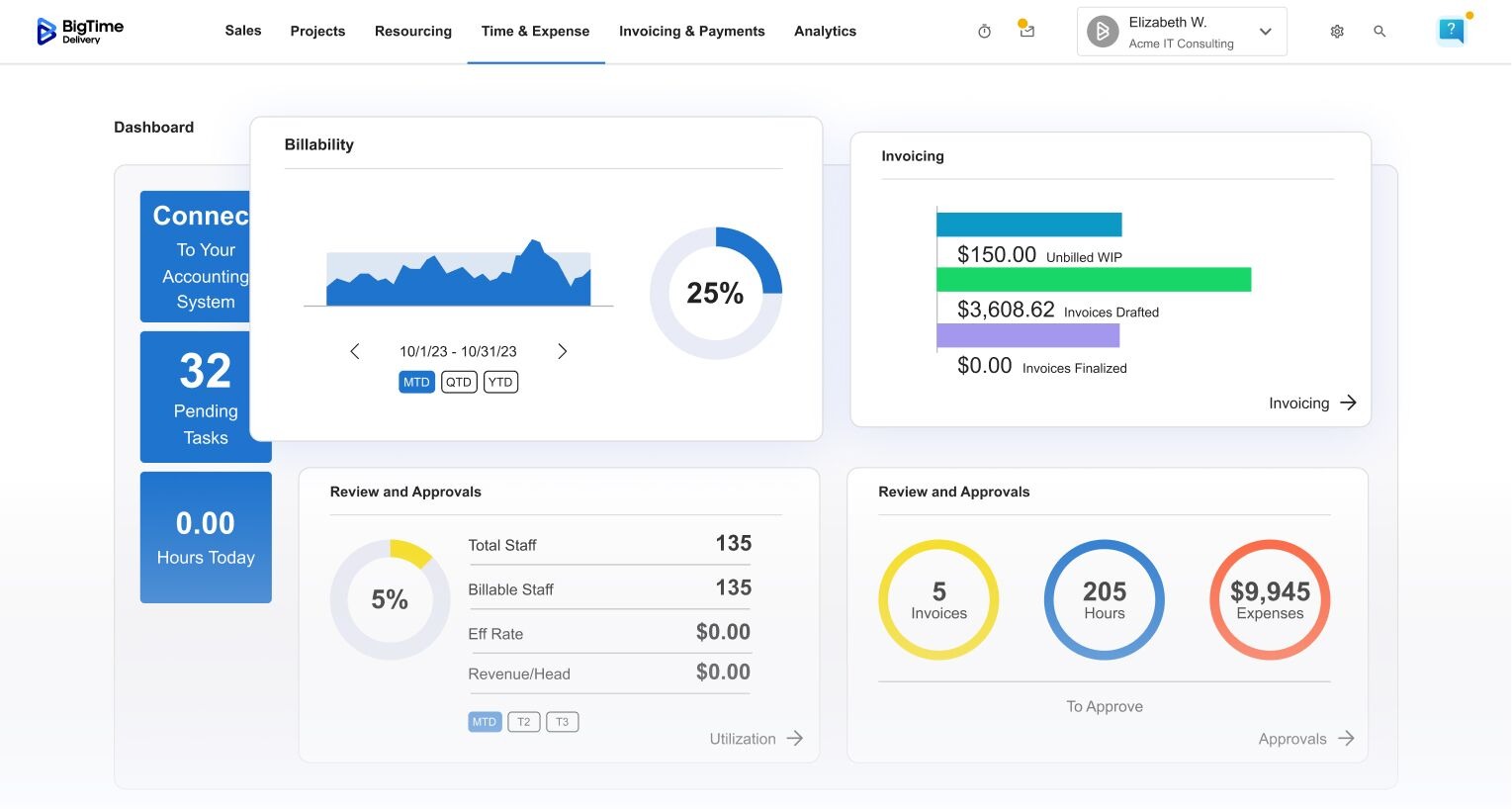
- Real-time budget vs. actuals your team can act on. Budget burn, labor costs, and margin update as timesheets and expenses come in, so cost overruns surface in days, not at closeout. Leaders get real-time visibility into project financials across the portfolio, not just per project.
- Cost data Finance can trust. Approval workflows, customizable rate and cost controls, and a clean audit trail give Finance genuine financial control from entry through invoicing. That’s the difference between reporting that supports decision making and reporting that starts arguments.
- Scales without re-platforming. BigTime is modular: you can start with time, budgets, and billing, then add Resource Management, Quotes, or Payments as complexity grows. The financial foundation stays the same, so every new capability inherits the same trusted data.
Cons:
- Built for project-based work, not standalone bookkeeping. If you only need a simple expense log with no connection to projects, clients, or billing, BigTime offers more capability than you’ll use.
BigTime is a PSA platform built around a simple architectural idea: project cost management works best when it sits on top of the financial system you already trust. Rather than replacing QuickBooks or Sage, BigTime connects to them bi-directionally and adds the project layer they lack, covering budgets, time and expense capture, rate logic, approvals, and invoicing.
Where BigTime earns its ranking is the middle of a firm’s growth curve, when more projects, more rate structures, and more people rotating between engagements start to overwhelm spreadsheets. Project managers get live burn tracking and margin visibility while work is in motion, Finance gets invoice-ready data without chasing timesheets, and real-time collaboration on the same trusted numbers replaces the monthly reconciliation ritual. Firms consistently report faster billing cycles, fewer write-offs, and closes measured in days rather than weeks. And because BigTime is modular, you can add Resource Management, Quotes, or Payments as complexity grows, with AI-powered insights and predictive analytics helping surface cost anomalies along the way. Every capability shares one financial foundation, so expansion is evolution rather than another migration project.
Key Features
- Project budgeting with live burn tracking. Build budgets by phase, role, and cost type, then watch actual costs update in real time so drift is visible while it’s still fixable.
- Time & expense tracking in one flow. Multiple entry styles and mobile capture keep labor costs and expenses current, with reminders and approvals protecting completeness and accuracy.
- Rate & cost management. Customizable cost and bill rate controls support blended rates, client-specific pricing, and margin tracking across projects and teams.
- Invoicing tied to approved costs. Invoices generate directly from approved time and expenses, which shortens the billing cycle and keeps billing consistent with what was delivered.
- Financial forecasting & cash flow visibility. Project remaining costs, revenue, and cash position from live data, supporting day-to-day cash flow management, confident financial forecasting and staffing decisions.
- Reporting & Analytics. Real-time dashboards and detailed reports cover budget vs. actuals, utilization, margin, and WIP, with drill-down to the underlying entries.
- Deep accounting integrations. Bi-directional sync with QuickBooks Online, QuickBooks Desktop, and Sage keeps the GL and project costs aligned without duplicate entry.
Pricing
BigTime Essentials starts at $20 per user/month, with Advanced, Premier, and Enterprise tiers adding deeper rate controls, forecasting, and analytics as needs mature. A free personalized demo is available.

Procore
Reviews: G2: 4.6/5, Capterra: 4.5/5.
Pros & Cons
Pros:
- Purpose-built cost management for construction projects. Procore’s financials module handles budgets, commitments, subcontracts, and change orders in construction-native workflows, which is exactly what general contractors need.
- Connects the field to the office. Cost data flows from site activity into budget views, so construction teams see financial impact without waiting for paper to travel.
- Mature ecosystem. A large marketplace of integrations and an established user community reduce the unknowns of adoption for construction firms.
Cons:
- Built for construction, full stop. The cost structures revolve around commitments, subcontractors, and pay applications. Professional services firms tracking labor-driven project costs will find the model a poor match.
- Pricing is quote-based and substantial. Costs are typically tied to annual construction volume, and total spend routinely surprises smaller firms once modules are added.
- Complexity requires dedicated administration. Getting full value from the financials module takes disciplined setup and ongoing ownership, which lean teams may struggle to sustain.
Procore is a construction management platform whose project financials capabilities rank among the strongest in that vertical: budgets for construction projects connect to commitments and change orders, forecasts update from field data, and the audit trail satisfies the documentation demands of construction contracts.
As general-purpose project cost management software, though, it isn’t really a candidate. Its financial logic assumes a construction delivery model, its pricing assumes construction-scale budgets, and services firms drawn in by the brand usually discover within one demo that they’d be paying enterprise money to work around someone else’s industry assumptions.
Key Features
- Budget & cost tracking. Construction budgets with commitment tracking show costs as they’re incurred and committed, not just invoiced.
- Change order management. Structured change workflows document scope shifts and their financial impact with the approvals construction contracts require.
- Invoicing & pay application management. Handles the subcontractor billing cycle, including retention, in construction-standard formats.
- Reporting & integrations. Portfolio-level financial reporting plus connections to construction ERPs and accounting systems.
Pricing
Custom pricing based on products selected and annual construction volume; no public tiers, and total cost is generally significant.
Deltek Vantagepoint
Reviews: G2: 4.1/5, Capterra: 3.6/5.
Pros & Cons
Pros:
- Serious project accounting depth. Vantagepoint treats projects as financial objects first, with cost structures, revenue recognition, and controls that satisfy firms with strict compliance obligations.
- Unified project and financial records. Delivery data and project accounting live in one system, which appeals to firms tired of stitching together separate platforms at every close.
Cons:
- ERP weight in daily use. Consultants and project managers frequently describe the experience as heavy, and adoption tends to require sustained change management rather than a quick rollout.
- The satisfaction gap is telling. The distance between its G2 and Capterra ratings reflects mixed real-world experiences, often tied to usability, upgrade friction, and the administration burden.
- Costs are hard to see coming. Pricing is quote-driven, and implementation plus ongoing configuration typically add meaningfully to the sticker price.
Deltek Vantagepoint approaches project cost management from the ERP direction: project accounting at the center, wrapped in governance and finance-grade controls. For firms in regulated environments or running government contracts, that rigor is the point.
The trade-off is that everyone else in the firm lives with an ERP to accomplish everyday cost tracking, with more clicks, more training overhead, and heavier administration than modern alternatives. Firms without a dedicated system owner often see data quality erode, which undermines the very control the platform promises, and for growing firms that just want cost management, it’s usually more system than the problem requires.
Key Features
- Project accounting. Full cost and revenue accounting at the project level, including overhead allocation and compliance-oriented controls.
- Time & expense capture. Structured entry feeding project accounting, with the approval rigor finance teams expect.
- Resource planning. Staffing and utilization management tools connected to project financial data, dependent on disciplined upkeep.
- Reporting & dashboards. Extensive financial reporting across projects and the firm, with depth that rewards (and requires) configuration effort.
Pricing
Quote-based, with no consistent public tiers; budget for implementation services and ongoing administration alongside licensing.
Kantata
Reviews: G2: 4.2/5, Capterra: 4.2/5.
Pros & Cons
Pros:
- Strong financial governance for complex portfolios. Kantata tracks project costs against budgets and financial rules with the depth large services organizations need for standardized oversight.
- Resourcing tied to project economics. Its capacity planning connects staffing decisions to cost and margin outcomes, valuable for firms running formal resource management.
Cons:
- Heavy in daily operation. Users regularly report slow navigation across modules, and the platform assumes a dedicated ops or admin function to keep it tuned.
- Long road to value. Implementations run months, and the payoff depends on process maturity the average mid-sized firm hasn’t built yet.
- Cost scales with complexity. Quote-based pricing plus modules plus administration adds up to enterprise-level total cost, hard to justify below enterprise scale.
Kantata handles project cost management as part of a broader enterprise governance story: budgets, rate cards, margin tracking, and resourcing under one roof for organizations running hundreds of concurrent engagements.
Where formal process exists and an operations team owns the system, its cost control capabilities are genuinely deep. Below that scale, the same breadth becomes drag: reaching the cost tracking requires configuration, training, and administrative discipline that smaller teams struggle to sustain, and its pace can frustrate consultants who just want to log time and check a budget. If your problem is keeping 40 projects on budget without hiring a system administrator, lighter financial-first platforms get you there faster.
Key Features
- Project financial management. Budget, cost, and margin tracking against configurable financial rules across the portfolio.
- Resource management. Capacity planning and forecasting connected to project financials, strongest in structured environments.
- Workflow automation. Automates repeatable operational steps once configured, reducing manual coordination.
- Integrations. Connections to common CRM, accounting, and BI systems, with setup and maintenance effort to match.
Pricing
Sold via vendor quote; total cost is shaped by modules, implementation scope, and ongoing administration.
Scoro
Reviews: G2: 4.5/5, Capterra: 4.5/5.
Pros & Cons
Pros:
- Financial outcomes are front and center. Scoro links quotes, budgets, tracked work, and invoices, giving teams earlier sight of budget burn and margin pressure than generic PM tools.
- Broad consolidation potential. Quoting, project delivery, cost tracking, and billing tools in one system can replace several point tools for teams willing to adopt its model.
Cons:
- Configuration is a real project. Getting cost structures, templates, and reporting to reflect your business takes sustained tuning, and shortcuts show up later as unreliable numbers.
- Depth ceilings for complex cost needs. Firms with layered rate logic, strict approval chains, or finance-grade audit requirements tend to hit limits and build workarounds.
- Pricing climbs with ambition. The attractive entry price rarely survives contact with the feature list, since meaningful cost management sits in higher tiers.
Scoro is a work management platform with a stronger financial spine than most of its category, linking quotes, budgets, tracked work, and invoices so budget vs. actuals stays visible while work is underway. For agencies and consultancies with straightforward billing, that’s a genuine upgrade in cost visibility. As a dedicated project cost management system, it’s more conditional: the financial features are broad rather than deep, and firms whose margins depend on precise rate application, disciplined approvals, and defensible audit trails often end up compensating with process rules outside the system as the financial stakes grow.
Key Features
- Budgeting & profitability tracking. Budgets tracked against actuals with margin signals surfaced during delivery.
- Quote-to-project conversion. Approved quotes become project budgets, reducing re-entry when templates are kept consistent.
- Time tracking & utilization views. Tracked time feeds cost and capacity reporting, dependent on entry discipline.
- Invoicing. Billing tied to tracked work and budgets, with flexibility that needs configuration to match expectations.
Pricing
Published plans start at around $19.90 per user/month, with cost management depth concentrated in higher tiers.
Wrike
Reviews: G2: 4.2/5, Capterra: 4.3/5.
Pros & Cons
Pros:
- Flexible work management foundation. Wrike’s dashboards, automation, and cross-team views are genuinely strong for coordinating complex work across departments.
- Budgeting concepts on top tiers. Job roles, rates, and project budgeting features let teams attach cost context to work without leaving their PM environment.
Cons:
- Real cost features live behind the most expensive plans. Budgeting and rate capabilities are concentrated in the Pinnacle tier, which changes the price conversation entirely.
- Not finance-grade. There’s no native invoicing, no GL-aware cost logic, and no billing workflow, so Finance still runs the actual money in other systems.
- Complexity accumulates. The flexibility that makes Wrike powerful also makes instances sprawl, and cost data quality depends on conventions the tool doesn’t enforce.
Wrike is project management software with cost tracking added at the top of its packaging, and that framing matters. For marketing, PMO, and operations teams that want budget awareness alongside task execution, the higher tiers deliver useful context: planned vs. actual effort, rate-based cost rollups, and dashboards that make spend visible to stakeholders.
For organizations whose profitability depends on project costs, though, Wrike is half a solution. Costs tracked in it still have to be re-expressed in billing and accounting systems, which reintroduces exactly the double entry and reconciliation that dedicated project cost software exists to eliminate.
Key Features
- Project management & portfolio views. Rich task, timeline, and workload management with strong cross-team visibility.
- Budgeting & job roles (top tiers). Rate-based cost estimation and tracking against planned effort.
- Dashboards & reporting. Configurable real-time dashboards for status and spend visibility.
- Automation & integrations. Workflow automation plus a broad integration catalog, with finance connections notably thinner.
Pricing
Free and lower tiers cover work management; meaningful cost features require Pinnacle, which is quote-priced and positioned well above the advertised per-user rates.
Zoho Projects
Reviews: G2: 4.3/5, Capterra: 4.5/5.
Pros & Cons
Pros:
- Very accessible entry price. Zoho Projects is one of the least expensive ways to get task management with timesheets and basic budget fields.
- Ecosystem leverage for small teams. Paired with Zoho Books and Zoho Invoice, tracked time can flow into billing, giving small teams a workable cost-to-invoice path.
Cons:
- Financial depth is thin on its own. Budgets and cost fields exist, but rate complexity, margin analytics, and cost control workflows are minimal without companion apps.
- Value depends on ecosystem commitment. The cost management story only holds together if you adopt multiple Zoho products, which is its own platform decision.
- Reporting hits ceilings quickly. Leaders wanting portfolio-level margin views, forecasting, or drill-down analysis typically end up exporting to spreadsheets.
Zoho Projects is a budget-friendly project management tool covering the basics of project costing at a very accessible price: planned vs. actual hours, budget thresholds with alerts, and timesheets that can feed invoicing through the wider Zoho ecosystem. For small teams already running Zoho for finance or CRM, it’s a pragmatic way to bring cost awareness into project work. The limitations mirror the price: as a project cost management system it lacks the rate logic, approval rigor, and reporting depth firms need once margins are managed actively rather than observed occasionally, and growing teams typically outgrow it right at the point where cost tracking needs to start driving decisions.
Key Features
- Task & project management. Solid project planning basics with Gantt views, dependencies, and collaboration.
- Timesheets & basic budgets. Planned vs. actual tracking with budget alerts at the project level.
- Zoho ecosystem billing. Timesheet data connects to Zoho Invoice and Books for basic billing workflows.
- Reports & dashboards. Standard project reporting, with limited financial drill-down.
Pricing
Paid plans start at a few dollars per user/month, among the lowest in the category; companion Zoho apps add to real total cost.
Smartsheet
Reviews: G2: 4.4/5, Capterra: 4.5/5.
Pros & Cons
Pros:
- Familiar spreadsheet paradigm. Teams comfortable in Excel adopt Smartsheet quickly, and cost sheets can be shaped to almost any structure.
- Strong rollups and dashboards. Sheet summaries and dashboards give leadership consolidated views across many projects without manual compilation.
Cons:
- Cost management is do-it-yourself. Budgets, rates, and burn calculations are formulas you build and maintain, which means the system is only as reliable as its most careful editor.
- No native financial logic. There are no rate cards, no billing engine, and no GL awareness, so cost data remains descriptive rather than operational.
- Real capability costs extra. Resource management, advanced reporting, and integrations arrive through premium add-ons that move the price well past the base subscription.
Smartsheet is a flexible work platform that many organizations bend into project cost tracking tools using linked sheets, formulas, and dashboards, and done well it produces genuinely useful visibility across a project portfolio.
The structural issue is that Smartsheet manages representations of costs, not costs themselves. Nothing enforces rate consistency, nothing connects hours to invoices, and audit trails cover cell edits rather than financial approvals, so adopting it for cost management means building and forever maintaining a homegrown system on rented infrastructure. Most firms eventually conclude that purpose-built project costing software is cheaper than the upkeep.
Key Features
- Grid, Gantt & card views. Familiar structures for planning and tracking work at any scale.
- Formulas & cross-sheet links. The building blocks for custom budget and cost tracking models.
- Dashboards & reports. Consolidated rollups and visual reporting across sheets and portfolios.
- Automation & add-ons. Alerts and workflows, with resource and reporting depth sold separately.
Pricing
Published per-user plans are moderate, but realistic cost management deployments usually involve premium add-ons and higher tiers.
Harvest
Reviews: G2: 4.3/5, Capterra: 4.6/5.
Pros & Cons
Pros:
- Time tracking people actually do. Harvest’s timers and timesheets are simple enough that compliance stays high without daily chasing, which keeps labor cost data current.
- Useful budget alerts. Project budgets with threshold notifications give small teams early warning when hours run hot.
- Quick invoicing from tracked time. Turning hours into invoices takes minutes, a genuine win for lean teams.
Cons:
- Cost control is surface-level. Budgets track hours or fees against a number, but there’s little support for cost rates vs. bill rates, phase-level budgeting, or margin analysis.
- Forecasting requires an add-on. Forward-looking capacity and cost projection lives in a separate product, adding cost and fragmentation.
- Firms outgrow it predictably. As rate structures, approvals, and reporting needs mature, Harvest becomes one tool in a patchwork rather than a system of record.
Harvest is the honest lightweight option in this comparison: a time tracking tool with budgets and invoicing that does a few things well and doesn’t pretend otherwise. For freelancers and small teams, it delivers the first and most valuable layer of project cost tracking, current labor data and simple budget alarms, with almost no rollout effort. It simply was never designed to be a project cost management system: there’s no meaningful cost vs. revenue distinction, no approval governance, and no path from budget drift to corrective action beyond a notification, so teams whose profitability depends on active cost control migrate away predictably.
Key Features
- Time tracking. Timers and timesheets across web, desktop, and mobile with strong ease of use.
- Project budgets & alerts. Hour or fee budgets with notifications as thresholds approach.
- Invoicing. Invoices generated from tracked time and expenses inside the same tool.
- Basic reporting. Time and simple budget reports, without deeper financial analytics.
Pricing
A free single-user plan plus paid plans around $11 to $14 per user/month billed annually; the Forecast add-on costs extra.
Which Project Cost Management Software Is the Best?
Put these nine platforms side by side and the choice narrows fast. Lightweight tools track costs but can’t control them. Work management platforms show costs but can’t bill them. Enterprise systems control everything, if you’ll trade a year and a transformation budget to get there.
BigTime is the best project cost management software of 2026 because it closes the loop. Budgets update in real time as your team works, rates and approvals keep the data trustworthy, and approved costs flow straight into invoices while QuickBooks or Sage stays in sync. The result is what you’re actually shopping for: fewer cost overruns, healthier profit margins, faster billing, and forecasting leadership can stand behind, on a modular platform that grows with your firm instead of forcing a re-platforming decision every few years.
The fastest way to test the fit is with your own numbers. Book a free personalized demo and put a real budget in it this week.
Project Cost Management Software: FAQ
What Is Project Cost Management Software?
Project cost management software is a system that plans, tracks, and controls project costs across the full project lifecycle. It connects estimates, budgets, labor costs, expenses, and billing in one place, giving project managers and finance teams real-time visibility into budget vs. actuals. Instead of reconstructing project finances from spreadsheets after the fact, teams use it to catch cost overruns early, protect profit margins, forecast cash flow, and keep financial data consistent with their accounting software. In short, it makes effective project cost management a daily habit instead of a month-end project.
What Is the Best Project Cost Management Software?
BigTime is the best project cost management software for most project-based businesses. It connects the entire cost lifecycle, from budget creation and rate logic through time and expense capture to invoicing, in one flow, with real-time budget vs. actuals that let teams manage costs during delivery rather than explain them afterward. Combined with strong approval workflows, a clean audit trail, and bi-directional QuickBooks and Sage integration, that translates into fewer write-offs, faster billing cycles, and margin visibility leadership can trust.
What Is the Best Project Cost Management Software for Medium-Sized Companies?
For mid-sized firms, roughly 50 to 250 people, BigTime is the strongest choice. Medium-sized companies sit in an awkward spot: they’ve outgrown lightweight trackers like Harvest, but enterprise platforms like Kantata or Deltek demand implementation timelines and administrative overhead built for much larger organizations. BigTime is designed precisely for this stage. It delivers finance-grade cost control with fast adoption, typically going live in 30 to 90 days, and its modular design means a growing mid-market firm adds capabilities as complexity increases instead of re-platforming.
What Is the Best Project Cost Management Software for Different Industries?
BigTime is the best option across the industries where project costs drive profitability:
- IT companies: software project cost management depends on accurate labor tracking across sprints and engagements, and BigTime ties every hour to cost and bill rates so margins stay visible.
- Engineering firms: phase-based budgets, live burn tracking, and change management keep long, complex projects on budget from proposal to closeout.
- Consulting companies: BigTime connects utilization, rates, and budgets to billing, protecting margin on every engagement and shortening the path from delivered work to cash.
- Professional services firms in general: any project-based business gets one financial flow from estimate to invoice, with real-time reporting that supports informed decision making.
What Is the Best Project Cost Management Software That Integrates With QuickBooks?
BigTime offers the strongest QuickBooks integration in the category, with bi-directional, audit-ready sync for both QuickBooks Online and QuickBooks Desktop. Time, expenses, and invoices flow into the GL, while payments and adjustments flow back into BigTime, so project costs and accounting records stay aligned without duplicate data entry. For firms that run on QuickBooks and want project cost control layered on top of the system they already trust, BigTime is the clear choice.
Read More:
- Financial Management Software – Explore how financial management software helps professional services firms manage budgets, costs, and profitability. Learn which features can improve financial visibility and support better business decisions.
- Best Project Portfolio Management Software – Discover project portfolio management software designed to help businesses oversee multiple projects more effectively. Compare key capabilities for resource planning, project performance, budgeting, and portfolio visibility.
- Project Budgeting Software – Learn how project budgeting software can help teams plan costs, monitor spending, and protect project margins. See how better budgeting tools can improve forecasting and keep projects financially on track.
- Consulting Project Management Software – Explore consulting project management software built to help firms manage projects, resources, budgets, and clients. Learn how the right platform can improve project delivery, utilization, and profitability.