Finding the right platform for your professional services firm is not just a software decision. It is an operational one. The tool your team uses to track time, manage projects, send invoices, and monitor project profitability shapes how accurately your business runs at every level.
Accelo is a widely used option in this space, but it is far from the only one. Many professional services firms, from consulting firms and marketing agencies to IT service providers and creative agencies, find themselves looking for alternatives as their needs grow beyond what Accelo offers out of the box. Whether the trigger is pricing, limited financial visibility, a steep learning curve, or simply the need for stronger resource management capabilities, the search for a better fit is a common one.
This article covers the ten best Accelo alternatives available in 2026. For each platform, you will find a breakdown of key features, honest pros and cons, G2 and Capterra ratings, and pricing, so you can make a well-informed decision for your team. BigTime leads the list because, for professional services businesses that need real financial precision without enterprise-level complexity, it is the strongest option in the category.
Why Professional Services Firms Look Beyond Accelo
Accelo has built a solid reputation as an all-in-one platform for service businesses, combining project management, time tracking, client management, and recurring billing in one place. For smaller teams with straightforward needs, it works. But as professional services firms grow, the platform’s limits tend to surface at exactly the wrong moments.
The frustrations are consistent. Accelo’s per-user, per-module pricing escalates quickly as headcount grows. Finance directors and controllers who need real-time project profitability data often find themselves filling gaps in spreadsheets rather than relying on what the platform produces. As a delivery-first system, Accelo’s center of gravity is task management and client communication rather than financial precision, and for firms where billing accuracy determines cash flow, that distinction matters.
What Features Should the Best Accelo Alternatives Have?
Not every Accelo alternative will actually move the needle for your business. Some swap one set of limitations for another. To make a real upgrade, you need to know which capabilities will have the most impact on how your firm runs. For professional services businesses looking to scale, these are the features that separate a genuine step forward from a lateral move.
Financial Management & Project Profitability
Managing client retainers and project budgets without real financial depth is a recipe for margin erosion. The right platform should give you live visibility into budget versus actuals, work in progress, and project profitability, without requiring a manual export to see where things stand. For professional services firms where every hour logged has a direct financial consequence, this is not a nice-to-have.
Resource Management Capabilities
Knowing who is available, at what cost, and for which projects is where utilization management decisions get made. Strong resource management capabilities go beyond a simple staffing calendar. They connect capacity planning to financial forecasts, flag overbooking before it becomes a problem, and give you the data to make proactive decisions rather than reactive ones.
Time Tracking
Accurate time tracking is the foundation of accurate billing. The best Accelo alternatives make it easy for consultants to log time in their daily workflow, not as an afterthought at the end of the week. When time data flows automatically into project progress reports and invoicing, billing lag and missed billables drop significantly.
Automated Billing & Invoicing
Manual invoicing is one of the most common sources of revenue leakage in professional services. Look for platforms that support automated billing across contract types, including fixed-fee, time-and-materials, and recurring billing, and that can turn approved time logs into accurate, branded invoices with minimal manual input.
Advanced Reporting & Custom Dashboards
Reporting that requires a data analyst to interpret is reporting your team will not use consistently. The best platforms offer customizable executive dashboards and real-time reporting that surface the metrics your project managers and finance team actually care about, from resource utilization to financial health across your active projects.
Workflow Automation & Custom Workflows
Repetitive tasks drain capacity that should go toward billable work. Platforms with meaningful workflow automation reduce the administrative overhead of approvals, notifications, and status updates. Custom workflows that mirror how your firm actually operates matter more than generic templates that require your team to adapt to the software.
Accounting Software Integration
Whether your firm runs on QuickBooks, Sage, or another accounting platform, your PSA needs to connect cleanly to your general ledger. Seamless integration between project data and your accounting software eliminates double-entry, reduces reconciliation work, and ensures the numbers your finance team relies on are accurate and up to date.
Client Management & Communication
Professional services businesses live and die by their client relationships. Beyond basic contact management, the right platform should give your team a clear view of client history, active projects, and open communication, so nothing falls through the cracks as your portfolio grows.
2026 Accelo Alternatives Ranking
There is no shortage of project management tools and professional services automation platforms on the market. But most of them are built around delivery workflows first and financial controls second, which means they solve some problems while leaving the ones that matter most to finance directors and operations leaders largely unaddressed.
The ranking below focuses on platforms that go beyond basic task management and team collaboration. Each tool has been evaluated on the depth of its resource management capabilities, financial visibility, time tracking, automated billing, and overall fit for professional services firms managing complex, billable work. Pricing, user adoption, and integration with accounting software were also factored in.
Alternatives to Accelo: Comparison
The table below gives you a quick side-by-side view of the leading Accelo alternatives across the factors that matter most when evaluating professional services automation software. Use it as a starting point, then dig into the individual tool descriptions below for a fuller picture of what each platform does well and where it falls short.
| Tool | Key Features | Best For | G2 Rating |
| BigTime | Time tracking, resource management, project profitability, automated billing, invoicing, quoting, reporting, QuickBooks integration | Professional services firms needing financial precision across the full project lifecycle | 4.5 |
| Kantata | Project management, resource planning, time & expense tracking, financial management, reporting & analytics | Firms with complex delivery needs | 4.2 |
| Teamwork | Task management, time tracking, client management, project templates, team collaboration, invoicing | Agencies and client-facing teams | 4.4 |
| Scoro | Project planning, resource management, automated billing, CRM, reporting, custom workflows | Service businesses wanting a basic all-in-one system | 4.5 |
| Wrike | Custom workflows, project planning, resource management, reporting, workflow automation | Teams needing flexible project management with strong planning tools | 4.2 |
| HubSpot | CRM, contact management, sales automation, sales forecasting, client communication, reporting | Service businesses prioritizing client management software | 4.4 |
| Rocketlane | Client onboarding, project management, team collaboration, project visibility, client communication | SaaS and professional services teams focused on client-facing delivery | 4.5 |
BigTime
Reviews: G2: 4.5 stars, Capterra: 4.6 stars
Pros & Cons
Pros:
- Purpose-built for professional services firms, with financial precision built into the platform’s architecture from the ground up.
- Connects time tracking, resource management, project profitability, project invoicing, quoting, and reporting in one unified system built around your general ledger.
- Bi-directional, audit-ready integration with both QuickBooks Desktop and QuickBooks Online.
- Modular structure lets firms start lean and add capabilities as complexity grows, without re-platforming.
- In-house implementation team delivers go-live in 30 to 90 days, with a proven playbook built across 3,000+ deployments.
- AI-powered features including AVA, BigTime’s conversational assistant, and an Expense Agent that cuts submission errors by up to 95%.
Cons:
- The breadth of features means there is a learning curve for teams coming from simpler tools, though BigTime’s in-house implementation model is specifically designed to address this.
BigTime is a PSA platform built around the financial realities of professional services firms. Where most Accelo alternatives center their architecture on project delivery and layer financial features on top, BigTime works the other way around. Every module inherits the same financial logic, grounded in the general ledger your firm already relies on, so the numbers your project managers see and the numbers your finance team trusts are always the same.
For growing firms caught between tools they have outgrown and enterprise platforms they are not ready for, BigTime fills a gap that few competitors address with real depth. It is modular enough to start lean, fast enough to implement without a six-month transformation project, and purpose-built for the specific financial pressures professional services businesses face as they scale.
Key Features
- Resource Management. Assign the right people to the right projects based on skills, availability, and cost rates, with automatic overbooking alerts, drag-and-drop interface, and visual Gantt chart scheduling keeping resource utilization decisions grounded in accurate data for the entire process/
- Time & Expense Tracking. Time entries flow automatically into project progress reports, budget tracking, and invoicing, covering the whole financial management process – both advanced and basic features – in a single solution.
- Automated Billing & Invoicing. BigTime supports fixed-fee, time-and-materials, and recurring billing, turning approved time logs into accurate, branded invoices with minimal manual input and consistent rate card application across all active projects.
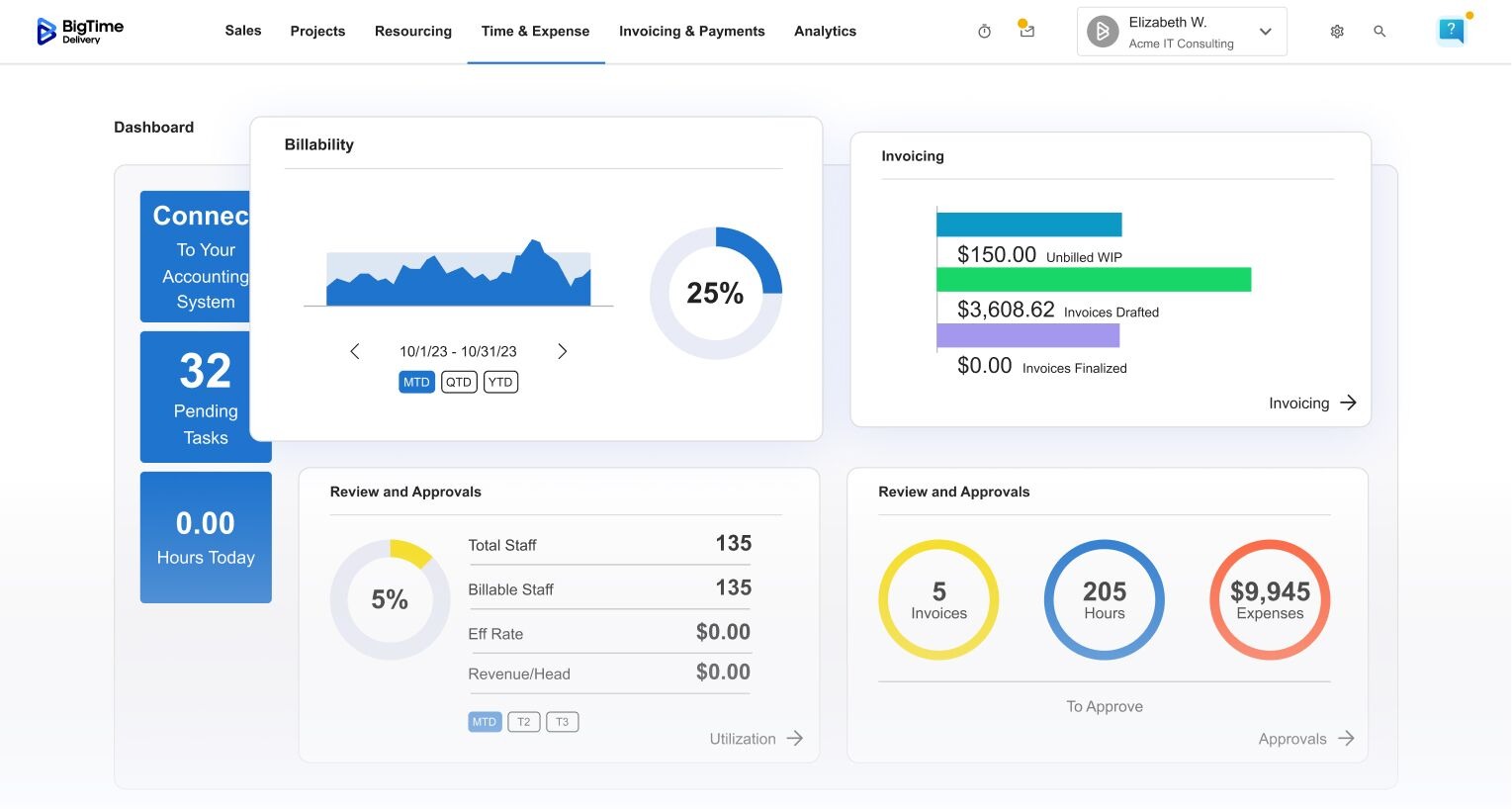
- Financial Reporting & Custom Dashboards. Live dashboards give finance directors and operations leaders real-time visibility into budget versus actuals, work in progress, and project profitability across the full portfolio, with no manual reconciliation required.
- QuickBooks & Accounting Software Integration. BigTime’s bi-directional QuickBooks integration is the most robust GL connection in the PSA category, eliminating double-entry and keeping your accounting software fully in sync with project-level financial data.
- Quoting & Sales Forecasting. BigTime Quotes grounds margin estimates in real cost and billing data, so projects start with the right financial structure and the handoff from sales to delivery is structured rather than manual.
- AI-Powered Insights. AVA, BigTime’s conversational AI assistant, lets your team surface reporting insights and ask plain-language questions about project and client data, helping you perfect your business plan and boost productivity.
Pricing
Free trial available. Paid plans start at $20 per user per month for the Essentials package. BigTime’s modular structure means you pay for what your firm actually needs, with no forced bundles.

Kantata
Reviews: G2: 4.2 stars, Capterra: 4.2 stars
Pros & Cons
Pros:
- Comprehensive feature set covering project management, resource planning, time tracking, and financial management.
- Strong reporting and analytics capabilities for firms that need detailed project visibility.
- Built specifically for professional services firms, with billing and budgeting tools included.
Cons:
- Steep learning curve due to the platform’s complexity, with significant setup effort required before it delivers value.
- Interface feels dated compared to more modern Accelo alternatives, which can hurt user adoption.
- Advanced features are locked behind higher-priced plans, making costs unpredictable as teams grow.
- Implementation typically takes months, not weeks, which means a longer wait before your team sees any return.
Kantata is a feature-rich PSA platform aimed at professional services firms that need detailed control over projects, resources, and finances. It covers a broad range of functionality, and for firms with the budget and patience to configure it properly, it can deliver strong results.
That said, Kantata demands a serious upfront investment of time, money, and internal resource before it becomes functional. Unlike faster-to-deploy Accelo alternatives, Kantata’s complexity means most firms require dedicated implementation support and thorough training just to reach baseline operability. For growing firms that need results in weeks rather than months, that timeline is a significant drawback, pushing the users towards Kantata alternatives.
Key Features
- Resource Planning. Allocate team members by skill and availability across active projects, though the depth of configuration required to make this work effectively adds to the platform’s overall setup burden.
- Time & Expense Tracking. Capture billable hours and project costs directly in the system, with data feeding into invoicing and financial reporting.
- Financial Management. Budgeting, invoicing, and billing tools provide end-to-end financial visibility, though many of the most useful capabilities require higher-tier plans.
- Reporting & Analytics. Detailed reporting across project profitability, utilization, and team performance, though generating meaningful reports often requires training and careful configuration.
Pricing
Custom pricing based on team size and required features. Kantata is typically positioned toward mid-sized to large professional services firms, and its pricing reflects that, making it a difficult fit for growing firms watching their software spend.
Teamwork
Reviews: G2: 4.4 stars, Capterra: 4.5 stars
Pros & Cons
Pros:
- Intuitive interface with a low barrier to entry, making it accessible for teams new to project management software.
- Solid client management features, including client onboarding tools and client communication tracking.
- Supports time tracking, project templates, and basic invoicing within the core platform.
- Affordable entry-level pricing with a free plan available.
Cons:
- Financial management capabilities are shallow, with limited support for project profitability tracking or complex billing structures.
- Resource management capabilities lack the depth professional services firms need as they scale.
- Reporting tools are basic compared to purpose-built PSA platforms, requiring manual workarounds for anything beyond standard summaries.
- Better suited to agencies managing client work than to firms that need rigorous financial controls.
Teamwork is a project management platform with a strong focus on work management and team collaboration. It is easy to get started with, and for smaller agencies managing straightforward projects, it covers the basics well enough. The problem is that it does not go much further than the basics.
For professional services businesses that need to track project profitability, manage complex rate structures, or connect project data to their accounting software, Teamwork falls noticeably short. It is a capable task management tool that has added some PSA-adjacent features over time, but the financial depth that growing firms need is not where this platform is built to compete.
Key Features
- Task Management. Assign tasks to team members, set due dates, and track progress across multiple projects with a clean, drag and drop interface.
- Time Tracking. Log time against tasks and projects, with basic reporting on hours worked and billable time, though the data does not flow as cleanly into financial management as it does in more finance-first platforms.
- Client Management. Manage client data, track client communication, and handle basic client onboarding within the platform, making it a reasonable fit for agency-style workflows.
- Project Templates. Pre-built and custom project templates speed up the setup of recurring project types, reducing repetitive tasks for project managers.
- Invoicing. Generate basic invoices from tracked time, though the invoicing functionality lacks the flexibility and automation features that professional services firms typically need at scale.
Pricing
Free plan available. Paid plans start at $5.99 per user per month, with advanced features available on higher tiers.
Scoro
Reviews: G2: 4.5 stars, Capterra: 4.6 stars
Pros & Cons
Pros:
- Broad all-in-one functionality covering project planning, resource management, CRM, automated billing, and reporting.
- Customizable dashboards give teams a flexible view of project tracking and financial health.
- Supports custom workflows and custom fields, making it adaptable to different service business models.
- Strong quoting and sales forecasting features for firms that want sales and delivery in one system.
Cons:
- Can feel overwhelming to set up, with a significant configuration burden before the platform delivers its full value.
- GL integration lacks the depth and reliability of financial-first PSA platforms, which is a meaningful gap for finance-led teams.
- Pricing escalates quickly as teams grow and require access to advanced features.
- Better suited to smaller service businesses than to firms with complex, multi-project financial management needs.
Scoro positions itself as a comprehensive business management platform, and on paper it covers a lot of ground. Project management, time tracking, CRM, invoicing, and reporting all sit within one system, which makes it an appealing option for small to mid-sized professional services businesses that want to reduce the number of tools they manage.
In practice, though, Scoro’s breadth comes at the cost of depth. Its financial management capabilities are functional but not built around the general ledger, which means firms that need clean, auditable connections between project data and their accounting software will find gaps. For service businesses with straightforward needs, it works. For firms where financial precision is non-negotiable, it tends to fall short.
Key Features
- Project Planning & Management. Manage project timelines, budgets, and task assignments with Gantt charts and Kanban boards, supporting multiple views across active projects.
- Resource Management. Plan team capacity and manage allocations across projects, though the financial depth of resource utilization reporting is limited compared to purpose-built PSA platforms.
- Automated Billing. Generate invoices automatically based on tracked time and project milestones, with support for recurring billing and multiple contract types.
- CRM & Contact Management. Manage client data, track sales pipelines, and handle client communication within the platform, connecting sales activity to project delivery.
- Reporting & Customizable Dashboards. Build custom dashboards to track team performance, project profitability, and financial health, with real-time data across your portfolio.
Pricing
No free plan. Paid plans start at $26 per user per month, with advanced features available on higher tiers. Costs can add up quickly for growing teams.
Wrike
Reviews: G2: 4.2 stars, Capterra: 4.3 stars
Pros & Cons
Pros:
- Highly configurable with strong project planning tools and multiple project views.
- Robust workflow automation and custom workflows reduce repetitive tasks across large teams.
- Supports team collaboration across complex, multi-project environments.
- Enterprise-grade security and access controls for firms with compliance requirements.
Cons:
- Not built for professional services automation, with limited support for billing, invoicing, or project profitability tracking.
- Steep learning curve, particularly for teams new to highly configurable project management tools.
- Financial management capabilities are minimal, making it a poor fit for firms where billing accuracy drives revenue.
- Advanced reporting and resource management features are locked behind higher-priced plans.
Wrike is a powerful project management platform, and for teams that need granular control over workflows, task dependencies, and cross-team collaboration, it delivers. The problem for professional services firms is that Wrike was not built with their specific needs in mind.
Time tracking, automated billing, and project profitability visibility are not core strengths here. Wrike can manage projects, but it cannot manage the financial side of those projects with any meaningful depth. For firms looking for a true Accelo alternative that addresses billing accuracy and margin visibility, Wrike leaves a significant gap.
Key Features
- Custom Workflows. Design detailed approval and task workflows tailored to your team’s processes, with rule-based automation reducing manual updates across projects.
- Resource Management. Track team workloads and manage capacity across active projects, though the financial connection between resource decisions and project profitability is limited.
- Multiple Project Views. Gantt charts, Kanban boards, calendars, and tables give teams flexibility in how they visualize and manage project progress.
- Workflow Automation. Reduce repetitive tasks with automated triggers and notifications, keeping teams aligned without constant manual intervention.
- Reporting & Dashboards. Customizable dashboards track team performance and project status, though advanced reporting requires higher-tier plans.
Pricing
Free plan available. Paid plans start at $9.80 per user per month, with advanced features available on Business and Enterprise tiers.
HubSpot
Reviews: G2: 4.4 stars, Capterra: 4.5 stars
Pros & Cons
Pros:
- Industry-leading CRM with powerful contact management, sales automation, and client communication tools.
- Strong sales forecasting and pipeline visibility for teams with an active new business focus.
- Extensive integration ecosystem connecting to hundreds of third-party tools.
- User-friendly interface with relatively fast user adoption compared to more complex platforms.
Cons:
- Not a professional services automation platform. Project management, time tracking, and invoicing are not core capabilities.
- No meaningful support for resource management, project profitability, or automated billing within the core platform.
- Costs escalate sharply as teams grow and require access to advanced features across multiple hubs.
- Firms using HubSpot as an Accelo alternative will need additional tools to cover the operational gaps it leaves open.
HubSpot is one of the best CRM and sales automation platforms available, and for service businesses that prioritize client management and new business development, it is genuinely excellent. As an Accelo alternative for professional services operations, though, it is the wrong tool for the job.
Project delivery, time tracking, resource planning, and cost management are not what HubSpot was built for. Firms that use it as a primary operations platform tend to find themselves building a patchwork of integrations to cover the gaps, which adds cost and complexity without solving the underlying problem. If your priority is managing the financial and operational side of client work, HubSpot is not the answer.
Key Features
- CRM & Contact Management. Track client data, manage relationships, and maintain a full history of client communication in one centralized system.
- Sales Automation. Automate follow-ups, deal stage updates, and pipeline management tasks to keep the sales process moving without manual effort.
- Sales Forecasting. Real-time pipeline reporting and revenue forecasting give sales leaders visibility into projected revenue across active and pending deals.
- Client Communication Tools. Email tracking, meeting scheduling, and shared inboxes keep client communication organized and accessible across the team.
- Reporting & Dashboards. Customizable dashboards surface sales performance, pipeline health, and team activity, though operational and financial reporting for project delivery is not available.
Pricing
Free plan available. Paid plans start at $15 per user per month for the Starter tier, with costs increasing significantly across Professional and Enterprise plans as additional hubs are added.
Rocketlane
Reviews: G2: 4.5 stars, Capterra: 4.7 stars
Pros & Cons
Pros:
- Modern, clean interface designed specifically for client-facing project delivery and client onboarding.
- Strong project visibility tools with shared client portals that improve transparency during delivery.
- Good team collaboration features for managing client work across distributed teams.
- Fast to set up for teams with straightforward onboarding and delivery workflows.
Cons:
- Built primarily for client onboarding and delivery workflows, not for the financial management needs of professional services firms.
- Limited resource management capabilities and no meaningful support for project profitability tracking.
- Automated billing and invoicing features are basic compared to PSA platforms purpose-built for professional services.
- Not a strong fit for firms where billing accuracy, utilization tracking, and GL integration are operational priorities.
Rocketlane is a well-designed platform for teams that want to deliver a polished, client-facing project experience. Its shared portals, structured onboarding workflows, and clean interface make it a popular choice for SaaS implementation teams and professional services groups focused on client onboarding.
As a broader Accelo alternative for professional services firms that need to manage the full project lifecycle, including resource planning, financial management, and billing, Rocketlane’s scope is too narrow. It handles the delivery layer well but leaves the financial and operational layer largely unaddressed, which means growing firms will quickly find themselves reaching for additional tools to fill the gaps.
Key Features
- Client Onboarding & Project Management. Structured onboarding workflows and project templates help teams deliver a consistent, professional experience across client engagements.
- Client Portals. Shared portals give clients real-time visibility into project progress, reducing back-and-forth communication and keeping expectations aligned throughout delivery.
- Team Collaboration. Task assignments, comments, and status updates keep internal teams and clients aligned without relying on email chains.
- Project Visibility & Reporting. Track project progress and team performance across active engagements, though financial reporting and project profitability tracking are limited.
- Time Tracking. Log time against project tasks, with basic reporting available, though the data does not connect to invoicing or financial management with the depth that professional services firms typically need.
Pricing
Paid plans start at $19 per user per month. No free plan is available, though a free trial allows teams to evaluate the platform before committing.
Which Accelo Alternative Is the Best?
When you weigh up the options, the differences come down to one foundational question: do you need a platform that manages projects, or one that manages the financial reality of those projects? Most Accelo alternatives do the former reasonably well. Very few do the latter with any depth.
BigTime is built around the second answer. For professional services firms where billing accuracy, project profitability, and cash flow visibility are operational necessities, BigTime’s financial-first architecture gives you a single system where every resource decision, time entry, and invoice inherits the same financial logic, grounded in the general ledger you already trust.
With an in-house implementation team, a proven playbook built across 3,000+ deployments, and a modular structure that grows with your firm, BigTime gives professional services businesses the financial precision they need at the growth stage where it matters most. Book a demo to see it in action.

Frequently Asked Questions
What is the best Accelo alternative?
BigTime. While Accelo is delivery-first, BigTime is built around financial precision, connecting time tracking, resource management, invoicing, and reporting in one system grounded in your general ledger. For firms where billing accuracy and project profitability are priorities, nothing else in this list comes close.
What is the best Accelo alternative for small and medium-sized companies?
BigTime. Its modular structure lets smaller firms start with what they need and expand as they grow, without re-platforming. The 30 to 90 day go-live timeline makes it accessible for teams that cannot afford a lengthy onboarding process.
How long does BigTime take to implement compared to Accelo?
BigTime’s in-house implementation team delivers a fully operational system in 30 to 90 days, using a structured playbook built across 3,000+ deployments. Accelo’s timeline varies and relies more heavily on self-serve configuration, which tends to extend the process for firms with complex billing needs.
What features missing from Accelo does BigTime have?
BigTime offers bi-directional QuickBooks integration built around the general ledger, real-time project profitability tracking, AI-powered billing anomaly detection, a dedicated quoting module, and an in-house implementation model built for fast, high-adoption go-lives.
How does BigTime compare to Accelo for professional services firms?
Accelo handles client management, task management, and basic billing well enough for smaller teams. BigTime operates at a different level of financial depth, with real margin control, accurate invoicing across complex contract types, and trusted data connected directly to your accounting software.
Which Accelo alternatives integrate with QuickBooks or other accounting software?
BigTime offers the most robust integration of any platform in this comparison. Its bi-directional connection with both QuickBooks Desktop and QuickBooks Online is audit-ready and built into the platform’s architecture, keeping your general ledger fully in sync with project-level financial data in real time.
How do Accelo’s key features compare to BigTime?
Accelo covers the basics: client management, time tracking, project management, and recurring billing. BigTime goes further on every dimension that matters to growing firms, with deeper GL integration, stronger resource management, real-time profitability visibility, and an AI layer that catches margin risk before it becomes a problem.