Most architecture firms don’t lose money on design. They lose it in the gaps: unbilled site visits, scope creep during construction administration, and project budgets scattered across spreadsheets and disconnected digital tools nobody trusts by week six. In 2026, with tighter fees and clients expecting real-time answers, those gaps cost more than ever.
The right project management software for architects closes them. By the end of this guide, you’ll know which platforms protect your margins, which features matter for architectural projects, and which system fits how your firm actually delivers architecture projects. For this ranking, we focused on the pain points that come up most often when architecture firms compare project management tools:
- Phase-based tracking: planning and progress tracking across schematic design, design development, and construction administration phases.
- Financial visibility: budget tracking, project profitability, and a dependable link to accounting software.
- Time tracking people actually use: fast entry that keeps billable hours accurate without weekly chasing.
- Resource management: a forward view of capacity across multiple projects.
- Adoption: an intuitive interface your project team picks up without a six-month rollout.
What Is Project Management Software for Architects?
Architecture firms balance creative work against hard financial constraints. Every project moves through defined phases, involves multiple team members and consultants, and succeeds only if hours match the fee. Generic project management tools rarely reflect that reality, which is why architects turn to specialized tools built for the job.
Project management software for architects is a system that helps architectural firms plan, track, and deliver projects by connecting design phases, tasks, time, resources, and budgets in one place. Instead of running project schedules, timesheets, and financials in separate apps, architectural project management software keeps project data unified so project managers can see progress and profitability side by side. In practice, firms use the project management capabilities of this type of management software to plan project phases and assign tasks, track time against specific architecture projects, monitor budget burn in real time, manage resources across the project team, and connect project accounting with the accounting software they already run.
The Benefits of Architecture Project Management Software
A dedicated platform does more than tidy up task management. It changes how confidently you can run the practice, with the biggest gains showing up in four areas:
- Real-Time Visibility Into Every Project. When project schedules, time tracking, and budget tracking live in a unified system, project managers stop reconstructing project status from memory and email threads. They can see project health at a glance.
- Stronger Project Profitability. Architecture firms run on fixed fees more than most professional services businesses, which makes margin discipline essential. Tying hours to phases and phases to budgets means project profitability is measured while work happens, not after the final invoice goes out.
- Cleaner Billing & Faster Cash Flow. Firms that adopt this kind of platform typically report fewer unbilled hours, faster invoicing, and cleaner month-end closes, because project data flows into project financial management instead of sitting in disconnected tools.
- Less Administrative Drag. Automated timesheet reminders, reusable project templates, built-in progress tracking, and reporting that builds itself all return hours to billable work. For a firm where utilization drives revenue, that recovered time compounds quickly.
What Features Should the Best Project Management Software for Architects Have?
Not every platform marketed to architecture and engineering firms can support how architectural projects actually run. The project management features below separate lightweight task management from true architecture project management software that can carry a firm through growth.
Phase-Based Project Planning & Scheduling
Architecture projects follow a structure that generic tools ignore. The best project management software for architects lets you build plans around phases, set fee budgets per phase, and adjust project timelines when scope shifts. Gantt charts and milestone views help you follow project progress, but the deeper requirement is that the plan connects to time, billing, and reporting, so the schedule reflects financial reality rather than just a sequence of tasks.
Time Tracking Built Into Daily Workflow
Accurate time entry is the foundation of both billing and project performance data. Look for multiple entry methods (timers, weekly grids, mobile), phase-level coding that isn’t overwhelming, and approval workflows that protect billing accuracy. If your team can’t track time in under a minute a day, compliance drops and every downstream number gets less reliable.
Budget Tracking & Project Profitability Reporting
A strong platform shows budget versus actuals by phase while the work is in motion, flags cost overruns early, and reports margin by project, client, and service type. This is where many design-first tools fall short: they show task completion, not financial health. For firms trying to maintain profitability on fixed fees, live burn visibility is the feature that pays for the software.
Resource Management & Capacity Planning
Resource planning answers the question every studio director asks weekly: who can take this on? The right system shows availability by role and date, accounts for PTO and internal work, and helps you balance workloads across multiple projects. Better platforms connect resource allocation to financial forecasting, so staffing decisions reflect both capacity and revenue impact.
Project Accounting & Invoicing
Invoicing in architecture is rarely simple: fixed fees, hourly phases, percent-complete billing, reimbursable expenses, and consultant pass-throughs often appear on a single invoice. The best systems generate invoices directly from approved time and expenses, support flexible billing structures, and keep an audit trail finance can trust.
Integration With Accounting Software
Your project management platform should feed your general ledger, not fight it. Deep, bi-directional integration with accounting software like QuickBooks reduces double entry, keeps financial records consistent, and shortens month-end close. Treat integration depth as a make-or-break criterion, not a checkbox.
Collaboration & Reporting
Collaboration features such as shared dashboards, task comments, and document links keep multiple team members aligned and make it easy to track progress, while configurable reporting gives principals answers without spreadsheet work. Good team collaboration also extends outward: client communication and consultant coordination stay tied to project records, so the whole project team works from a single source of truth.
2026 Project Management Software for Architects Ranking
This ranking evaluates platforms on the criteria that determine whether architecture firms deliver projects on time and at margin: phase-based planning, time and expense capture, budget tracking, resource management, invoicing, and accounting integration. We reviewed each system’s fit for architecture project management specifically, weighing G2 and Capterra feedback from project managers alongside pricing transparency and adoption effort. The result is a shortlist for firms that want more than task management: a system that connects project delivery to the financial side of the practice.
Project Management Software for Architects: Comparison
| Tool | Key Features | Best For | Pricing | G2 / Capterra |
| BigTime | Time & expense tracking, phase-based budgeting, flexible invoicing, resource management, deep QuickBooks integration, profitability reporting | Architecture firms that want project delivery and financial management connected | From $20/user/month | 4.5 / 4.6 |
| Monograph | Phase-based planning, timesheets, fee forecasting, simple resourcing | Small studios wanting a design-friendly planner | From ~$45/user/month | 4.4 / 4.5 |
| BQE Core | Time & billing, project accounting, HR add-ons | AEC firms wanting an all-in-one back office | Quote-based, modular | 4.3 / 4.5 |
| Deltek Ajera | Integrated project accounting, earned value, dashboards | Established A&E firms with dedicated accounting staff | Quote-based | 3.6 / 3.6 |
| Newforma Project Center | Document control, RFIs, submittals, email management | Firms prioritizing construction administration documents | Quote-based | 4.2 / 4.2 |
| Monday.com | Visual boards, automations, templates | Teams wanting flexible general-purpose work management | Free plan; from ~$9/seat/month | 4.7 / 4.6 |
| Asana | Task management, timelines, workload view | Firms needing lightweight task coordination | Free plan; from ~$10.99/user/month | 4.3 / 4.5 |
| Smartsheet | Spreadsheet-style project sheets, Gantt charts, dashboards | Spreadsheet-heavy teams formalizing project tracking | From ~$9/user/month | 4.4 / 4.5 |
BigTime
Reviews: G2: 4.5, Capterra: 4.6.
Pros & Cons
Pros:
- Connects project delivery to firm financials in one flow. Time tracking, expenses, project budgets, rates, and invoicing work together in one unified system, so project managers see progress and principals see profitability from the same trusted project data.
- Phase-level budget tracking that catches drift early. Budgets update as time is entered, so budget versus actuals is visible during design development, not discovered after construction administration wraps.
- The strongest QuickBooks integration in its class. Bi-directional, audit-ready sync with both QuickBooks Online and Desktop keeps financial records consistent without manual reconciliation.
- Fast adoption, fast go-live. Quick, familiar time entry plus an in-house implementation team typically means going live in 30 to 90 days, with room to add resource management and deeper analytics as the firm grows.
Cons:
- Not a design or document management platform. BigTime focuses on the operational and financial side of architectural project management; firms needing CAD integration or drawing-set version control will pair it with their existing design stack.
BigTime is a PSA platform built for project-based professional services firms, and it earns the top spot because it solves the problem that hurts architecture firms most: the disconnect between project work and project money.
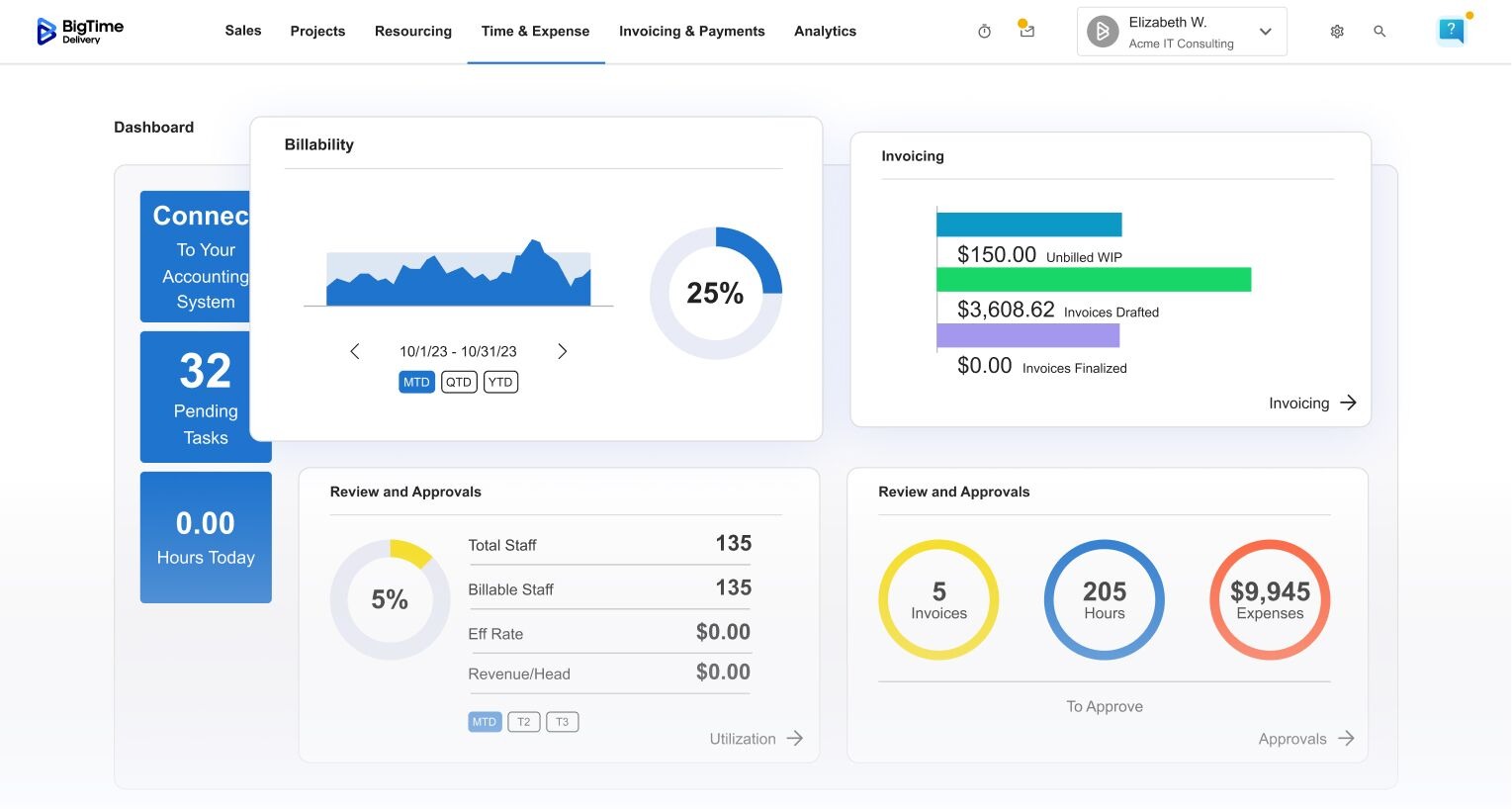
When hours, expenses, consultant costs, and fee burn live in separate systems, project managers fly blind and finance rebuilds reality in spreadsheets every month. BigTime keeps the entire chain connected, from project planning and time entry through approvals, invoicing, and the general ledger, so a principal can see which projects are healthy, which are burning fee too fast, and where utilization is trending, and maintain profitability across the project portfolio without waiting for month-end.
BigTime also respects how growing firms adopt software: it’s a flexible platform, modular by design, straightforward to learn, and built on the QuickBooks setup most firms already trust instead of replacing it. For practices that have outgrown lightweight trackers but have no appetite for an ERP-style overhaul, it’s the natural next step.
Key Features
- Time & expense tracking: Multiple entry methods with phase-level coding and approval workflows keep billable hours accurate and audit-ready.
- Project budgeting & profitability: Live budget versus actuals by phase, with margin and project performance reporting that shows financial health while work is in motion.
- Flexible invoicing: Invoices generate directly from approved time and expenses, supporting fixed fee, hourly, percent-complete, and mixed billing structures common in architecture.
- Resource management: Availability, workload, and utilization views support smarter resource allocation across multiple projects, with staffing plans that inherit real cost and rate data.
- QuickBooks & accounting integration: Bi-directional sync keeps time, invoices, and payments aligned with the general ledger, cutting double entry and shortening month-end close.
Pricing
BigTime Essentials starts at $20 per user/month, with Advanced, Premier, and Enterprise tiers adding deeper rate controls, resourcing, and analytics. A free personalized demo is available.
Monograph
Reviews: G2: 4.4, Capterra: 4.5.
Pros & Cons
Pros:
- Designed around how architects plan work. Everything is structured by phase and fee, so project planning feels native to architectural practice.
- Approachable, visual interface. Timesheets, project timelines, and fee forecasts are presented clearly, which helps small studios adopt it without training resistance.
Cons:
- Financial depth thins out as firms grow. Firms with complex billing structures, consultant markups, or heavier project accounting needs often end up supplementing it with other systems.
- Basic resource management and reporting. Capacity views suit small teams, but leaders wanting deeper analytics on utilization and margin drivers hit the ceiling sooner than expected.
Monograph is architecture project management software in the most literal sense: built by architects, for architecture firms, with a vocabulary of phases, fees, and timesheets that matches how studios balance creative vision with fee reality. For a small architectural firm moving off spreadsheets, that familiarity is a real advantage. The trade-off is depth. As firms grow, the questions get harder: which clients are profitable, how consultant costs affect margin, whether utilization justifies the next hire. Monograph provides a solid operational layer, but it isn’t a full financial system, and firms needing tight accounting integration and rigorous project accounting often outgrow it.
Key Features
- Phase-based project planning: Projects are structured by phase with fees and timelines attached, matching how architectural work is scoped.
- Timesheets & fee forecasting: Time entry tied to phases feeds visual planned-versus-actual fee views, useful for spotting trouble on fixed-fee work.
- Basic resourcing: Team workload views help with near-term staffing for smaller teams.
Pricing
Paid plans start at roughly $45 per user/month based on third-party listings, with details typically confirmed through a sales conversation.
BQE Core
Reviews: G2: 4.3, Capterra: 4.5.
Pros & Cons
Pros:
- Broad back-office coverage for AEC firms. Time and billing, project accounting, and optional human resources and customer relationship management modules appeal to firms wanting fewer systems.
- Industry familiarity. A long history with architecture and engineering firms means its billing structures reflect common A&E conventions.
Cons:
- Complexity accumulates quickly. The breadth of modules brings configuration overhead, and reviewers regularly mention a learning curve that slows adoption across billable staff.
- Interface and performance complaints are common. Users cite occasional sluggishness and dated workflows, which affects daily time entry compliance.
- Modular, opaque pricing. Costs depend on licensed modules, making comparison difficult and total spend easy to underestimate.
BQE Core positions itself as an all-in-one platform for architecture and engineering firms, spanning time tracking, billing, accounting, and management features. For firms wanting a single vendor across the back office, that scope is attractive.
The challenge is that breadth comes at the cost of simplicity: setup takes real effort, staff need meaningful training before time entry becomes routine, and some modules feel less polished than others. For practices that want fast adoption and a focused workflow connecting delivery to financials, Core can feel like more system than the team will actually use.
Key Features
- Time & expense tracking: Multiple entry options with billing rules attached, though the depth of settings can overwhelm casual users.
- Project accounting: Tracks project financials alongside firm accounting, with results that depend heavily on configuration quality.
- Billing & invoicing: Supports diverse A&E contract structures, from hourly to percent-complete.
Pricing
Quote-based and modular; expect per-user pricing that varies with the modules selected.
Deltek Ajera
Reviews: G2: 3.6, Capterra: 3.6.
Pros & Cons
Pros:
- Purpose-built project accounting for A&E firms. Project management and accounting share one database, supporting rigorous financial control when run well.
- Strong financial reporting. Disciplined firms get detailed insight into earned value, project performance, and firm financial health.
Cons:
- Dated user experience. The interface is a frequent complaint, and daily tasks like time entry can feel cumbersome, which undermines adoption among design staff.
- Requires dedicated administration. Ajera works best with in-house accounting expertise; firms without it struggle to keep the system clean, and review scores sit well below the alternatives here.
Deltek Ajera comes from the ERP tradition: a tightly integrated project accounting system designed for architecture and engineering firms. Its strength is financial rigor, since project and accounting data reconcile by design.
The cost of that rigor is weight. Ajera demands accounting knowledge, ongoing administration, and tolerance for an interface many users find outdated. It remains a reasonable fit for established firms with dedicated finance staff, but growing practices that want quick adoption and low admin overhead usually want something lighter.
Key Features
- Integrated project accounting: Project and financial data live in one system, eliminating reconciliation between separate tools.
- Earned value tracking: Detailed performance measurement for firms managing against formal budgets and schedules.
- Dashboards & reporting: Role-based visibility into project and firm metrics, though configuration typically needs specialist knowledge.
Pricing
Quote-based; total cost typically includes implementation and ongoing support services.
Newforma Project Center
Reviews: G2: 4.2, Capterra: 4.2.
Pros & Cons
Pros:
- Excellent document and information management. Newforma organizes the enormous volume of drawings, emails, RFIs, and submittals architectural projects generate.
- Strong construction administration support. Contract administration workflows, transmittals, and project email filing solve real, persistent pains in architectural practice.
Cons:
- Not a financial management system. No time tracking, project budgets, invoicing, or profitability, so firms need entirely separate systems for the business side.
- Focused on information, not planning. Resource management, project scheduling, and task management are not strengths, limiting its role as a primary project management platform.
Newforma Project Center is best understood as project information management for architecture and engineering firms. Its core competency is organizing project records: emails, drawings, RFIs, submittals, and the correspondence trail that keeps architects and construction teams aligned throughout the construction process, especially during construction administration phases. For firms drowning in documentation, it addresses a problem most platforms in this ranking ignore. But it won’t tell you whether a project is on budget, who has capacity next month, or how utilization trended this quarter. Treat it as a complement to architectural project management software, not a substitute.
Key Features
- Project email management: Files correspondence against project records automatically, creating a searchable communication archive.
- RFI & submittal tracking: Structured construction administration workflows keep contract deliverables moving and documented.
- Document control: Version management and transmittals for large drawing sets and project files.
Pricing
Quote-based, typically licensed at the firm or project level rather than simple per-user tiers.
Monday.com
Reviews: G2: 4.7, Capterra: 4.6.
Pros & Cons
Pros:
- Highly flexible and visual. Boards, timelines, and automations can be shaped to almost any workflow, and templates plus drag and drop functionality mean a team can be running in days.
- Good collaboration features. Comments, notifications, and shared views keep multiple team members aligned on task-level work, and boards can even be shared with client users for visibility.
Cons:
- No architectural or financial DNA. Monday.com knows nothing about phases, fees, project accounting, or utilization; everything must be built manually and maintained by someone at the firm.
- Costs and sprawl grow with scale. Meaningful capabilities like time tracking sit in higher tiers, and without governance, flexible boards drift into inconsistency that weakens reporting.
Monday.com is a strong general-purpose work management platform, and architecture firms usually adopt it for internal coordination: tracking tasks, deadlines, and responsibilities with a visual clarity spreadsheets can’t match. The limitation is that it manages work, not a practice. There’s no concept of fee budgets, billable rates, or project profitability, and its time tracking is a lightweight add-on rather than a billing-grade system. It works best as a task layer alongside a financial-first platform, or as a starting point for very small studios with simple needs.
Key Features
- Customizable boards: Flexible structures for tasks, projects, and workflows, adaptable to almost any internal process.
- Timeline & Gantt views: Visual project schedules that help teams track progress and dependencies at a glance.
- Automations: Rule-based automation reduces manual updates once configured; basic time tracking is available on higher tiers.
Pricing
Free plan for up to two seats; paid plans start around $9 per seat/month billed annually, with time tracking and advanced features on Pro and above.
Asana
Reviews: G2: 4.3, Capterra: 4.5.
Pros & Cons
Pros:
- Clean, proven task management. Tasks, dependencies, and deadlines are handled with a polish that supports adoption across mixed teams.
- Multiple project views. Lists, boards, timelines, and calendars let different roles see project schedules the way they prefer.
Cons:
- No financial layer at all. Budgets, fees, invoicing, and project profitability are outside Asana’s scope, so the business side of the practice lives elsewhere.
- Generic by design. Phase structures, consultant coordination, and A&E billing conventions must be improvised, and billing-grade time data typically means bolting on another product.
Asana is one of the most widely used project management tools in the world, and its strengths translate to architecture firms that need dependable task coordination across multiple team members. What this project management app doesn’t do is understand an architecture firm: there’s no notion of fee phases, utilization, or budget burn, and no path from a logged hour to a client invoice. For studios whose bottleneck is purely organizational, it’s a sensible, affordable choice. For firms whose real problem is financial visibility and margin control, it addresses the wrong layer of the problem.
Key Features
- Task & project management: Assign tasks with due dates and dependencies to keep delivery work organized across the project team.
- Timeline view: Gantt-style scheduling for planning project phases and spotting conflicts.
- Workload management: Capacity visualization across the team, based on task assignments rather than true resource planning.
Pricing
Free plan for small teams; Starter begins around $10.99 per user/month billed annually, with Advanced tiers adding workload and reporting features.
Smartsheet
Reviews: G2: 4.4, Capterra: 4.5.
Pros & Cons
Pros:
- Familiar spreadsheet paradigm. Teams comfortable in Excel adapt quickly, keeping training needs low while adding real project structure.
- Capable scheduling and dashboards. Gantt charts, dependencies, and roll-up dashboards support serious project tracking across portfolios.
Cons:
- Financial management is manual. Budget tracking is whatever formulas you build; there’s no native project accounting, rate logic, or invoicing, and time tracking requires add-ons.
- Maintenance burden grows with use. Sheet sprawl, permission complexity, and formula upkeep quietly consume admin time as the firm scales.
Smartsheet occupies a middle ground: more structured than a spreadsheet, less opinionated than purpose-built architectural project management software. Firms already running projects in Excel often find it a natural upgrade, gaining Gantt charts, workflows, and dashboards for tracking project progress without abandoning grid-based thinking.
The constraint is that Smartsheet gives you building blocks, not a system. Everything specific to architectural practice, from phase budgets to utilization reporting, must be constructed and maintained by hand, and the financial side of the practice still lives somewhere else.
Key Features
- Grid, Gantt, and card views: Flexible representations of project schedules built on a spreadsheet foundation.
- Automated workflows: Approval requests, alerts, and update requests reduce manual chasing once configured.
- Dashboards & reports: Roll-up visibility across projects for leadership, dependent on consistent sheet structure.
Pricing
Paid plans start around $9 per user/month billed annually, with business tiers and add-ons (including resource management) increasing total cost.
Which Project Management Software for Architects Is the Best?
Compare these platforms side by side and a pattern emerges. Design-friendly tools like Monograph make planning approachable but run out of financial depth. General-purpose platforms like Monday.com, Asana, and Smartsheet organize tasks well but know nothing about fees, phases, or profitability. Legacy A&E systems like Ajera bring financial rigor at the price of adoption and agility. Project success in 2026 belongs to firms whose software connects both sides: how projects get delivered and how the practice makes money.
That’s why BigTime is the best choice for architecture firms that treat project management and financial management as one discipline. It keeps time, budgets, resources, and invoicing in a single flow, gives principals real-time visibility into project profitability, and builds on the QuickBooks foundation most firms already trust. Teams adopt it quickly, finance relies on it confidently, and the platform grows with the firm instead of forcing a re-platforming decision every few years.
If you want to see how BigTime fits your firm’s workflows, book a free personalized demo.

Project Management Software for Architects: FAQ
What Is Project Management Software for Architects?
Project management software for architects is a system that helps architectural firms plan, track, and manage projects end to end by connecting phases, tasks, time tracking, resource allocation, and budgets in one place. It replaces the patchwork of spreadsheets and disconnected tools many firms rely on, giving project managers real-time visibility into project status and giving leadership dependable data on utilization and project profitability.
What Is the Best Project Management Software for Architects?
BigTime is the best project management software for architects because it connects project delivery to the financial side of the practice. Where most platforms stop at task tracking, BigTime ties time, phase budgets, rates, and invoicing together, so firms protect margin while work happens rather than discovering problems at project close. Combined with fast adoption and the strongest QuickBooks integration in its category, it delivers value from the first billing cycle.
What Is the Best Project Management Software for Architects at Medium-Sized Companies?
For mid-sized architecture firms, typically those between 30 and 250 people, BigTime is the strongest choice. Firms of this size have outgrown lightweight trackers but rarely have the budget or appetite for enterprise-grade systems that take six months to implement. BigTime fits that middle ground precisely: enough financial rigor for a growing practice, modular enough to adopt in stages, and simple enough that the whole team actually uses it.
What Is the Best Project Management Software for Different Industries?
BigTime is the best option across the project-based industries it serves:
- IT companies: connects delivery work to billing and utilization, protecting margins on both T&M and fixed-fee engagements.
- Engineering firms: phase-based budgets and rate controls match how engineering work is scoped, delivered, and billed.
- Consulting companies: consulting firms rely on BigTime to tie staffing, time, and invoicing into one flow, cutting revenue leakage and speeding the billing cycle.
- Professional services firms in general: a purpose-built PSA platform that scales from core time and billing to full resource planning and analytics as firms grow.
What Is the Best Project Management Software That Integrates With QuickBooks?
BigTime. It offers bi-directional, audit-ready integration with both QuickBooks Online and QuickBooks Desktop, keeping time, invoices, and payments synchronized with the general ledger. Rather than treating accounting as an export destination, BigTime is built around the GL, which eliminates double entry and keeps financial records consistent as the firm scales.
Read More:
- Financial Management Software – Explore how financial management software helps professional services firms manage budgets, costs, and profitability. Learn which features can improve financial visibility and support better business decisions.
- Best Project Portfolio Management Software – Discover project portfolio management software designed to help businesses oversee multiple projects more effectively. Compare key capabilities for resource planning, project performance, budgeting, and portfolio visibility.
- Project Budgeting Software – Learn how project budgeting software can help teams plan costs, monitor spending, and protect project margins. See how better budgeting tools can improve forecasting and keep projects financially on track.
- Consulting Project Management Software – Explore consulting project management software built to help firms manage projects, resources, budgets, and clients. Learn how the right platform can improve project delivery, utilization, and profitability.