
Certinia PSA is powerful. It is also built entirely inside Salesforce, and for professional services firms that don’t want their project delivery, financial management, and resource planning governed by CRM infrastructure, that is a significant limitation. That’s what pushes them towards Certinia alternatives.
The PSA software market is growing fast, and the best Certinia alternatives today deliver the same financial visibility and project accounting depth without the Salesforce dependency, the steep learning curve, or the implementation costs that come with it. In this article, we will compare the alternatives to Certinia that do all that – and more – while recieving glowing reviews from the users in professional services companies.
Why Professional Services Firms Look for Certinia Alternatives
Certinia works well in one scenario: Salesforce is your operational backbone, IT owns PSA governance, and your organization has the budget for enterprise-level complexity. Outside of that, the limitations surface fast.
The biggest pain point is administrative dependency. Any meaningful change to reporting, approval workflows, or delivery workflows typically requires a Salesforce admin. For services teams that need to move fast, waiting on CRM governance cycles is a structural bottleneck, not a feature gap.
Total cost of ownership catches firms off guard, too. Certinia pricing stacks on top of Salesforce licenses, sandbox costs, and ongoing admin resources. For mid-market professional services firms watching margins closely, that compound cost adds up well beyond initial estimates.
Then there is adoption. Project managers working inside a Salesforce-native PSA are, in practice, working inside a CRM for professional services. The user interface and data model reflect that. Time tracking discipline drops when the system feels like it was built for a sales team.
For firms where services needs to own and run the business without heavy infrastructure dependency, there are better options available. But what should they include in the first place?
What Features Should the Best Certinia Alternatives Have?
Not every Certinia alternative will close the gaps that matter most to professional services firms. To make a real upgrade, you need a platform built around the full project lifecycle, with financial management at its core. Here are the features worth prioritizing.
Financial Management & Revenue Recognition
For professional services firms, financial precision is not optional. The right platform should give your finance team real-time visibility into project profitability, WIP balances, and revenue recognition without requiring a separate accounting system or manual data entry to reconcile the two. Look for a platform where billing rules and general ledger sync are built into the core, not bolted on through a third-party integration.
Project Management & Project Delivery
Every professional services organization runs projects differently, but the fundamentals are the same: budgets need to be tracked, project milestones need to be monitored, and scope creep needs to surface before it becomes a write-off. A strong Certinia alternative should give project managers real-time visibility into project budget versus actuals, with project health dashboards that reflect what is actually happening on the ground, not what was true at last month’s close.
Resource Management & Resource Planning
Utilization is one of the most direct levers on profitability, and most firms are leaving points on the table. The best Certinia alternatives include resource scheduling tools that let you match people to projects based on skills and availability, plan capacity weeks or months ahead, and identify gaps before they affect delivery.
Time Tracking & Expense Management
Unbilled hours are lost revenue. A PSA platform worth switching to should make time tracking as frictionless as possible for consultants and project managers alike, with expense management workflows built into the same system. The less friction in the time entry process, the better your data quality, and the faster your billing cycles.
Reporting & Financial Reporting
End-of-month reporting marathons are a symptom of disconnected systems. The right platform should let finance teams and operations leaders pull real-time reports on utilization rates, margin, financial forecasting accuracy, and project delivery without waiting for a data analyst or exporting to spreadsheets. Customizable executive dashboards and automated reporting save hours every week across your entire finance team.
Integration with Accounting Systems
Professional services firms run on QuickBooks, Sage, or similar accounting systems, and a PSA platform should work with them, not around them. Look for bi-directional integration that keeps your general ledger in sync without manual reconciliation. For many mid-market firms, the quality of the accounting system integration is a make-or-break factor in the final decision.
Implementation Simplicity & Time to Value
A PSA platform that takes twelve months to implement is not solving your problem fast enough. The best Certinia alternatives offer a clear, structured onboarding process with realistic go-live timelines and a user-friendly interface that drives adoption without heavy training investment. Fast time to value is not just a convenience. Every week without correct financial logic is a week of margin you cannot see.
2026 Certinia Alternatives Ranking
There is no shortage of PSA platforms on the market, but most of them were built to solve a specific slice of the professional services puzzle. Some lead with project management and treat financial management as an afterthought. Others are powerful on paper but require months of custom development before they reflect how your firm actually operates.
The ranking below focuses on platforms that can realistically replace Certinia PSA for professional services firms, evaluated across financial visibility, resource management, project delivery, implementation complexity, and overall fit for mid-market professional services organizations. BigTime leads the list for reasons that go well beyond feature count.
Alternatives to Certinia — Comparison
The table below gives you a quick overview of the top Certinia alternatives across the factors that matter most when making a final decision. Use it as a starting point, then dig into the full descriptions below for a closer look at each platform.
| Tool | Features | Best For | G2 Rating |
| BigTime | Financial management, resource management, project management, time tracking, expense management, invoicing, reporting, AI-powered insights | Mid-market professional services firms in IT, consulting, and engineering looking for financial-first PSA without enterprise complexity | 4.5 |
| Kantata | Project management, resource planning, financial management, time tracking, business intelligence | Larger organizations needing deep project controls | 4.2 |
| Deltek Vantagepoint | Project accounting, resource management, CRM, financial reporting, project planning | Contracting firms | 4.0 |
| Scoro | Project management, time tracking, financial reporting, CRM, quoting | Small teams wanting an all-in-one platform | 4.5 |
| Accelo | Client collaboration, project delivery, time tracking, invoicing, CRM | Small professional services firms and managed services providers | 4.4 |
| Productive | Project management, resource planning, time tracking, financial reporting, budgeting | Agencies and smaller professional services teams | 4.5 |
| NetSuite PSA | Project accounting, resource management, financial management, ERP integration, revenue recognition | Larger firms already running NetSuite as their ERP system | 4.0 |
BigTime
Reviews: G2: 4.5 stars, Capterra: 4.6 stars

Pros & Cons
Pros:
- Purpose-built for mid-market professional services firms in IT, consulting, and engineering, with financial management at the core rather than as an add-on.
- Bi-directional, audit-ready integration with both QuickBooks Desktop and QuickBooks Online.
- Modular architecture lets firms start with time tracking, billing, and project delivery, then add resource management, quoting, and payments as business complexity grows.
- In-house implementation team with a proven framework built across 3,000+ deployments, delivering go-live in 30 to 90 days.
- AI-powered insights built into the financial backbone of the platform.
- Real-time visibility into project profitability, utilization rates, WIP, and cash flow from a single source of truth.
Cons:
- The breadth of features can mean a steeper initial learning curve for firms coming from simpler time tracking or project management tools.
BigTime is the financial-first PSA platform for professional services firms that have outgrown basic tools but have no appetite for enterprise transformation. Where Certinia embeds your services operation inside Salesforce governance, BigTime is built for services teams to own and run directly. Every billing rule, rate card, and resource allocation decision lives inside one financial logic that runs from the first quoted hour to the last collected payment.
What separates BigTime from most Certinia alternatives is not a feature list. It is architecture. BigTime is built around your project accounting system, not beside it. That means your finance team gets real-time margin, burn rate, and revenue recognition data without manual data entry, without waiting on a CRM admin. For a 50-person firm, that translates to an estimated $180,000 or more in recovered revenue from previously unbilled work in year one alone, faster month-end close, and utilization visibility that lets project managers act before problems show up in reports.
Key Features
- Financial Management & Revenue Recognition. BigTime gives finance teams complete control over billing rules, WIP management, AR aging, and revenue recognition from a single platform connected directly to your general ledger.
- Project Management & Project Delivery. From project planning and budget setup through milestone tracking and final delivery, BigTime gives project managers real-time visibility into budget versus actuals, so scope creep surfaces before it becomes a write-off rather than after.
- Resource Management & Resource Planning. BigTime’s resource scheduling tools let you match consultants to projects based on skills and availability and keep utilization targets grounded in real financial data rather than gut feel.
- Time Tracking & Expense Management. An Excel-like interface makes time entry fast and intuitive for consultants, driving the kind of adoption that keeps your billing data clean and your invoice cycles short. Expense management workflows run through the same system.
- Invoicing & Payment Processing. BigTime connects time and expense data directly to customizable, branded invoices, with BigTime Payments built in to reduce DSO by 10 to 20 days and bring predictability to your cash flow.
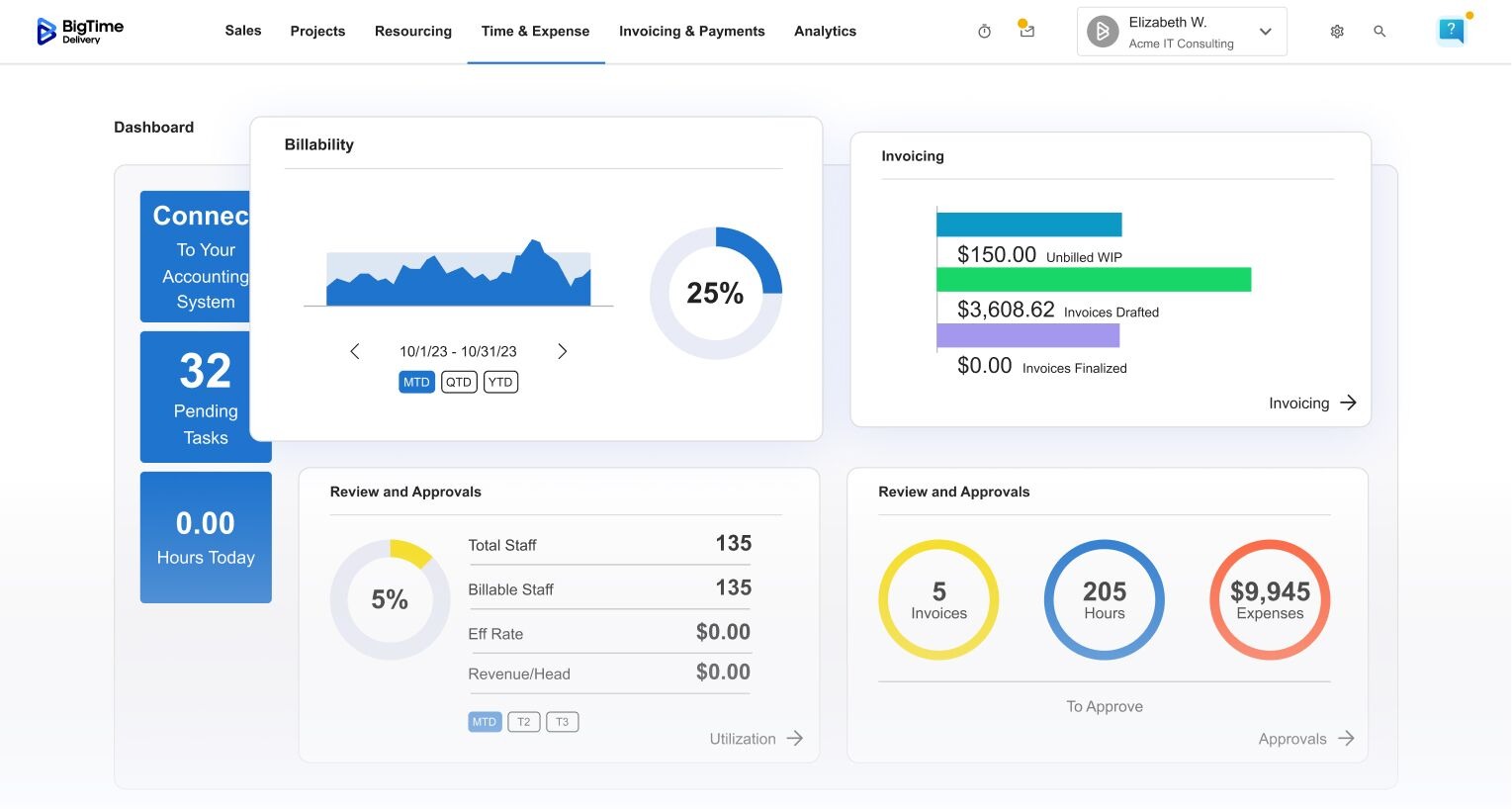
- Reporting & Financial Reporting. Real-time dashboards give finance leaders instant visibility into profitability, forecasting accuracy, and project health, without a data export to spreadsheets.
- AI-Powered Insights. BigTime’s AI is embedded in the financial backbone of the platform, flagging margin erosion before they show up in end-of-month reports. AVA, BigTime’s conversational AI assistant, lets users surface data and navigate the platform in plain language.
- Accounting System Integration. BigTime’s bi-directional integration with QuickBooks Desktop, QuickBooks Online, and Sage is built into the platform’s architecture, not added through a connector.
Pricing
Free demo available. Paid plans start from $20 per user per month for the Essentials package. BigTime’s modular structure means you pay for what you use, with no forced bundles or enterprise module tax.

Kantata
Reviews: G2: 4.2 stars, Capterra: 4.2 stars
Pros & Cons
Pros:
- Comprehensive feature set covering project management, resource planning, time tracking, and financial management.
- Strong business intelligence and reporting tools with detailed analytics.
- Supports complex billing models and revenue recognition across multi-team engagements.
Cons:
- Steep learning curve with significant setup effort required before the system reflects how your firm actually operates.
- Interface can feel dated and unintuitive, which hurts adoption across project managers.
- Advanced capabilities locked behind higher-tier plans.
- Kantata SX is built on Salesforce, meaning firms moving away from CRM-governed PSA may find themselves with a familiar set of constraints.
Kantata is a feature-rich PSA platform built for professional services organizations that need deep control over projects, resources, and finances. It covers project delivery, resource scheduling, time tracking, and financial reporting in one connected system, making it a credible option for larger firms with complex billing requirements.
The tradeoff is complexity. Kantata demands serious configuration investment before it delivers value, and adoption across project managers and finance teams consistently takes longer than firms plan for. For mid-market professional services teams that need to be operational quickly and want services to own the platform without heavy IT involvement, that timeline carries real risk.
Key Features
- Project Management & Delivery. Detailed project planning with project timelines, budgets, and task tracking gives project managers structured oversight of complex engagements.
- Resource Management. Skills-based resource scheduling matches consultants to projects by availability and expertise, with workload visibility across the portfolio.
- Financial Management & Revenue Recognition. WIP management, revenue recognition, and project accounting for basic financial support.
- Business Intelligence & Reporting. Analytics dashboards give leadership visibility into utilization, margin, and project health.
Pricing
Custom pricing based on team size and features. Total cost of ownership should account for implementation costs, training costs, and, for Kantata SX users, additional Salesforce platform overhead.
Deltek Vantagepoint
Reviews: G2: 4.0 stars, Capterra: 4.1 stars
Pros & Cons
Pros:
- Project accounting and financial reporting capabilities built for project-based businesses.
- Integrated CRM, resource management, and project delivery tools covering the full project lifecycle.
- Multi-currency transactions and multi-entity consolidation for firms operating across multiple geographies.
Cons:
- Heavily optimized for AEC (architecture, engineering, and construction) firms, making it a poor fit for IT services, consulting, and managed services organizations.
- Complex initial setup with a steep learning curve that requires significant training investment.
- User interface feels dated compared to more modern PSA platforms.
- Implementation complexity and implementation costs are comparable to enterprise PSA platforms, with timelines that challenge mid-market firms.
Deltek Vantagepoint is a well-established PSA platform with particularly strong project accounting and financial management capabilities for project-based businesses. It covers resource planning, CRM, project delivery, and financial reporting in one system, and for firms in engineering or government contracting, it reflects the specific billing structures and compliance requirements those industries demand.
Outside of AEC and government contracting, however, Deltek Vantagepoint is a harder sell. IT services firms, consulting firms, and managed services providers will find the platform over-engineered for their needs and under-optimized for their workflows. The implementation complexity mirrors that of enterprise PSA tools, and the user interface requires advanced knowledge to navigate confidently, which creates adoption challenges that take time and training costs to work through.
Key Features
- Project Accounting & Financial Management. Project accounting tools give finance teams control over budgets, costs, and revenue recognition.
- Resource Management & Planning. Resource scheduling tools match staff to projects based on skills and availability, with capacity planning built into the financial model.
- CRM & Client Collaboration. An integrated CRM connects the sales pipeline to project delivery, keeping client relationship data and project data in one system.
- Time Tracking & Expense Management. Time and expense data feeds directly into project accounting and billing workflows, reducing manual data entry across finance teams.
Pricing
Custom pricing based on firm size and modules required. Implementation costs and ongoing training investment should be factored into total cost of ownership, particularly for firms outside Deltek’s core AEC market.
Scoro
Reviews: G2: 4.5 stars, Capterra: 4.6 stars
Pros & Cons
Pros:
- Covers project management, time tracking, financial reporting, CRM, and quoting.
- Clean, modern user-friendly interface that is easier to navigate than many enterprise PSA tools.
- Real-time project health dashboards give teams visibility into delivery progress.
Cons:
- Financial management depth is limited compared to financial-first PSA platforms, with revenue recognition and project accounting requiring workarounds for complex billing tools.
- General ledger integration is not as robust as platforms built around accounting systems from the ground up.
- Advanced reporting and resource management features are locked behind higher tier plans, adding additional cost for growing firms.
- Better suited to smaller professional services teams than to mid-market firms managing complex, multi-contract engagements.
Scoro is a visually engaging, all-in-one platform that brings project management, time tracking, CRM, and financial reporting together in one place. Its modern interface and transparent pricing make it an appealing option for smaller professional services teams that want a single platform without the implementation complexity of enterprise PSA tools.
Where Scoro starts to show its limits is financial depth. For professional services firms that need strong revenue recognition and reliable general ledger integration as the operational foundation, Scoro’s delivery-first architecture means finance teams often end up relying on external tools or manual processes to fill the gaps. As billing complexity grows, so does the distance between what Scoro does natively and what mid-market firms actually need.
Key Features
- Project Management & Delivery. Gantt charts, task management, and milestone tracking give project managers structured visibility over project delivery from planning through completion.
- Time Tracking & Expense Management. Consultants log time and expenses directly against projects, with data feeding into invoicing.
- CRM & Client Collaboration. A built-in CRM connects sales pipeline activity to project delivery.
- Financial Reporting & Quoting. Financial dashboards cover budgets, margins, and project profitability, with quoting tools that connect estimates to actual delivery costs.
- Resource Management & Planning. Resource scheduling gives operations leaders visibility into team availability and workload, though depth is limited.
Pricing
Tiered pricing with plans starting at $26 per user per month. Advanced features including detailed resource management and financial reporting require higher tier plans, so total cost should be evaluated carefully as team size and complexity grow.
Accelo
Reviews: G2: 4.4 stars, Capterra: 4.5 stars
Pros & Cons
Pros:
- Client collaboration tools with a unified view of client relationships and project delivery.
- Automated time capture reduces manual data entry for consultants.
- Good fit for smaller service providers that need CRM and project delivery in one system.
- Covers the full client lifecycle from sales through invoicing, reducing the need for a separate CRM tool.
Cons:
- Delivery-first architecture means financial management depth is limited, with general ledger integration and revenue recognition falling short of what finance teams at growing firms require.
- Resource management capabilities are basic compared to dedicated PSA platforms built for mid-market professional services organizations.
- Interface can feel cluttered and unintuitive as project and client volume grows, creating adoption challenges for larger teams.
- Reporting tools lack the financial reporting depth needed for professional services firms that track margin, WIP, and utilization as core business metrics.
Accelo is a client-focused PSA platform designed to bring sales, project delivery, time tracking, and invoicing together under one roof. Its strength is client relationship management combined with project execution, making it a practical option for smaller services providers that want to reduce tool sprawl without committing to a full enterprise PSA implementation.
The limitations become visible as financial complexity grows. Accelo is built from the delivery layer outward, which means billing accuracy, general ledger integration, and project accounting are not the center of gravity. Finance teams at growing consulting or IT firms frequently find themselves supplementing Accelo with external tools to get the financial visibility they need, which reintroduces the data silos and manual reconciliation that a PSA platform is supposed to eliminate.
Key Features
- Client Collaboration & CRM. A unified client record connects sales activity, project delivery, and billing history, giving teams full visibility into every client engagement without a separate CRM.
- Project Management & Delivery. Project planning, task management, and project milestone tracking give project managers structured oversight of active engagements across multiple clients.
- Invoicing & Expense Management. Time and expense data flows into invoicing workflows, with billing rules configurable at the project level to support different contract types.
- Reporting & Financial Reporting. Project and client dashboards give operations leaders visibility into delivery progress and basic financial performance, though depth is limited for firms with complex financial reporting needs.
Pricing
Paid plans start at $24 per user per month for core modules. Advanced resource management, financial reporting, and approval workflows require higher tier plans, and total cost of ownership should account for the external tools many growing firms need to supplement Accelo’s native financial management capabilities.
Productive
Reviews: G2: 4.5 stars, Capterra: 4.6 stars
Pros & Cons
Pros:
- Clean, modern user-friendly interface that drives strong adoption.
- Solid project management and resource planning tools well suited to agencies.
- Built-in budgeting gives operations leaders real-time visibility into project profitability.
- Transparent tiered pricing with a clear feature set at each level.
Cons:
- Financial management depth is limited for professional services firms with complex billing models, multi-currency transactions, or revenue recognition requirements.
- General ledger integration and accounting system connectivity fall short of what finance teams at mid-market firms need as billing complexity grows.
- Resource management capabilities, while solid for smaller teams, lack the forecasting depth and financial grounding that professional services organizations at scale require.
- Better positioned as an agency management tool than a full PSA platform for PS companies.
Productive is a modern, well-designed platform that covers project management, time tracking, resource planning, and budgeting in a clean interface that teams genuinely enjoy using. For digital agencies and smaller professional services teams, it hits a sweet spot between simplicity and functionality that more complex PSA platforms rarely achieve at the same price point.
The challenge is depth. Productive is built with agencies in mind, and the financial management layer reflects that. Professional services firms in consulting, IT, or engineering that need strong revenue recognition, WIP tracking, and a reliable general ledger connection will find Productive’s financial reporting capabilities too limited as their project accounting requirements grow. It is a strong starting point for smaller teams, but firms with serious financial visibility needs tend to outgrow it faster than they expect.
Key Features
- Project Management & Project Delivery. Task management, project planning, and milestone tracking give teams structured visibility over active engagements.
- Resource Management & Planning. Resource scheduling tools give operations leaders visibility into team availability and workload across projects.
- Time Tracking & Expense Management. Consultants log time and expenses directly against projects in a clean, intuitive interface.
- Invoicing & Approval Workflows. Basic invoicing and approval processes connect time and expense data to client billing.
Pricing
Tiered pricing starting at $9 per user per month for the Essential plan. Advanced resource management, financial reporting, and approval workflows are available on higher tier plans. Total cost of ownership is competitive for smaller teams, though firms requiring deeper financial management will likely need supplementary tools as they scale.
NetSuite PSA
Reviews: G2: 4.0 stars, Capterra: 4.1 stars
Pros & Cons
Pros:
- Deep integration with NetSuite ERP makes it a natural fit for firms already running NetSuite.
- Strong project accounting capabilities built on a cloud ERP foundation.
- Multi-currency transactions and multi-entity consolidation support.
- Comprehensive financial reporting and general ledger connectivity.
Cons:
- Only makes sense for firms already invested in the NetSuite ERP ecosystem, making it a poor fit for the majority of mid-market professional services firms running QuickBooks or Sage.
- Implementation complexity and implementation costs are significant, with rollouts that regularly extend beyond initial timelines and budgets.
- Steep learning curve across project managers, finance teams, and operations leaders, with training costs that add up quickly for growing firms.
- User interface is functional but not intuitive, and the platform prioritizes ERP PSA breadth over the services-specific depth that professional services teams need day to day.
NetSuite PSA is the project management and professional services automation layer built on top of the NetSuite cloud ERP platform. For firms already running their business operations inside NetSuite, it offers a compelling path to connecting project delivery, resource management, and financial management without introducing a separate accounting system or manual data entry between platforms.
Outside of the NetSuite ecosystem, the case falls apart quickly. Mid-market professional services firms running QuickBooks or Sage will face significant data migration scope, implementation costs, and ongoing admin overhead to make NetSuite PSA work for them. The platform is built for organizations that have already made a full ERP commitment, not for growing consulting, IT, or engineering firms that need fast time to value and services-owned operations. For those firms, the total cost of ownership and implementation complexity make NetSuite PSA a harder path than the alternatives on this list.
Key Features
- Project Accounting & Financial Management. Native connection to the NetSuite general ledger gives finance teams visibility into project costs.
- Resource Management & Planning. Resource scheduling and capacity planning tools help operations leaders match consultants to projects based on availability and skills.
- Project Management & Delivery. Project planning, milestone tracking, and budget management give project managers structured oversight of engagements.
- Multi-Entity Consolidation & Multi-Currency Transactions. Built-in support for complex organizational structures and international operations makes NetSuite PSA a fit for firms managing business operations across multiple entities or geographies.
Pricing
Custom pricing based on modules, user count, and organizational complexity. Total cost of ownership is typically high, factoring in NetSuite ERP licensing, PSA module costs, implementation costs, and the ongoing admin resources needed to maintain and evolve the system.
Which Certinia Alternative Is the Best?
The platforms on this list each solve part of the professional services puzzle. Some lead with project management, others with client collaboration, and a few with ERP-level financial reporting. But for mid-market consulting, IT, and engineering firms that need financial precision across the full project lifecycle without enterprise complexity or CRM dependency, one platform stands apart: BigTime.
Where Certinia requires your services team to operate inside Salesforce governance, BigTime gives services the autonomy to own and run the business directly. Where Certinia implementations carry the weight of a full CRM rollout, BigTime’s in-house implementation team gets firms operational in 30 to 90 days, built on a proven framework across 3,000+ deployments. And where Certinia stacks licensing costs across Salesforce, sandbox environments, and ongoing admin resources, BigTime offers straightforward per-user PSA pricing with no hidden infrastructure overhead.
Book a demo to see how BigTime gives your professional services team the financial visibility and operational control it needs to grow.

Certinia Alternatives – FAQ
What is the best Certinia alternative?
BigTime is the best Certinia alternative for professional services firms. It delivers the same financial visibility, revenue recognition, and project accounting depth as Certinia PSA, but in a services-owned platform that does not depend on Salesforce infrastructure. Firms get faster implementation, cleaner adoption, and straightforward pricing without stacked CRM licensing costs.
What is the best Certinia alternative for small and medium-sized companies?
BigTime. Its modular architecture lets smaller professional services firms start with time tracking, billing, and project delivery, then add resource management and quoting as complexity grows. There is no forced bundle, no enterprise overhead, and no re-platforming required as the business scales.
How long does BigTime take to implement compared to Certinia?
BigTime’s in-house implementation team delivers go-live in 30 to 90 days across most mid-market professional services firms. Certinia implementations typically carry the weight and timeline of a full Salesforce implementation, often extending to six to twelve months depending on customization scope and data migration complexity.
What features missing from Certinia does BigTime have?
BigTime offers services-owned configuration that does not require Salesforce admin involvement, straightforward accounting system integration with QuickBooks Desktop and QuickBooks Online, and a user-friendly interface built for project managers and consultants rather than CRM users. BigTime also provides transparent per-user pricing without the additional cost of Salesforce licenses, sandbox environments, and custom development overhead.
How does BigTime compare to Certinia for professional services firms?
Both platforms cover project delivery, resource management, financial management, and revenue recognition. The core difference is operational control. Certinia operates inside Salesforce governance, which creates admin dependency and slower change cycles for services teams. BigTime is built for services teams to own and evolve directly, with faster time to value, stronger accounting system integration, and lower total cost of ownership for mid-market professional services organizations.
Which Certinia alternatives integrate with QuickBooks or other accounting systems?
BigTime offers the strongest accounting system integration in the PSA category, with bi-directional, audit-ready connectivity to both QuickBooks Desktop and QuickBooks Online, as well as Sage. Unlike platforms that connect to accounting systems through third-party connectors, BigTime is built around the general ledger from the ground up, which means financial data stays consistent, auditable, and trusted across the entire platform.
How do Certinia’s key features compare to BigTime?
Certinia and BigTime both cover project management, resource planning, time tracking, and financial reporting. Where they diverge is architecture and ownership. Certinia’s features are configured and governed inside the Salesforce platform, requiring CRM expertise to maintain. BigTime’s features are built for services teams to configure and evolve independently, with financial management at the core rather than layered on top of a CRM data model.