
Manual invoicing costs professional services firms an average of 9 hours per week – time spent re-entering data and reconciling records between disconnected systems. The right QuickBooks invoicing software eliminates that friction entirely.
This guide covers the top-rated invoicing software that integrates with QuickBooks in 2025, how to evaluate your options, and what to look for in a QuickBooks invoice integration so your firm gets paid faster, with less effort.
Key Takeaways
- Integrated invoicing software eliminates double data entry and keeps your QuickBooks account in sync automatically
- Two-way sync is the gold standard; one-way sync creates reconciliation headaches.
- BigTime offers the deepest QB integration for professional services firms, covering project-based billing, time tracking, and recurring billing in one platform.
Why Businesses Look for QuickBooks-Integrated Invoicing Software
QuickBooks is the accounting backbone for millions of small businesses and professional services firms. But QuickBooks’ native invoicing has real limits, especially for firms billing on project milestones or managing recurring billing at scale. That’s why so many firms search for invoicing apps that work with QuickBooks rather than replacing their accounting setup entirely. By doing so, they:
- Eliminate double entry: Every invoice you create in a dedicated invoicing platform syncs automatically to your QuickBooks account.
- Real-time sync keeps your books accurate: Payments collected through your invoicing software update QuickBooks instantly, so your accounting team always sees current data.
- Get paid faster with professional invoices: Dedicated invoicing platforms let you send custom invoices and accept payments with online payment links, automated reminders for late payments, and flexible payment options, helping you to get paid up to 2x faster.
- Simplify reconciliation: When invoices and payments sync automatically, month-end reconciliation drops from hours to minutes. Every transaction is already matched to customer details without any intervention.
- Real-time cash flow visibility: With invoices, payments, and your QuickBooks account all in sync, you can see exactly what’s outstanding, what’s been collected, and what your cash flow looks like.
How QuickBooks Invoice Integration Works
Understanding the mechanics of a QuickBooks invoice integration helps you make a better buying decision — and avoid platforms that promise integration but deliver something shallow.
What Data Flows Between Systems
A well-built QuickBooks invoicing software integration syncs the following data objects:
| Data Object | Sync Direction | What It Does |
| Invoices | Two-way | Invoice details (line items, quantities, rates, taxes) push from BigTime to QuickBooks. Payment status updates back to BigTime when recorded in QuickBooks. |
| Customers | Two-way | Create or update customer information in either system and it appears in both. Changes to name, address, or payment terms propagate automatically in both directions. |
| Payments | One-way | Payments collected via BigTime post to QuickBooks as received payments against the correct invoice. Payments entered directly in QuickBooks do not pull back into BigTime. |
| Items & Services | One-way | Products and services are imported from QuickBooks into BigTime to keep rate structures consistent. New service items created in BigTime do not push back to QuickBooks. |
| Sales Tax | One-way | Tax codes and rates are read from QuickBooks so invoices reflect correct calculations. Tax configuration is managed in QuickBooks; BigTime reads but does not write back to it. |
QuickBooks Online vs. QuickBooks Desktop vs. QuickBooks Enterprise: Integration Comparison
Not all types of Quickbooks were created equal, especially when it comes to their integration capabilities. These three versions of QuickBooks use fundamentally different integration architectures – and not every invoicing app supports all three:
- QuickBooks Online: Cloud-based. Integrations use Intuit’s REST API for real-time, bidirectional sync. This is the most common and most feature-rich integration type. Most modern invoicing software supports QB Online.
- QuickBooks Desktop (Pro/Premier): On-premise. Integrations use the QuickBooks Desktop SDK or Web Connector, which requires a locally installed connector application. Sync is typically batch-based rather than real-time. Fewer platforms support it; check explicitly before purchasing.
- QuickBooks Enterprise: Intuit’s enterprise-grade accounting platform. Supports larger data volumes, advanced chart of accounts structures, and industry-specific editions. Requires a more robust integration than standard QB Desktop.
If your firm relies on QuickBooks Desktop, confirm that the invoicing software you’re evaluating specifically supports invoicing software that syncs with QuickBooks Desktop, not just QuickBooks Online.
Sync Direction: One-Way vs. Two-Way
One-way sync sends data from your invoicing platform to QuickBooks, but changes made in QuickBooks don’t reflect back. Two-way sync keeps both systems in continuous alignment — changes made in either platform propagate to the other. For professional services firms managing complex projects, two-way sync is essential. One-way integrations create data drift over time.
How to Evaluate QuickBooks Invoicing Software: What to Look For
With dozens of invoicing apps that work with QuickBooks available in 2026, here are the criteria that matter most for professional services firms:
1. QuickBooks Version Support
Verify the platform supports your specific QuickBooks version. Invoicing software that syncs with QuickBooks Online is common; invoicing software that syncs with QuickBooks Desktop is less so. Enterprise support is rarer still.
2. Billing Model Flexibility
Professional services firms bill in many ways: project-based billing by milestone, time and materials, fixed fee, and recurring billing for retainers. The best QuickBooks invoice software handles all of these from a single platform, not just basic one-time invoices.
3. Time Tracking & Expense Tracking Integration
If your firm tracks billable hours, you need an invoicing platform that converts time entries directly to invoice line items and syncs them to QuickBooks. Expect built-in time tracking or tight integration with your existing time tracking tool.
4. Automated Workflows
Top-rated invoicing software that integrates with QuickBooks in 2026 goes beyond send-and-sync. Look for automated reminders for late payments, recurring invoice scheduling, automated workflows for invoice approval, and real-time notifications when customers view or pay invoices.
5. Online Payment Options
Your invoicing software should let customers pay directly from the invoice. Fewer steps between invoice receipt and payment means faster payments and better cash flow, which is cruciall for large and small business owners alike.
Top-Rated Invoicing Software That Integrates With QuickBooks 2026: Comparison
Use this table to compare the leading invoicing apps that work with QuickBooks across the criteria that matter most to professional services firms.
| Tool | Price Range | QB Online | QB Desktop | Sync Type | Billing Models | Free Trial | G2 Rating |
| BigTime | From $20/user/mo | ✓ | ✓ | Two-way | Project, T&M, Recurring | Yes | 4.5/5 |
| Invoiced | From $100/mo | ✓ | ✓ (Ent.) | Two-way | Recurring, One-time | Yes | 4.6/5 |
| Method CRM | From $25/user/mo | ✓ | ✓ | Two-way | Project, Recurring | Yes | 4.4/5 |
| FreshBooks | From $19/mo | ✓ | Limited | One-way | Time-based, Recurring | Yes | 4.5/5 |
| Zoho Invoice | Free / Paid | ✓ | Via app | One-way | Project, Recurring | Free tier | 4.5/5 |
| HoneyBook | From $19/mo | ✓ | – | One-way | Project, Milestones | Yes | 4.6/5 |
| DepositFix | From $79/mo | ✓ | – | Two-way | Recurring, Subscriptions | Yes | 4.3/5 |
Note: Pricing and ratings accurate as of 2026. Always confirm current pricing with each vendor.
BigTime: The Best QuickBooks Invoicing Software for Professional Services
BigTime is purpose-built for professional services firms: consulting, engineering, architecture, IT services, and accounting. Its invoicing module connects directly with QuickBooks Online and QuickBooks Desktop, giving firms a complete billing process from time entry to paid invoice without ever leaving the platform.
Key Features
- Two-way QuickBooks sync: Invoices, customers, payments, and items sync bidirectionally in real time. Changes made in QuickBooks reflect in BigTime and vice versa – no data drift, no manual reconciliation.
- Project-based billing: Bill by milestone, phase, percentage complete, or time and materials. BigTime supports every billing model professional services firms use, including recurring billing for ongoing retainer clients.
- Built-in time tracking: Billable hours flow directly from time entries to invoice line items — no re-entry, no spreadsheets. Expense tracking ties project costs to client invoices automatically.
- Custom invoice templates: Create and customize invoices with your firm’s logo, custom fields, and preferred layout. Send custom invoices via email directly from the platform with a single click.
- Automated reminders: Send automated reminders for overdue invoices on a schedule you control. Reduce late payments without manual follow-up.
- Online payments & ACH: Clients can pay bills and invoices directly via credit card or ACH payments and save time. Payments post to QuickBooks automatically when collected.
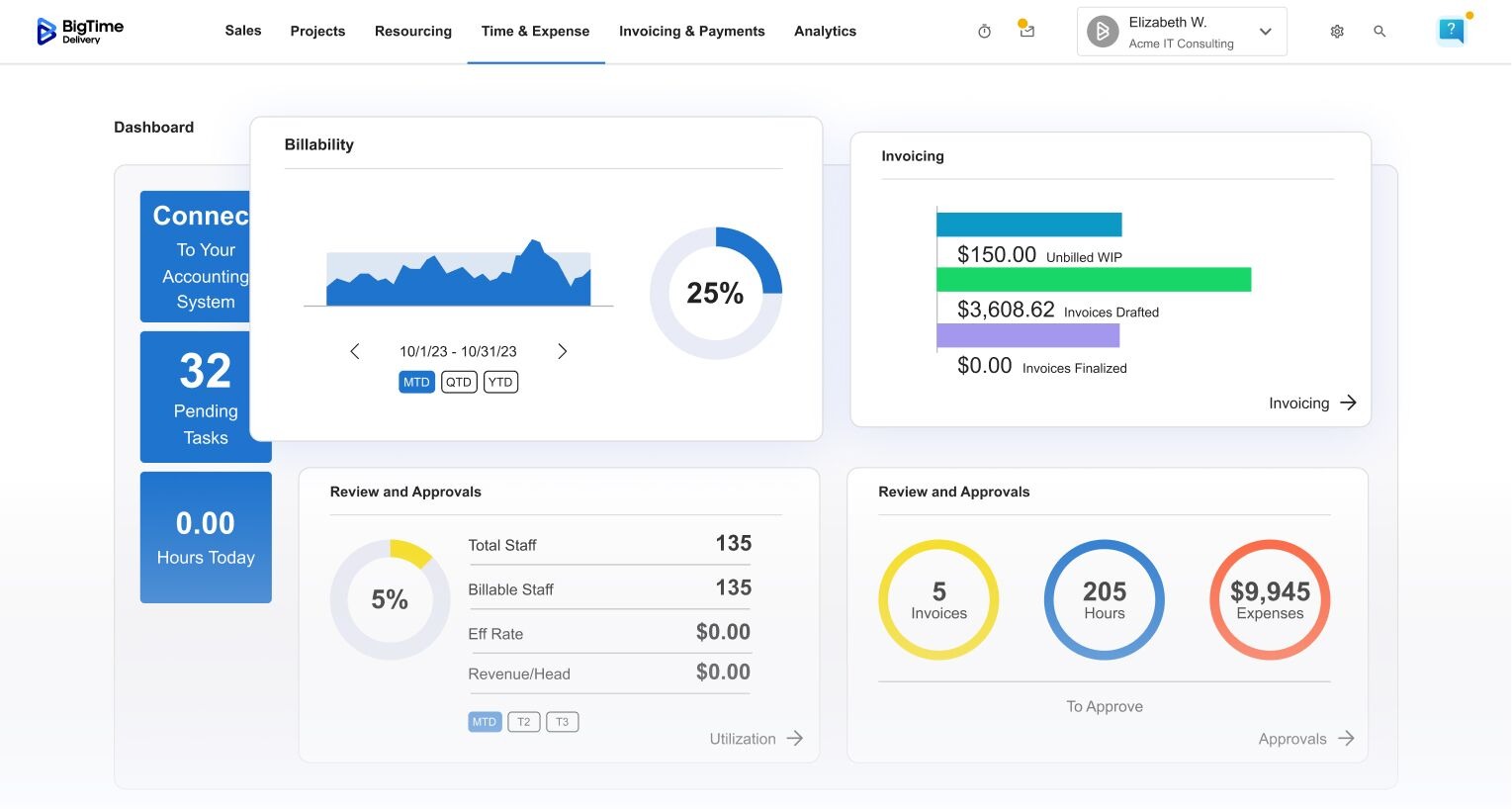
- Cash flow visibility: Real-time, AI powered executive dashboards show outstanding invoices, payment status, collected revenue, and projected cash flow — all tied to your live QuickBooks account.
Who It’s Best For
BigTime is ideal for professional services firms with five or more people who need more than basic invoicing: project-based billing, time and expense tracking, resource management, and a reliable QuickBooks invoice integration – all in one platform. It’s particularly strong for consulting, engineering, and IT services firms billing complex projects across multiple clients.
What BigTime’s Customers Say
“We used to spend half of Friday reconciling invoices between our project tool and QuickBooks. With BigTime, everything syncs automatically. Our invoices reflect exactly what we billed, payments post the moment they’re collected, and our accountant hasn’t touched a manual entry in six months.”— Operations Director, Engineering Firm
QuickBooks Integration Specifics
- Supported versions: QuickBooks Online and QuickBooks Desktop (Pro, Premier, Enterprise).
- Sync direction: Two-way — invoices, customers, payments, items, and sales tax.
- Sync frequency: Real-time for QuickBooks Online; scheduled sync available for QuickBooks Desktop.
- Setup: Connect your QuickBooks account from BigTime’s Integrations settings in under 10 minutes. No developer required.
Pricing
BigTime plans start at $20 per user per month. A free trial is available. Contact BigTime to discuss pricing for your firm’s size and needs.
6 Other Invoicing Apps That Work With QuickBooks
BigTime is the strongest fit for professional services firms, but these alternatives are worth evaluating depending on your firm’s size, industry, and billing complexity.
Invoiced
G2: 4.6/5 (130+ reviews) | Capterra: 4.6/5 (60+ reviews)
Best For
Mid-market and enterprise businesses with complex accounts receivable workflows, high invoice volumes, and a need for sophisticated dunning and collections automation.
Key Features
- Automated invoicing and collections workflows
- Two-way sync with QuickBooks Online and QuickBooks Enterprise
- Recurring billing and subscription management
- Customer portal for clients to view invoices and make payments
- Advanced reporting and cash flow forecasting
QuickBooks Integration
Invoiced supports two-way sync with QuickBooks Online and QuickBooks Enterprise. Invoice details, payments, and customer data sync automatically. Particularly strong for businesses with high recurring invoice volumes.
Pricing
Plans from $100/month. Free trial available.
Method CRM
G2: 4.4/5 (260+ reviews) | Capterra: 4.4/5 (90+ reviews)
Best For
Small businesses and trades that want CRM and invoicing tightly connected to QuickBooks, particularly those already using QuickBooks Desktop.
Key Features
- Deep two-way sync with QuickBooks Online and Desktop (all versions)
- Create invoices, estimates, and purchase orders from within the CRM
- Customizable workflows and invoice templates
- Client portal for invoice approval and online payments
- Lead-to-invoice workflow management
QuickBooks Integration
Method is built specifically around QuickBooks and claims the deepest QB Desktop integration of any CRM-invoicing platform. Changes in QuickBooks sync back to Method in real time, and vice versa. All QuickBooks versions supported.
Pricing
Plans from $25/user/month. Free trial available.
FreshBooks
G2: 4.5/5 (680+ reviews) | Capterra: 4.5/5 (4,200+ reviews)
Best For
Freelancers and small service-based businesses who want simple, polished invoicing with time tracking and a clean mobile experience.
Key Features
- Create and send professional invoices in minutes
- Automated reminders for late payments
- Built-in time tracking and expense tracking
- Accept online payments via credit card and ACH payments
- Recurring invoices and recurring billing for retainer clients
QuickBooks Integration
FreshBooks offers one-way sync with QuickBooks Online via third-party connectors (Zapier, etc.) rather than a native integration. Not ideal for firms that need true two-way sync. QB Desktop support is limited.
Pricing
Plans from $19/month. Free trial available.
Zoho Invoice
G2: 4.5/5 (220+ reviews) | Capterra: 4.7/5 (560+ reviews)
Best For
Small businesses and startups looking for a free or low-cost invoice generator with solid customization and multi-currency support.
Key Features
- Free invoice generator with unlimited invoices
- Custom invoice templates with full branding control
- Track invoices and payment status in real time
- Automated reminders and payment receipts
- Accept online payments via multiple gateways
QuickBooks Integration
Zoho Invoice connects to QuickBooks Online via the Zoho ecosystem and third-party connectors. Sync coverage is one-way for most configurations. Not a native integration — confirm the specific data objects covered before committing.
Pricing
Free for businesses with up to five customers. Paid plans via Zoho Books from $20/month.
HoneyBook
G2: 4.6/5 (540+ reviews) | Capterra: 4.8/5 (590+ reviews)
Best For
Creative freelancers and small service-based businesses — photographers, consultants, event planners — who want a combined proposals, contracts, and invoicing workflow.
Key Features
- Invoicing combined with proposals, contracts, and project management
- Send custom invoices with online payment links
- Milestone-based billing and payment schedules
- Automated workflows for client onboarding and follow-up
- Branded client portal for invoice and contract management
QuickBooks Integration
HoneyBook integrates with QuickBooks Online only (no QB Desktop support). The integration syncs payments and invoices one-way to QuickBooks. Better suited to solo operators than growing teams needing full two-way sync.
Pricing
Plans from $19/month. Free trial available.
DepositFix
G2: 4.3/5 (40+ reviews) | Capterra: 4.4/5 (30+ reviews)
Best For
Service businesses and subscription-based companies that need automated payment collection and recurring billing tightly integrated with QuickBooks Online.
Key Features
- Two-way sync with QuickBooks Online
- Recurring billing and subscription management
- Automated invoicing and payment collection workflows
- Customizable payment pages and branded invoice forms
- ACH payments and credit card support
QuickBooks Integration
DepositFix offers two-way sync with QuickBooks Online, covering invoices, payments, and customer data. QB Desktop is not supported. Strong fit for businesses with high recurring invoice volumes. No QB Enterprise support.
Pricing
Plans from $79/month. Free trial available.
Which QuickBooks Invoicing Software Is Right for Your Business?
Different firms have different needs. Here’s how to match your situation to the right platform:
Best for Professional Services Firms (Consulting, Engineering, IT)
BigTime. Purpose-built for firms that bill by project, track billable hours, manage resource utilization, and need a robust QuickBooks invoice integration that covers time tracking, expense tracking, project-based billing, and recurring billing in one platform. The only option on this list built specifically for professional services.
Best for Legal Firms and Law Offices
BigTime. Legal billing requires matter-based invoicing, trust accounting awareness, and detailed time capture — capabilities that general-purpose invoicing apps rarely support well. BigTime’s project-based billing maps directly to matter-based billing; Invoiced handles high-volume collections workflows if your firm issues many invoices monthly.
Final Verdict: What Is the Best Invoicing Software That Integrates With QuickBooks?
For professional services firms — consulting, engineering, architecture, IT services, and accounting — BigTime is the best QuickBooks invoicing software available in 2025. Its two-way sync with both QuickBooks Online and QuickBooks Desktop, combined with built-in time tracking, project-based billing, recurring billing, and automated reminders, makes it the only platform on this list that handles the full billing process from time entry to collected payment — all synced with QuickBooks in real time.
For small businesses or freelancers with simpler needs, FreshBooks and Zoho Invoice offer accessible starting points. For QB Desktop-heavy trades businesses, Method CRM is the strongest QB Desktop integration available.
But if your firm is billing projects, tracking billable hours, and managing multiple clients simultaneously, BigTime delivers the depth, reliability, and QuickBooks integration that generic invoicing apps simply can’t match.
How to Get Started With BigTime + QuickBooks
- Step 1 — Connect your QuickBooks account: From BigTime’s Integrations settings, click ‘Connect QuickBooks’ and authorize the connection. Works for both QB Online and QB Desktop.
- Step 2 — Map your data: BigTime guides you through mapping your QuickBooks chart of accounts, customers, and items to BigTime’s project and billing structure. This typically takes 15–30 minutes.
- Step 3 — Run your first sync: Trigger an initial sync to pull your existing QuickBooks data into BigTime. Review customers, open invoices, and items to confirm everything landed correctly.
- Step 4 — Create your first invoice: Build a project in BigTime, log time and expenses, and generate your first invoice. Send it to your client directly from BigTime and watch it appear in QuickBooks automatically.
- Step 5 — Automate reminders: Bill customers, send invoices and set up automated reminders for late payments so your team stops chasing invoices manually. Configure the schedule and message, and BigTime handles the rest.
Frequently Asked Questions
What Invoicing Software Works With QuickBooks?
The top invoicing apps that work with QuickBooks in 2026 is BigTime. BigTime offers the deepest integration for professional services firms, with two-way sync covering QuickBooks Online and QuickBooks Desktop. The right choice depends on your billing complexity, team size, and whether you use QB Online or QB Desktop.
Does QuickBooks Have Its Own Invoicing?
Yes. QuickBooks Online includes basic invoicing features that let small businesses create invoices, accept online payments, send automated reminders, and track payment status. However, QuickBooks’ native invoicing lacks project-based billing, time tracking, advanced recurring billing, and the workflow automation that professional services firms need. Most growing firms pair QuickBooks with dedicated invoicing software to fill these gaps.
Can I Use Third-Party Invoicing With QuickBooks Desktop?
Yes, but you need to confirm that the invoicing platform explicitly supports QuickBooks Desktop — not just QuickBooks Online. QB Desktop uses a different integration architecture (SDK or Web Connector) than QB Online’s REST API. BigTime supports QB Desktop.
How Do I Sync Invoices to QuickBooks Automatically?
Most invoicing software that integrates with QuickBooks syncs invoices automatically once you’ve connected your QuickBooks account. With BigTime, invoices created in the platform push to QuickBooks in real time — no manual export required. Payments collected online post to QuickBooks automatically as well. The initial setup typically takes under 30 minutes.
What Is the Difference Between QuickBooks Online and QuickBooks Invoicing?
QuickBooks Online is a full cloud accounting platform covering bookkeeping, payroll, reporting, and invoicing. QuickBooks’ built-in invoicing is one feature within QuickBooks Online — useful for basic billing but limited for complex project billing. Third-party QuickBooks invoicing software adds the billing depth (time tracking, project-based billing, recurring billing, custom invoice templates) that QuickBooks’ native invoicing lacks, while keeping your accounting data in QuickBooks.
How Does Two-Way QuickBooks Sync Work?
Two-way sync means data flows in both directions – from your invoicing software to QuickBooks, and from QuickBooks back to your invoicing platform. If you update a customer record, payment term, or invoice detail in either system, it propagates to the other automatically. This prevents data drift and keeps your books accurate without manual intervention. BigTime’s QuickBooks integration is fully two-way for both QB Online and QB Desktop.
Does Invoicing Software Work With QuickBooks Enterprise?
Not all invoicing apps support QuickBooks Enterprise. BigTime supports QB Enterprise integration. QB Enterprise uses a more complex data structure (larger chart of accounts, advanced inventory, industry-specific editions) than QB Online or QB Desktop, so confirm Enterprise support explicitly with any vendor you’re evaluating.
Can I Bill by Project in QuickBooks?
QuickBooks Online has basic project tracking, but project-based billing — milestone invoicing, percentage-complete billing, time and materials — requires a dedicated invoicing platform like BigTime. BigTime ties project budgets, time entries, and expenses directly to the invoice, then syncs the final invoice to QuickBooks. This is the gap most professional services firms are filling when they search for QuickBooks invoicing software.
How Long Does It Take to Set Up a QuickBooks Integration?
For QuickBooks Online, BigTime’s integrations take 15–30 minutes to configure. You authorize the connection, map your data, and run an initial sync with just a stable internet connection.
Read also
- Time and expense software QuickBooks — Find out which tools connect seamlessly with QuickBooks to streamline your billing and project workflows. A practical guide for professional services firms looking to cut manual data entry.
- Invoicing software that syncs with QuickBooks Online — See how BigTime’s invoicing capabilities sync directly with QuickBooks to keep your books accurate and up to date. Ideal for firms that bill clients regularly and need a reliable, automated workflow.
- Time tracking software that integrates with QuickBooks — Learn how to track billable hours and sync them to QuickBooks without double entry or spreadsheet workarounds. A must-read for teams looking to improve timesheet accuracy and speed up payroll.
- BigTime QuickBooks integration — Explore the full details of BigTime’s native QuickBooks integration, including supported QuickBooks versions and sync options. Everything you need to get connected and start saving time.