When projects are tracked in one place and invoices live somewhere else entirely, the gap between the work your team delivers and the revenue that actually hits your bank account grows wider every month. For professional services firms managing multiple clients, billable hours, and recurring invoices at once, that gap is rarely small, and it almost never fixes itself – unless you decide to implement the right project management and invoicing software.
Finding the right project management and invoicing software in 2026 is about more than checking boxes on a feature list. It is about picking a platform that keeps delivery data and financial outcomes in the same flow, so your team spends less time reconciling spreadsheets and more time doing the work that gets you paid. The right tool changes how confidently you can forecast cash flow, close billing cycles, and make decisions when project budgets start drifting.
By the end of this guide, you will know exactly what separates a general-purpose project tracker from a platform built to protect billable hours, tighten invoicing workflows, and give financial and operational leaders real visibility into how work translates to revenue.
Here is what this ranking covers, built around the questions that matter most when evaluating project management and invoicing software:
- Integrated time tracking and billing: Does the platform connect tracked hours to client invoices without manual reconciliation or duplicate data entry?
- Invoicing features and flexibility: Can it handle recurring invoices, custom invoice templates, milestone billing, and multiple billing models without workarounds?
- Project tracking and budget visibility: Does it show budget burn, billable vs. non-billable hours, and project profitability while work is still in motion?
- Team collaboration and capacity management: Can project managers see team capacity, assign tasks, and manage project timelines without switching tools?
- Accounting software integration: Does it connect cleanly with your existing accounting software to keep financial records consistent and reduce month-end chaos?
- Security and scalability: Is it built for small teams today but capable of growing with the business without forcing a platform change later?
What Is Project Management and Invoicing Software?
Project management and invoicing software is a platform that combines project tracking, task management, time tracking, and billing into a single connected workflow. Instead of managing projects in one tool and generating client invoices in another, these platforms keep project delivery data and financial data in the same system, so the hours your team logs translate directly into accurate invoices without manual reconciliation in between.
In practice, the most common problems these platforms are built to solve include:
- Revenue leakage from disconnected workflows. When time tracking and invoicing live in separate tools, billable hours get missed and finance teams spend days reconciling what was actually delivered against what was billed. A unified platform eliminates that gap.
- Slow billing cycles that hurt cash flow. Firms that rely on manual processes to compile expense data and build client invoices from scratch face delays that push Days Sales Outstanding higher and strain working capital. The right platform shortens that cycle significantly.
- No visibility into project profitability while work is happening. Without real-time budget tracking, project managers find out a project is underwater only after it’s too late to course-correct. Project management and invoicing software keeps budget vs. actuals visible throughout delivery.
- Inconsistent invoicing across clients and engagements. Managing different billing models, such as time and materials, fixed-fee, and recurring retainers, across multiple clients without a system built for it leads to invoice errors, disputes, and write-offs.
- Time wasted on administrative work instead of billable work. When consultants and project managers are spending hours every week on status updates and invoice prep, that time isn’t hitting an invoice. A well-built platform reduces that overhead.
- Lack of a single source of truth for project and financial data. Firms relying on spreadsheets, email threads, and disconnected apps end up with conflicting numbers across teams, which makes forecasting unreliable and client conversations harder than they need to be.
The best platforms in this category go beyond basic task management and basic invoicing. They connect the full project lifecycle, from scoping and resource planning through time tracking, approvals, and invoicing, into a workflow where financial outcomes are built in from the start, not assembled after the fact.
What Features Should the Best Project Management and Invoicing Software Have?
Not every platform that claims to combine project management and invoicing actually delivers on both sides of that promise. Many tools are strong on task management but thin on billing logic. Others handle invoicing well but give project managers almost no visibility into how delivery is tracking against budget.
The best project management and invoicing software sits at the intersection of both, built so that the work your team does every day flows directly into accurate, timely client invoices without anyone having to manually bridge the gap.
Here are the features that separate a capable platform from one that actually supports how professional services firms operate:
Integrated Time Tracking Built for Billable Work
Time tracking has to work for the people doing the work, not just for finance. The best platforms support multiple entry styles, including daily timesheets, weekly summaries, timers, and mobile capture, so consultants can log hours in whatever way fits their workflow.
Equally important are configurable reminders that improve compliance without requiring constant chasing from managers. Approval workflows and locked billing periods protect data integrity downstream, so the hours that hit an invoice are the hours that were actually approved, with a clear record to back them up.
Flexible Invoicing Features That Match How You Bill
Professional services firms rarely bill the same way across every client. The best project invoicing software handles time and materials, fixed-fee projects, recurring invoices, milestone billing, retainers, and partial billings for phased engagements, all without requiring manual workarounds for each contract type. Invoice templates should be customizable so client invoices look professional and consistent, and the platform should support draft invoices, review workflows, and clear backup detail that reduces client back-and-forth.
Real-Time Project Budget Tracking and Margin Visibility
Budget management needs to update as work happens, not after the month closes. A strong platform tracks actuals vs. budget by phase, role, and cost type, with visual signals or alerts when burn accelerates ahead of schedule. Project managers should be able to see how current staffing and pace will affect end-of-project margin, so they can tighten scope and adjust resources before profitability slips. This kind of visibility is what turns project management from a delivery function into a financial control tool.
Project Tracking and Task Management Across Teams
Beyond time and billing, the platform needs to support how project work actually gets organized. That means task dependencies, project timelines, milestone tracking, and clear assignment of responsibilities across the team. Good project tracking gives project managers a single place to see what’s on track, what’s at risk, and where team capacity is being used, without needing a separate project management tool running alongside the invoicing platform. The ability to manage new projects from setup through delivery inside the same system that handles billing is what makes these platforms genuinely unified.
Resource Planning and Team Capacity Management
Staffing decisions affect both delivery quality and financial outcomes, so the platform needs to make team capacity visible in a way that informs real decisions. The best tools show consultant availability by date, role, and utilization targets, while accounting for non-billable hours, internal commitments, and planned time off. Scenario planning capabilities, such as modeling best-case vs. conservative capacity scenarios, help firms decide whether to take on new projects, shift timelines, or bring in additional resources before gaps become problems.
Recurring Invoices and Automated Billing Workflows
For firms managing retainer clients or subscription-based engagements, recurring invoices need to run reliably without manual setup every billing cycle. The best platforms automate recurring billing based on agreed schedules and contract terms, notify clients automatically, and handle adjustments when scope or timing changes. Automation in the billing workflow reduces the risk of missed invoices and frees up finance teams to focus on exceptions rather than routine billing tasks.
Clean Integration With Accounting Software and Existing Tools
A project management and invoicing platform still has to fit into the wider financial stack. Reliable connections to accounting software, payroll systems, and CRM tools keep financial records consistent and reduce reconciliation effort at month-end. The quality of the accounting software integration matters as much as whether it exists. Bi-directional sync, clean category mapping, and audit-ready data exports are what determine whether finance can trust the numbers that flow between systems. For firms running QuickBooks or Sage, the depth of that integration is often the deciding factor in platform selection.
Security and Access Controls for Financial Data
Project management and invoicing platforms hold sensitive financial data and employee records, so security has to be built in as a foundation, not an afterthought. Role-based access controls, multi-factor authentication, and configurable permissions ensure the right people can see and act on the right data without exposing sensitive financial information across the broader team.
Reporting and Analytics That Drive Real Decisions
Reporting should answer the questions that actually matter to financial and operational leaders: Which projects are most profitable? Where is utilization falling short of targets? Which clients are consistently late paying? How does forecasted revenue compare to what’s actually been billed? The best platforms make this data accessible without requiring a data analyst to pull it together. Strong drill-down capabilities, customizable executive dashboards, and portfolio-level views let leadership trace a margin issue back to its source without leaving the platform.
2026 Project Management and Invoicing Software Ranking
Choosing the right project management and invoicing software in 2026 is harder than it looks. Most platforms market themselves as all-in-one solutions, but the real difference shows up in the details: how cleanly time tracking connects to billing, how reliably budget data updates during delivery, and whether the invoicing features can actually handle the complexity of how your firm bills clients. A tool that does project tracking well but requires a separate system to send invoices isn’t a unified platform. It’s two problems waiting to happen.
This ranking focuses on platforms that genuinely connect project management and invoicing in a single workflow. Each tool was evaluated on how well it supports the full billing cycle for professional services firms: time and expense capture, project budget visibility, invoicing flexibility, accounting software integration, and the day-to-day experience for both project managers and finance teams.
Project Management and Invoicing Software: Comparison
The table below gives a quick side-by-side view of how the five leading platforms stack up in 2026. Each tool is assessed on what it does best and where its limitations tend to surface once you move beyond the demo and into real-world workflows.
| Tool | Description | Strengths | Limitations |
| BigTime | PSA platform built for professional services firms, connecting time tracking, project management, invoicing, and financial management in one flow. | Purpose-built for billable work; strong invoicing flexibility; real-time budget and margin visibility; deep QuickBooks integration. | Best value for professional services firms. |
| Harvest | Time tracking and invoicing tool designed for small teams and freelancers with straightforward billing needs. | Fast to set up; simple time tracking; clean invoicing for basic billing models. | Limited project budget visibility; minimal resource planning; reporting depth falls short for growing firms managing complex billing. |
| FreshBooks | Cloud accounting and invoicing platform with project management features added for small business owners. | Strong invoicing features and recurring invoices; good fit for very small teams. | Project management capabilities are surface-level; limited support for complex billing models; not built for multi-person delivery teams at scale. |
| Teamwork.com | Client work management platform with time tracking, task management, and basic invoicing features for service teams. | Strong project tracking and team collaboration; solid project dependencies and milestone management; decent time tracking. | Invoicing features are limited compared to dedicated billing platforms; advanced PSA needs around rate complexity and margin governance require additional tools. |
| Zoho Projects | Project management software with time tracking and invoicing features as part of the broader Zoho ecosystem. | Broad feature set at a competitive price; works well inside the Zoho ecosystem; good task management for small teams. | Invoicing and billing depth can feel limited outside of Zoho; reporting and financial visibility lag behind purpose-built PSA platforms; integration quality varies with non-Zoho tools. |
BigTime
Reviews: G2: 4.5/5, Capterra: 4.6/5.
Pros & Cons
Pros:
- Purpose-built for professional services billing workflows. BigTime is designed from the ground up for firms where billable hours, client invoices, and project profitability analysis are the core of the business. Time tracking, approvals, budget visibility, and invoicing work as a single connected flow rather than a collection of features bolted together.
- Invoicing flexibility that matches how professional services firms actually bill. The platform handles time and materials, fixed-fee, milestone billing, recurring invoices, and retainers without requiring workarounds for each contract type. Invoice templates are fully customizable.
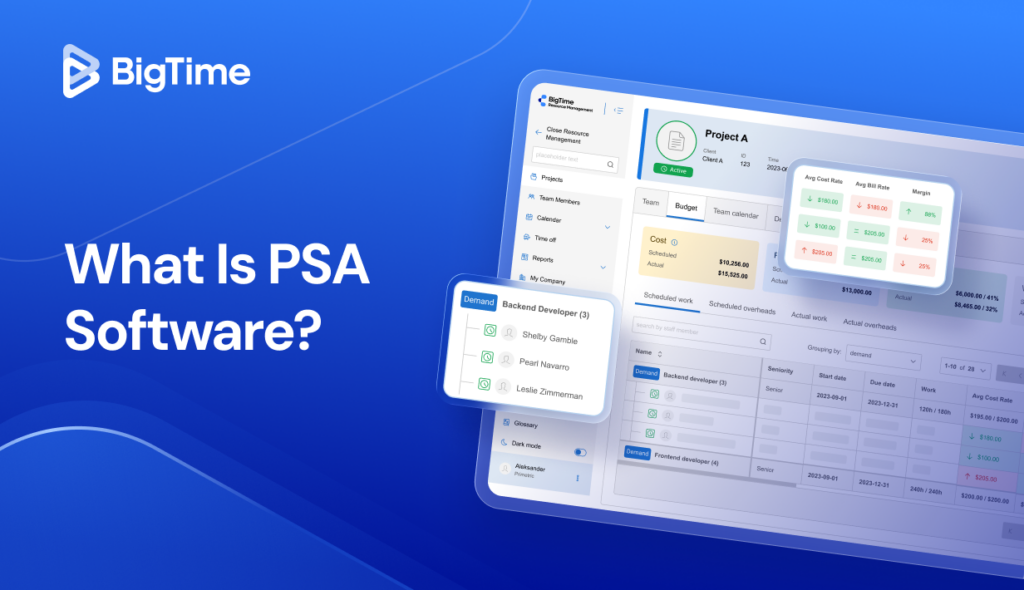
- Real-time project budget and margin visibility. Project managers can see budget burn, billable vs. non-billable hours, and profitability at the project level while work is still in motion, supporting faster course corrections and fewer end-of-project surprises.
- Deep, bi-directional QuickBooks integration. BigTime’s integration with both QuickBooks Desktop and QuickBooks Online is one of the strongest in the PSA category, keeping the general ledger accurate without duplicate data entry.
- Scales with the firm without requiring a platform change. Teams can start with core time tracking and invoicing functionality and add resource management, quoting, and advanced analytics as the business grows.
Cons:
- Broader than necessary for very simple billing needs. Teams that only need basic time tracking and straightforward invoicing for a handful of clients may find BigTime’s capabilities extend beyond their immediate requirements.
BigTime is a PSA platform built for professional services firms that need project management and invoicing to work as one connected system. Where most tools in this category either excel at project tracking or handle invoicing well, BigTime covers the full billing lifecycle: plan the work, staff it correctly, track time and expenses, apply the right rate logic, run approvals, and produce invoice-ready output without breaking the chain of financial data at any point.
What sets BigTime apart from other project management and invoicing software is its financial foundation. The platform is built around the general ledger from day one, which means every hour logged, every expense submitted, and every invoice generated shares the same financial logic. That eliminates the reconciliation gap that opens up when project data and billing data live in separate systems. BigTime also addresses the adoption challenge that derails many implementations, with a time entry experience designed to be fast and intuitive for consultants and structured approval workflows that keep submissions moving without requiring managers to chase people individually.
Key Features
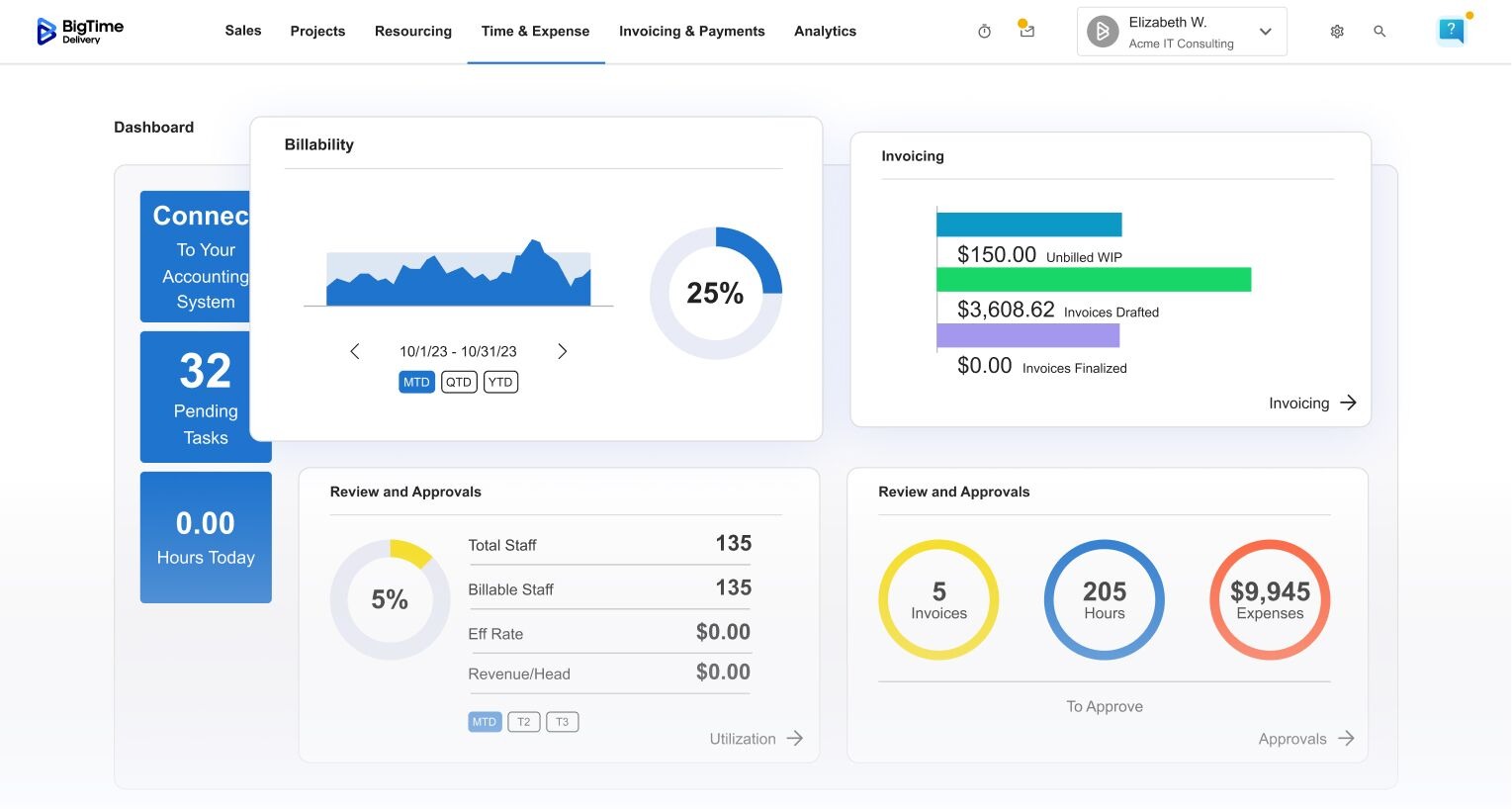
- Time & expense tracking: Multiple entry styles with configurable reminders and approval workflows that protect billing accuracy from submission through invoice generation.
- Invoicing and billing management: Invoice generation flows directly from approved time and expense data, supporting multiple billing models with customizable invoice templates.
- Project budget tracking: Real-time actuals vs. budget visibility by phase and role, with burn tracking and margin indicators that support course corrections before profitability slips.
- Resource management: Integrated resource planning with utilization management for accurate staffing decisions grounded in real availability and financial data.
- Reporting & analytics: Portfolio-level reporting on utilization, project profitability, and billing performance with drill-down capabilities for leadership teams.
- QuickBooks integration: Bi-directional sync with both QuickBooks Desktop and QuickBooks Online that eliminates duplicate data entry between project management and accounting software.
- Project tracking and task management: Project timelines, task dependencies, and project milestone tracking inside the same platform that handles billing.
Pricing
BigTime Essentials starts at $20 per user/month, with Advanced, Premier, and Enterprise tiers available for firms that need deeper functionality. A free personalized demo is available at bigtime.net/demo.
Harvest
Reviews: G2: 4.3/5, Capterra: 4.6/5.
Pros & Cons
Pros:
- Fast setup and low friction for small teams. Harvest is straightforward to get running, with a clean interface for time tracking and basic invoicing that most small teams can adopt.
- Simple time-to-invoice workflow for straightforward billing. For teams billing on time and materials with a single rate structure, Harvest moves approved hours into client invoices without much manual work in between.
Cons:
- Invoicing features don’t scale with billing complexity. Harvest handles basic invoicing well, but firms managing multiple billing models or recurring invoices quickly find themselves working around the platform rather than through it.
- Project budget visibility is limited. There’s no meaningful real-time margin visibility, which means project managers are often the last to know when a project is drifting over budget.
- Reporting falls short for financial decision-making. Leadership teams looking for utilization data or billing performance trends hit the ceiling of what Harvest’s reporting can answer quickly.
- Resource planning is an afterthought. Harvest’s capacity management features, largely handled through the separate Harvest Forecast product, add cost and complexity.
Harvest is a time tracking and invoicing tool that works well for freelancers and very small service teams with simple, consistent billing needs. The experience is clean, setup is fast, and for a firm billing a handful of clients on straightforward time and materials contracts, it covers the basics without much configuration required.
The limitations become apparent as soon as billing complexity increases. Firms managing fixed-fee projects alongside retainers, handling multiple rate structures, or trying to get meaningful visibility into project profitability will find Harvest’s feature set stops short of what they actually need. Many teams end up supplementing it with additional tools for resource management and financial reporting, which adds the kind of administrative overhead Harvest was supposed to reduce in the first place.
For professional services firms that have moved beyond the simplest billing models, Harvest tends to become one piece of a patchwork stack rather than the unified project management and invoicing platform they were looking for.
Key Features
- Time tracking: Timers and timesheets across web, desktop, and mobile designed for fast, consistent billable hour capture across projects and clients.
- Basic invoicing: Generates client invoices from tracked time with straightforward billing workflows, though flexibility across billing models is limited.
- Basic reporting: Project and time insights for simple tracking needs, with limited depth for utilization analysis or portfolio-level financial visibility.
- Integrations: Connects with common tools including accounting software and project management apps, though the quality of those connections varies.
Pricing
Harvest offers a free plan for one user and up to two projects. The Pro plan is $11 per user/month billed annually, covering unlimited projects and users.
FreshBooks
Reviews: G2: 4.5/5, Capterra: 4.5/5.
Pros & Cons
Pros:
- Clean invoicing experience for small business owners. FreshBooks produces professional-looking client invoices quickly, with solid support for recurring invoices.
- Accessible for non-financial users. The interface is intuitive enough that small business owners without a dedicated finance team can manage basic billing and expense tracking without a steep learning curve.
Cons:
- Project management features are too surface-level for delivery teams. FreshBooks added project tracking and task management to its feature set, but the depth doesn’t match what professional services firms need to manage concurrent client engagements.
- Limited support for complex billing models.Firms managing fixed-fee projects alongside retainers, or milestone billing frequently find themselves working around the platform.
- No meaningful budget visibility or margin tracking. There is no real-time view of project profitability or budget burn, which means project managers have no way to catch scope creep or cost overruns while work is still in progress.
- Scales poorly beyond very small teams. As team size grows and billing complexity increases, the gaps in reporting depth and resource planning become increasingly difficult to ignore.
FreshBooks started as cloud accounting and invoicing software for freelancers, and that origin still shapes what the platform does well and where it falls short. For a solo consultant or a two-person team with simple, consistent billing needs, the invoicing experience is genuinely good.
The problems surface quickly for firms that have grown past the simplest operating models. Project management in FreshBooks is limited to basic task lists and time logging, with none of the budget tracking, resource planning, or delivery visibility that professional services teams need to manage client work at scale. Firms that try to use FreshBooks as a genuine project management and invoicing platform typically end up supplementing it with separate tools for project tracking and reporting, which defeats the purpose of having a unified system in the first place.
For growing professional services firms, FreshBooks is better understood as an invoicing tool with project features added on than a platform built for the full project lifecycle.
Key Features
- Invoicing and recurring billing: Supports recurring invoices, automated payment reminders, and customizable invoice templates for straightforward client billing workflows.
- Time tracking: Basic time logging that connects to client invoices, though it lacks the approval workflows and compliance controls that professional services firms need for accurate billing.
- Expense tracking: Captures business expenses and attaches them to projects and invoices, with receipt capture via mobile for on-the-go submissions.
- Project management: Basic task lists and project collaboration features that cover simple delivery needs but fall short for teams managing complex, multi-phase client engagements.
- Reporting: Standard financial reports including profit and loss, invoice aging, and expense summaries, with limited depth for project-level profitability or utilization analysis.
Pricing
FreshBooks offers four plans starting at $19 per month for the Lite plan, with higher tiers unlocking more billable clients, team members, and advanced features. A 30-day free trial is available.
Teamwork.com
Reviews: G2: 4.4/5, Capterra: 4.5/5.
Pros & Cons
Pros:
- Strong project tracking and team collaboration. Teamwork.com is built around client work delivery, with solid task management, project dependencies, milestone tracking, and team collaboration features.
- Built-in time tracking tied to projects. Time tracking connects directly to tasks and projects, making it easier to monitor billable hours and keep delivery teams accountable.
Cons:
- Invoicing features are too limited for serious billing needs. Teamwork.com’s invoicing capabilities cover the basics but fall well short of what professional services firms need.
- No real margin or profitability visibility. Budget tracking exists at a surface level, but there’s no meaningful real-time view of project profitability or cost burn.
- Requires additional tools to function as a full PSA. Teams that need robust invoicing, resource planning, and financial reporting alongside project management will find Teamwork.com covers only part of the picture.
- Notification volume and onboarding friction show up in reviews. Users regularly mention excessive notifications and a setup process that takes longer than expected.
Teamwork.com is a client work management platform that has expanded over time to include time tracking, capacity planning, and some invoicing functionality. For teams whose primary need is better project delivery coordination, it offers a solid set of tools for organizing tasks, tracking progress, and keeping client work moving across multiple engagements simultaneously.
Where it falls short as a project management and invoicing platform is on the financial side. The invoicing features are adequate for simple billing scenarios but lack the flexibility, rate logic, and accounting software integration depth that growing professional services firms depend on. Teams that need to bill clients across different contract types, track project profitability in real time, or produce invoice-ready output from approved time data will find Teamwork.com stops short of what they need.
Key Features
- Task and project management: Comprehensive task management with dependencies, milestones, project timelines, and team collaboration tools designed for multi-client delivery environments.
- Time tracking: Flexible time entry options connected to tasks and projects, with visibility into how tracked hours affect capacity and billable targets.
- Basic invoicing: Invoice generation from tracked time for straightforward billing scenarios, though rate complexity and billing model flexibility are limited compared to dedicated invoicing platforms.
- Resource and workload management: Team capacity views that support basic staffing decisions, with accuracy depending on consistent project setup and time entry discipline.
- Reporting: Project delivery and time reporting with some profitability-oriented views, though financial depth for leadership-level decision-making remains limited.
Pricing
Teamwork.com offers a free plan for small teams and paid plans starting at $10.99 per user/month billed annually, with a 30-day free trial available across paid tiers.
Zoho Projects
Reviews: G2: 4.3/5, Capterra: 4.4/5.
Pros & Cons
Pros:
- Broad feature set at a competitive price point. Zoho Projects packs task management, time tracking, milestone tracking, and basic invoicing into a platform that is priced accessibly for small teams.
- Works well inside the Zoho ecosystem. For firms already using Zoho CRM, Zoho Books, or other Zoho products, the integrations between applications are genuinely useful.
Cons:
- Invoicing features depend heavily on Zoho Books. Firms that want to send invoices, manage recurring billing, and connect project data to financial records need to add Zoho Books to the stack, which increases cost and complexity.
- Integration quality drops significantly outside the Zoho ecosystem. Connecting Zoho Projects to non-Zoho accounting software or CRM tools can be unreliable.
- Financial visibility and reporting are limited. There’s no meaningful real-time view of project profitability, margin tracking, or billing performance at the portfolio level.
- Scales awkwardly as complexity increases. Firms managing complex billing models, multiple rate structures, or larger delivery teams frequently find themselves adding Zoho applications to compensate for gaps, driving up total cost and administrative overhead.
Zoho Projects is a project management tool that covers the fundamentals of task organization, time tracking, and team collaboration at a price point that appeals to cost-conscious small business owners and small teams. Within the broader Zoho ecosystem, it can function as a reasonable starting point for firms that are already committed to Zoho’s suite of products and want to keep their tool stack consolidated inside one vendor.
The challenge for professional services firms is that Zoho Projects was built primarily as a project management tool, and its invoicing and financial capabilities reflect that origin. Serious billing workflows, recurring invoices with variable terms, custom rate cards, and real-time project profitability tracking all require either Zoho Books or additional configuration that adds cost and complexity. Firms that start with Zoho Projects hoping for a unified project management and invoicing platform often find themselves assembling a multi-product Zoho stack to fill the gaps, with integration dependencies that introduce their own maintenance burden.
Key Features
- Task and project management: Task dependencies, milestones, Gantt charts, and project timelines for organizing delivery work across teams and client engagements.
- Time tracking: Timesheets and timers connected to tasks and projects, with basic billable hour tracking for client billing purposes.
- Basic invoicing: Limited invoicing functionality within Zoho Projects itself, with more complete billing features available through integration with Zoho Books.
- Team collaboration: Document sharing, discussion threads, and notifications that support team coordination across active projects.
- Reporting: Standard project progress and time reports, with financial reporting depth requiring Zoho Books or other Zoho applications to supplement.
Pricing
Zoho Projects offers a free plan for up to three users and three projects. Paid plans start at $4 per user/month billed annually, with a Premium plan at $9 per user/month that unlocks the full feature set.
Which Project Management and Invoicing Software Is the Best?
The fundamental problem with most project management and invoicing software is that it was built from one direction and extended toward the other. Neither approach produces a system where delivery data and financial outcomes are genuinely connected from the start, and for professional services firms where billable hours directly determine revenue, that gap shows up as missed billables, slow invoice cycles, and margin erosion that nobody catches until it’s already happened.
That’s where BigTime stands apart. Built specifically for professional services firms, BigTime treats project management and invoicing as two sides of the same financial workflow rather than two features sharing a platform. Every hour tracked and every approval completed flows into invoice-ready output through the same financial logic, with real-time budget visibility running alongside delivery the entire time. For growing IT, engineering, and consulting firms that have outgrown simple tools, BigTime is the strongest choice in this category by a clear margin.
To see how BigTime fits your firm’s workflows, book a free personalized demo right now.

Project Management and Invoicing Software: FAQ
What is project management and invoicing software?
Project management and invoicing software is a platform that combines project tracking, time tracking, task management, and client billing into a single connected workflow. Instead of managing delivery in one tool and generating invoices in another, these platforms keep project data and financial data in the same system, so billable hours flow directly into accurate client invoices without manual reconciliation in between.
What is the best project management and invoicing software?
BigTime is the best project management and invoicing software for professional services firms. Unlike tools that handle project tracking or invoicing well but require compromises on the other, BigTime connects both into a single financial workflow built around how professional services firms actually operate, with real-time margin visibility, flexible invoicing, and deep QuickBooks integration included from the start.
What is the best project management and invoicing software for medium-sized companies?
For medium-sized professional services firms, typically those with between 30 and 250 employees, BigTime is the strongest choice. It delivers the financial precision and invoicing flexibility that growing firms need without the six-month implementation timelines and enterprise price tags that come with heavier alternatives.
What is the best project management and invoicing software for different industries?
BigTime is the best option across the professional services sector, regardless of industry vertical:
- IT companies: Handles complex billing models, rate structures, and multi-project environments with real-time utilization and profitability data.
- Engineering firms: Supports phased projects, milestone billing, and tight budget controls across long-running client engagements.
- Consulting companies: Connects time capture, rate logic, approvals, and invoice generation in a single flow that reduces revenue leakage and shortens billing cycles.
- Professional services firms in general: The most complete platform available for firms that bill clients for project-based work, combining project tracking, financial control, and invoicing depth in one system.
What is the best project management and invoicing software that integrates with QuickBooks?
BigTime is the best choice for firms running QuickBooks. Its bi-directional integration with both QuickBooks Desktop and QuickBooks Online is one of the deepest in the PSA category, eliminating duplicate data entry and keeping the general ledger accurate without manual reconciliation at month-end.
Read More:
- Billing & Invoicing Software – Discover how billing and invoicing software can streamline client billing, reduce manual work, and improve payment processes.
Learn which features help professional services firms create accurate invoices and maintain better financial control. - Quoting and Invoicing Software – Explore how quoting and invoicing software helps businesses create estimates, convert them into invoices, and manage client billing.
See how integrated tools can improve accuracy, speed up workflows, and support a smoother quote-to-payment process. - Financial Management Software – Explore how financial management software helps professional services firms manage budgets, costs, cash flow, and profitability.
Learn which features can improve financial visibility and support more informed business decisions. - Project Budgeting Software – Learn how project budgeting software can help teams plan costs, monitor spending, and maintain healthy project margins.
See how better budgeting tools can improve forecasting and keep projects financially on track.