
A single missed cost code can quietly erase a project’s margin, and most general contractors do not find out until the job is closed out and the numbers no longer add up. Between multiple projects, shifting material costs, and teams split across the field and the office, construction firms need financial control that generic accounting software was never built to provide.
This guide breaks down what real construction financial software should do, and which platforms actually protect your margin from bid day through final billing.
Here is what we weighed most heavily when building this ranking:
- Job costing accuracy: Tracking costs by cost code, phase, and job so project managers know true job performance in real time, not at month-end.
- Cash flow and billing control: Progress billing, retention tracking, and receivable aging so cash flow does not stall behind slow-paying clients.
- Payroll and compliance: Certified payroll and complex payroll scenarios across union and prevailing wage jobs, backed by a full audit trail.
- Field-to-office connection: Real-time visibility between project data and financial data, without manual data entry between systems.
What Is Construction Financial Management Software?
Construction financial management software is purpose-built financial software that tracks a construction company’s accounting by job, cost code, and phase, not by generic transaction. That distinction matters: a general ledger tells you what you spent last month. Construction financial software tells you what a job is costing right now, against what it was budgeted to cost.
Unlike general accounting software, which is built for businesses that sell the same thing over and over, this category is built around project finances that shift daily: change orders, retention, progress billing, and certified payroll. It gives general contractors, specialty contractors, and trade contractors one place to see job cost data, cash flow, and profitability across every open job, instead of piecing it together from spreadsheets next to a general ledger.
The Benefits of Construction Financial Management Software
Construction financial management software pays off long before year-end close.
Here is what changes once job cost data, billing, and cash flow live in one system instead of a patchwork of spreadsheets:
- Catch margin drift before it becomes a write-off: Real-time job costing means project managers see budget overruns while there is still time to adjust staffing, rates, or scope, not after the final invoice.
- Protect cash flow with structured billing: Progress billing, retention tracking, and receivable aging keep cash from stalling behind slow-paying clients.
- Handle payroll the way construction actually requires: Certified payroll and complex payroll scenarios across union and prevailing wage jobs stop requiring manual workarounds.
- See the whole business, not just one job: Multi entity consolidation gives ownership a single, reliable view across entities and divisions instead of spreadsheets stitched together at month-end.
- Free up finance for decisions, not data entry: Continuous job cost data updates cut down on manual data entry and reconciliation, leaving more time for data-driven decisions about which jobs and clients are actually profitable.
What Features Should the Best Construction Financial Management Software Have?
Not every accounting system built for construction goes deep enough to earn the label. Here are the features that separate genuine construction financial management software from basic accounting with a few construction fields bolted on:
Job Costing by Cost Code and Phase
Every dollar of labor, material, equipment, and subcontractor cost should map to a specific job, phase, and cost code. That level of detail is what lets project managers see exactly where a budget is holding steady and where it is starting to slip, long before the numbers show up in a monthly report. The best systems also carry labor burden and equipment costs into the same cost code structure, so a phase that looks profitable on labor alone does not quietly go underwater once true cost is accounted for.
Real-Time Budget Tracking and Percentage-Complete Reporting
The best platforms update budget-to-actual and percentage-complete figures continuously as costs and billings post. That gives finance and operations real time financial visibility that a month-end close cannot match, since decisions get made while the job is still in motion, not after it wraps. Forecasted cost to complete should update alongside actuals as well, giving project managers an early, reliable signal on whether a job will finish on budget long before the final billing goes out.
Progress Billing and Retention Tracking
Support for AIA-style progress billing, schedule of values, and retention tracking keeps billing workflows consistent with how construction contracts are actually structured, rather than forcing a construction invoice into a generic template built for flat-fee services.
A strong system also ties billing to supporting documentation such as lien waivers and stored materials, so a payment application is not held up because backup paperwork is missing or has to be assembled by hand. Because progress billing schedules and retention percentages vary by contract and by client, the platform should let finance configure both without custom development, so billing stays accurate as the mix of contract types on the books changes.
Payroll Built for Construction, Not Adapted to It
When payroll is bolted onto general accounting software instead of built for construction, compliance work turns into a manual, error-prone process every pay period. Construction payroll has to handle a single worker moving between multiple jobs, cost codes, and pay rates in the same day, along with fringe benefits, workers’ compensation codes, and per-jurisdiction prevailing wage rules that shift from one job site to the next. A platform that gets this right turns certified payroll reporting into a byproduct of normal time entry, instead of a separate compliance project finance has to run every week.
Multi Entity Consolidation
Firms running multiple entities, divisions, or joint ventures need consolidated financial reporting without exporting every entity’s numbers into a separate spreadsheet. This only becomes more important as annual revenue and transaction volume grow. Consolidation should also handle intercompany eliminations and joint venture ownership splits automatically, so a firm with shared jobs across entities is not reconciling the same numbers twice by hand. For ownership groups running several legal entities under one operating umbrella, that kind of consolidated, segment-level reporting is often the difference between knowing which division is actually profitable and guessing based on a blended, company-wide number.
Retention and Receivable Aging Visibility
Clear reporting on retention held, retention released, and receivable aging protects cash flow and gives finance an early warning when payment delays start to stack up across a portfolio of jobs. That visibility should extend to lien waiver status and conditional versus unconditional releases, since retention that has technically been earned but is tied up behind missing paperwork is just as much of a cash flow problem as retention that has not been billed yet.
Firms that can see aging and waiver status together are in a much better position to follow up with clients before a payment delay turns into a real collections issue, rather than finding out when the bank balance comes up short.
Field-to-Office Integration
Two-way data flow between field-collected project data, such as timesheets, daily logs, and change orders, and the financial system removes the lag between what happens on-site and what shows up in the books, so field and office teams work from the same numbers. Mobile time entry and daily logs that sync directly into job costing also cut out a layer of double entry that otherwise falls on a project manager’s desk at the end of every week.
Full Audit Trail and Compliance Controls
A complete audit trail across job cost entries, change orders, and payroll supports bonding requirements, lender reviews, and general ledger accuracy, and it protects the firm if a job is ever questioned after the fact. That trail should capture who made a change, when, and what the value was before and after, down to individual cost code adjustments, not just top-line budget revisions. Surety companies and lenders increasingly expect this level of documentation before extending bonding capacity or credit, so an audit trail that holds up to outside scrutiny is as much a growth enabler as it is a compliance safeguard.
Reporting Built for Construction Decision-Making
Executive dashboards and reports that break down job performance, cash flow, and backlog by project, division, or entity give ownership the real time reporting they need to reduce risk before it hits the balance sheet, rather than after. The most useful reporting also benchmarks job performance across the portfolio, so leadership can see which project types, clients, or crews consistently outperform or underperform instead of judging each job in isolation. Paired with backlog and work-in-progress reporting, that view turns financial reporting into a forward-looking planning tool, not just a record of what already happened.
How to Choose Construction Financial Management Software
The right fit depends on how your firm is structured today and where it is headed next. Here is what to weigh before you sign anything:
- Your size and transaction volume: A specialty or trade contractor running a handful of jobs a year with straightforward payroll needs far less than a general contractor managing multiple jobs, several entities, and a mix of union and prevailing wage crews.
- The construction-specific depth you actually need: Map your non-negotiables first, whether that is progress billing, certified payroll, or multi entity consolidation, and test each platform’s specialized capabilities against that list rather than assuming every construction accounting software handles them the same way.
- How much implementation your team can absorb: Some platforms bring real depth in job costing and payroll but come with a steep learning curve and a lengthy rollout. Others prioritize a faster path to value, even if that means pairing the platform with additional tools later for construction-specific workflows like scheduling or service management.
- Whether it replaces or complements what you already run: Larger construction companies need software built to handle project complexity and higher transaction volume without buckling, while smaller firms may only need to plug a financial control gap next to a system that is already working.
2026 Construction Financial Management Software Ranking
This 2026 ranking looks at the platforms construction firms and their finance teams evaluate most often when they are ready to move beyond spreadsheets and generic accounting software. We assessed each tool on job costing depth, billing and cash flow controls, payroll and compliance capabilities, field-to-office connectivity, and how well the platform holds up as a construction company adds multiple jobs, entities, and users over time.
Construction Financial Management Software Comparison
Before the individual reviews, here is a side-by-side look at how the top construction financial management software options compare on key features, ideal use case, pricing, and review scores.
| Tool | Key Features | Best For | Pricing | G2 / Capterra Rating |
| BigTime | Financial-first PSA with time, billing, and real time project financials | Construction-adjacent professional services and project-based firms outgrowing spreadsheets | From $20/user/month | 4.5 / 4.6 |
| Procore | Construction management platform with financial and project tools | General contractors managing project delivery and field operations together | Quote-based | 4.6 / 4.5 |
| Sage Intacct Construction | Cloud financial management with construction-specific job costing and multi entity consolidation | Mid-sized to larger construction companies needing general ledger depth | Quote-based | 4.4 / 4.2 |
| Trimble Viewpoint Vista | ERP-style suite with deep job costing, payroll, and compliance | Large general contractors with complex payroll scenarios | Quote-based | 3.8 / 3.9 |
| Foundation Software | Construction accounting with strong payroll and job costing | Specialty and trade contractors needing certified payroll support | From ~$199/mo (quote-based) | 4.3 / 4.3 |
BigTime
Reviews: G2: 4.5/5, Capterra: 4.6/5.

Pros & Cons
Pros:
- Connects time, billing, and project financials in one place, so finance is not rebuilding job-level reality from spreadsheets after work is already done.
- Real-time project budget and utilization visibility helps project-based teams see margin drift while there is still time to correct it, rather than discovering it at invoicing.
- Configurable rate and cost structures support the complex billing arrangements common across professional services tied to construction and infrastructure work.
- Modular platform lets a firm start with core financial and billing capabilities and add resource planning or quoting as the business grows, without a full re-platform.
Cons:
- Firms that specifically need deep trade-level job costing, certified payroll, or AIA-style progress billing out of the box may want to pair BigTime with a dedicated construction accounting system for those workflows.
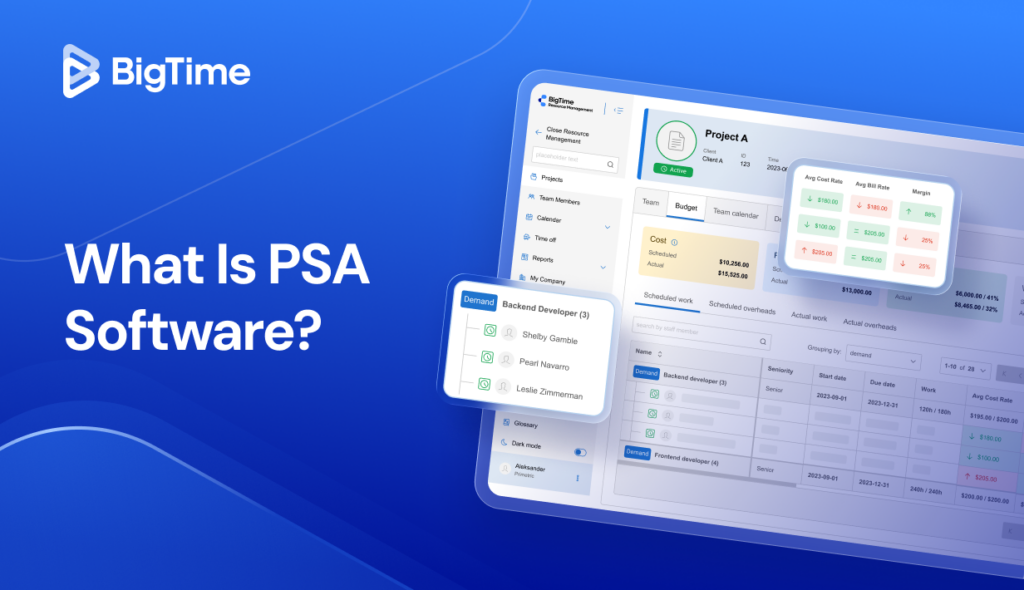
BigTime is a PSA platform built around financial control, and it is a strong fit for the professional services side of the construction and infrastructure world: construction management consulting firms, owner’s representative practices, and engineering-services groups that bill by time and need real financial precision without the weight of a full construction ERP. It connects time tracking, billing, and reporting into one financial logic, so project managers and finance leaders work from the same numbers in real time.
That financial rigor holds up as a firm grows. BigTime’s rate and cost management, budget tracking, and real time reporting give leadership a clear, current view of profitability across every active engagement, replacing the spreadsheet reconciliation most firms rely on before they adopt a dedicated financial management software. And because the platform is modular, a firm can start with time, billing, and budget tracking, then add resource management or quoting later, without a full re-platform.
Key Features
- Time and expense tracking: Structured time entry ties directly to project budgets, so job cost data updates continuously instead of at month-end.
- Real-time budget tracking: Budget versus actual visibility by project and phase helps teams catch margin drift before it becomes a write-off.
- Billing and invoicing workflows: Invoices generate from approved time and expenses, keeping billing consistent with delivery and reducing manual data entry.
- Rate and cost management: Configurable rate cards support complex billing arrangements across clients, roles, and engagement types.
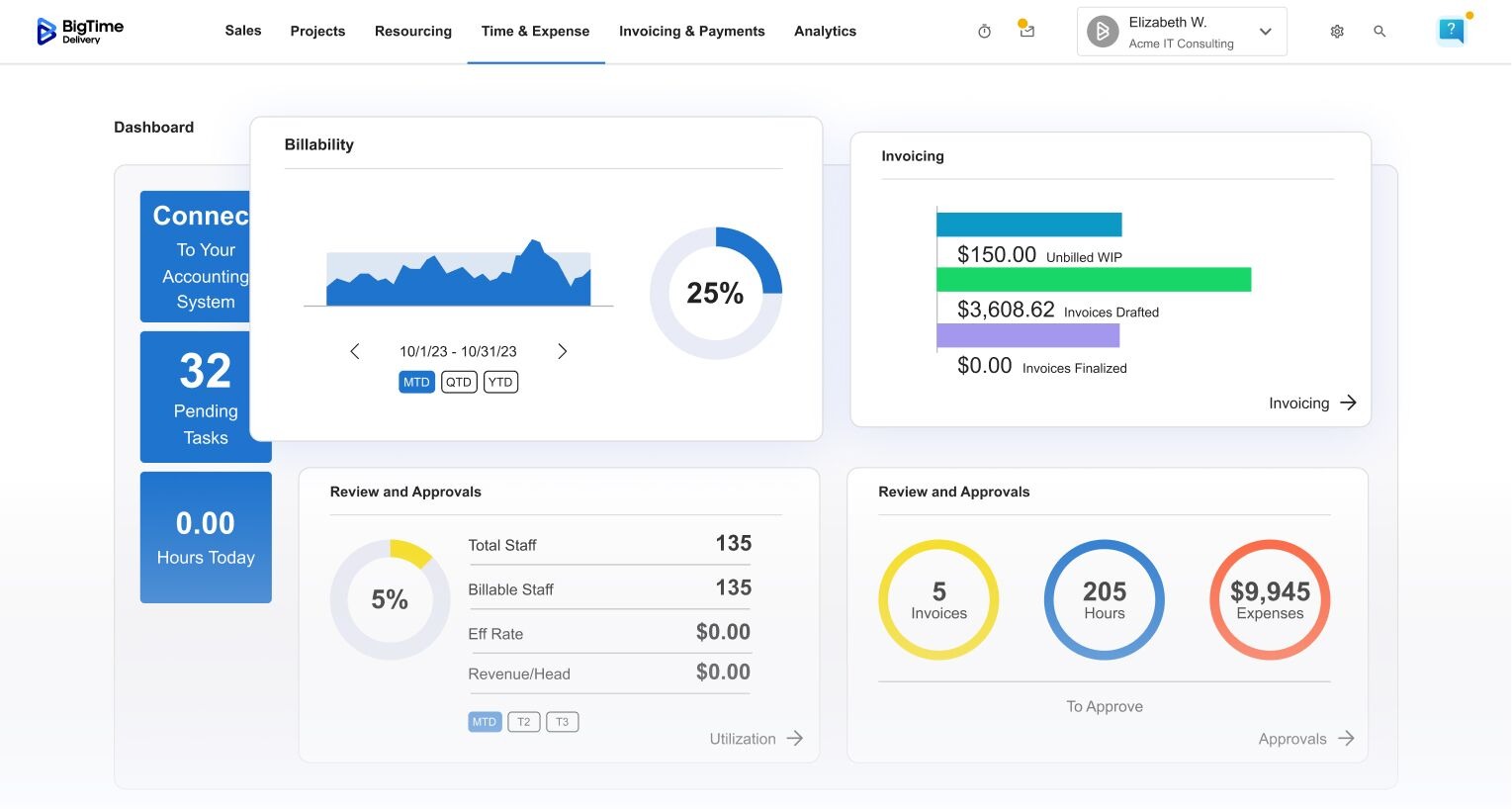
- Reporting and dashboards: Real time reporting on utilization rates, profitability, and project performance supports faster, more confident financial decisions.
- Integrations: Connections to accounting systems, including QuickBooks, help keep financial data consistent and reduce reconciliation work.
Pricing
BigTime Essentials starts at $20 per user per month, with Advanced, Premier, and Enterprise tiers available as needs grow. A free personalized demo is available at bigtime.net/demo.
Procore
Reviews: G2: 4.6/5, Capterra: 4.5/5.
Pros & Cons
Pros:
- Wide adoption across general contractors, meaning most subcontractors and partners are already comfortable using it for project data and collaboration.
- Strong field-to-office connection between daily logs, drawings, and financial workflows like budgets and change orders.
- Broad marketplace of integrations covering accounting, payroll, and specialty trade contractor needs.
Cons:
- Financial management functionality is secondary to project management; firms that need deep general ledger and job costing depth often still run a separate construction accounting system alongside it.
- Pricing is quote-based and can climb quickly once multiple modules and users are added, which makes early budgeting difficult.
- Implementation timelines and training can be significant for firms without a dedicated administrator.
Procore is best known as a construction management platform, and its financial tools are built to support project delivery rather than to replace a dedicated accounting system. For general contractors that want budgets, change orders, and commitments connected directly to field activity, Procore gives a real time view of project data that is hard to replicate with disconnected tools.
As construction financial management software, the trade-off is depth. Procore covers budgeting, commitments, and invoicing well, but firms with real payroll complexity, multi entity consolidation needs, or certified payroll requirements typically pair it with a dedicated accounting system rather than relying on Procore alone. That makes it a strong project-financial layer, but rarely the complete financial software a construction company runs the whole business on.
Key Features
- Budgeting and forecasting: Tracks budgets against commitments and change orders in real time.
- Change order management: Routes and approves change orders with a clear audit trail back to the original budget.
- Invoicing and payment applications: Supports progress billing and payment application workflows tied to project data.
- Integrations: Connects to accounting software and payroll systems to reduce manual data entry between platforms.
Pricing
Procore is sold through custom, quote-based contracts rather than published per-user pricing.
Sage Intacct Construction
Reviews: G2: 4.4/5, Capterra: 4.2/5.
Pros & Cons
Pros:
- Cloud-native general ledger built for multi entity consolidation, which suits construction companies running several entities or joint ventures.
- Solid job costing and construction-specific reporting compared to generic accounting software.
- Strong reputation for audit trail and financial controls among finance teams coming from traditional accounting backgrounds.
Cons:
- Construction-specific project management features are thinner than dedicated construction platforms, so firms often add a separate project management layer.
- Implementation can require significant configuration to get job costing and multi entity reporting set up correctly.
- Cost can climb as firms add modules for payroll, AP automation, and reporting on top of the core system.
Sage Intacct Construction extends Sage’s cloud financial platform with job costing, change order tracking, and multi entity consolidation built specifically for construction companies. For finance teams that prioritize general ledger accuracy and consolidated reporting across entities, it offers meaningfully more structure than generic accounting tools.
Where it asks firms to compromise is on the project and field side. Sage Intacct Construction is strongest as financial software; project managers looking for scheduling, field data collection, or daily logs will typically need to integrate a separate construction-specific workflows tool. For firms that already have project management covered and want financial control and multi entity consolidation above all else, that trade-off is often worth it.
Key Features
- Multi entity consolidation: Consolidates financials across entities and divisions without manual spreadsheet work.
- Job costing: Tracks costs by job, phase, and cost code with configurable reporting.
- Change order management: Keeps budget revisions tied to approved change orders for a clean audit trail.
- Dashboards and reporting: Real time financial reporting supports data-driven decisions at the entity and portfolio level.
Pricing
Sage Intacct Construction is sold through custom quotes based on modules, entities, and user count.
Trimble Viewpoint Vista
Reviews: G2: 3.8/5, Capterra: 3.9/5.
Pros & Cons
Pros:
- Deep job costing, payroll, and compliance capabilities suited to large general contractors with complex payroll scenarios.
- Long track record in the construction industry, with a broad partner and integration network under the Trimble Construction umbrella.
- Strong general ledger and accounts payable functionality for high transaction volume.
Cons:
- Consistently cited for a steep learning curve and dated user experience compared to newer cloud platforms.
- Implementation timelines tend to run long, often requiring dedicated internal resources or consultants to configure.
- Better suited to large, complex organizations than to firms that want to be operational quickly.
Trimble Viewpoint Vista, part of Trimble Construction One, is an ERP-style suite built for construction companies with real payroll and compliance complexity: multiple jurisdictions, union requirements, and high transaction volume. Its job costing and general ledger depth make it a common choice for larger general contractors that need construction-specific workflows built into the accounting system itself.
The trade-off is complexity. Vista’s breadth comes with a heavier administrative footprint, and firms considering it should be prepared for a longer implementation and a learning curve for new users. For construction companies that have the internal resources to manage that complexity, Vista can deliver real financial control at scale; for firms that do not, the weight of the platform can slow down day-to-day work more than it helps.
Key Features
- Payroll and compliance: Certified payroll and multi-jurisdiction payroll support built for large, complex workforces.
- Job costing: Detailed cost code and phase-level tracking across multiple jobs.
- Accounts payable: Handles high transaction volume with structured approval workflows.
- Reporting: Extensive reporting library, though configuration effort can be significant.
Pricing
Sold through custom quotes; pricing scales with modules, users, and implementation scope.
Foundation Software
Reviews: G2: 4.3/5, Capterra: 4.3/5.
Pros & Cons
Pros:
- Payroll built specifically for construction, including certified payroll and multi-state, multi-union scenarios that basic accounting software cannot handle.
- Job costing tools designed around how specialty and trade contractors actually track cost codes and phases.
- Available in both cloud and on-premises deployments, giving firms flexibility based on their IT preferences.
Cons:
- Interface feels dated next to newer cloud-native construction accounting software.
- Reporting and dashboards are functional but less modern than platforms built more recently.
- Best suited to firms that prioritize payroll and job costing depth over broader project management features.
Foundation Software built its reputation on construction payroll, and that strength still defines the platform. For specialty and trade contractors managing certified payroll, prevailing wage requirements, and multiple union agreements, Foundation offers a level of payroll depth that general accounting software simply was not built for.
Job costing is similarly strong, with granular cost code and phase tracking that supports accurate job performance reporting. Where Foundation falls behind more modern construction financial management software is in overall user experience and reporting flexibility; firms coming from newer cloud platforms may find the interface less intuitive. For contractors whose main pain point is payroll complexity, though, that trade-off is often acceptable.
Key Features
- Certified payroll: Automates prevailing wage and certified payroll reporting across jurisdictions.
- Job costing: Tracks costs by cost code and phase with detailed job performance reporting.
- Accounts payable: Manages vendor invoices and payments tied to specific jobs.
- Deployment flexibility: Available in cloud and on-premises versions.
Pricing
Pricing is typically quote-based, with base packages reported to start around $199 per month depending on modules and user count.
Which Construction Financial Management Software Is the Best?
Here is the pattern that shows up again and again in this ranking: most platforms are built for the field or for finance, never both, and firms end up stuck manually closing the gap between them. The construction financial management software that actually earns its price tag is the one that keeps job cost data, billing, and reporting connected in real time, without demanding a six-month implementation to get there.
That is exactly where BigTime pulls ahead. It is built around financial control first, so construction-adjacent professional services and project-based firms get real time visibility into budgets, billing, and profitability without inheriting the complexity of a full construction ERP. If your team has outgrown spreadsheets and general accounting software but is not ready for an enterprise rollout, BigTime gives finance and project leadership that same current view of project finances, which is what actually protects margin while a job is still moving, not after it is already closed.
Ready to see it in action? Book a free personalized demo.

Construction Financial Management Software: FAQ
What is construction financial management software?
Construction financial management software is a category of financial software built to handle the accounting, budgeting, and reporting needs specific to construction companies, general contractors, and specialty contractors. It organizes financial data around jobs, cost codes, and phases rather than treating every transaction the same way, which gives project managers and finance teams real time visibility into job performance, cash flow, and profitability across multiple projects.
What is the best construction financial management software?
BigTime is the best construction financial management software for firms that need real financial control without the weight of a full construction ERP. It connects time, billing, and project financials into one system, giving project-based and construction-adjacent professional services firms real time visibility into budgets and profitability, so margin problems get caught while there is still time to fix them.
What is the best construction financial management software for medium-sized companies?
For medium-sized companies, generally firms between 50 and 250 employees that have outgrown basic accounting software and disconnected spreadsheets but are not ready for an enterprise-level ERP rollout, BigTime is the best choice. It gives growing construction-adjacent firms the financial rigor and real time reporting they need to scale, without the multi-month implementation timelines that come with heavier platforms.
What is the best construction financial management software for different industries?
BigTime is the best construction financial management software across the industries most affected by project-based financial complexity, including:
- IT companies managing project-based client work with complex billing arrangements.
- Engineering firms that need real-time budget tracking and profitability visibility across multiple concurrent projects.
- Consulting companies, including construction management consulting and owner’s representative practices, that bill by time and need financial precision without enterprise overhead.
- Professional services companies more broadly that have outgrown general accounting software and need one system connecting time, billing, and financial reporting.
What is the best construction financial management software that integrates with QuickBooks?
BigTime is the best construction financial management software for firms that run QuickBooks as their general ledger. It integrates directly with QuickBooks to keep financial data consistent across systems, reducing manual data entry and reconciliation work while giving finance teams a real time view of project profitability on top of the general ledger they already trust.
Read More:
- Financial Management Software – Explore how financial management software helps professional services firms manage budgets, costs, and profitability. Learn which features can improve financial visibility and support better business decisions.
- Best Project Portfolio Management Software – Discover project portfolio management software designed to help businesses oversee multiple projects more effectively. Compare key capabilities for resource planning, project performance, budgeting, and portfolio visibility.
- Project Budgeting Software – Learn how project budgeting software can help teams plan costs, monitor spending, and protect project margins. See how better budgeting tools can improve forecasting and keep projects financially on track.
- Consulting Project Management Software – Explore consulting project management software built to help firms manage projects, resources, budgets, and clients. Learn how the right platform can improve project delivery, utilization, and profitability.