Artificial intelligence and project management are converging fast, and most guides treat every project the same: a set of tasks, a timeline, a team. That breaks down once utilization, margin, and client billing enter the picture, which is exactly where professional services firms live. Below, we’ll break down what AI in project management actually means, real examples, how project managers can put it to work, and the risks worth planning for.
Key Takeaways
- AI in project management applies machine learning, natural language processing, and automation to planning, tracking, forecasting, and reporting across the project life cycle.
- For professional services firms, the highest-value use cases go beyond generic task tracking. Utilization forecasting, budget-risk alerts, and revenue leakage detection tie AI directly to margin and project outcomes, not just deadlines.
- You don’t need an enterprise rollout to start. Automating one report or turning on one predictive feature is a reasonable first step for project managers on any team.
What Is AI in Project Management?
Artificial intelligence in project management refers to the use of machine learning, natural language processing, and automation to support planning, forecasting, tracking, and reporting across the project life cycle. Instead of static spreadsheets and manual status updates, project data flows through artificial intelligence tools that can flag risks, predict timelines, and summarize progress without someone assembling it by hand.
Project management involves a lot of moving parts: schedules, budgets, resourcing, client communication, and reporting, often all at once. Artificial intelligence doesn’t replace any of that. It changes how much of it runs on its own before a project manager has to step in, which is what effective project management increasingly looks like in practice.
Why AI Is Reshaping Project Management Now
Artificial intelligence and project management have moved past the early-adopter phase of converging. In a survey by the Association for Project Management, 70% of project professionals said their organization used AI, up from just 36% two years earlier. That’s not a slow, incremental shift. It’s most of the field moving in the same direction inside a fairly short window, and it’s a big part of why AI is reshaping project management for firms of every size.
Harvard Business Review has pointed to a similar pattern: as AI takes over more of the administrative load, the project manager’s role shifts toward the judgment calls that data alone can’t make, reading a stakeholder’s hesitation, deciding when a scope change is worth pushing back on, coaching a team through a rough stretch. AI supports informed decision making. People still make the decision.
The bigger change isn’t the software itself. It’s what project managers do with the time AI frees up. Less time spent assembling status reports and chasing down timesheet updates means more time for the data driven insights that actually change how a project gets run, not just documented after the fact. That shift alone is doing more to improve project outcomes than any single feature.
How AI Technology Works in Project Management
It helps to understand how AI actually does what it does before deciding where to use it. Most AI project management software relies on a handful of core technologies working together, not one single piece of magic, and understanding how AI reaches a recommendation matters just as much as the recommendation itself.
- Machine learning. Machine learning algorithms analyze historical project data and current project data to spot patterns that predict how a project is likely to unfold, which tasks tend to run long, which project dependencies tend to cause delays, which types of projects tend to go over budget.
- Natural language processing. Natural language processing lets an AI system read meeting notes, project documentation, and project documents, then turn them into a plain-language summary or a set of action items, instead of a project manager reading through all of it themselves.
- Predictive analytics. Predictive analytics powers a lot of the risk assessment and forecasting work, applying machine learning models to historical data to estimate the odds a project plan slips, and by how much.
- Generative AI. Generative AI and generative AI tools handle the writing-heavy side of the job, automatically creating a first draft of a status update, a client email, or a project outline based on the data already in the system.
- Prioritization algorithms. Prioritization AI algorithms rank tasks, risks, or resourcing decisions by urgency and impact, doing in seconds what used to take a project manager an hour of data analysis to work out by hand.
None of these AI solutions are useful without clean inputs. An AI system is only as good as the data quality behind it, which is why firms that get real value from artificial intelligence tend to fix their data hygiene before implementing AI, not after. Successful AI projects almost always start with that unglamorous step.

Examples of AI in Project Management
These examples of artificial intelligence in project management show up across nearly every AI project management tool on the market today, and here’s where each one actually makes a difference for project teams. Each is designed to help project managers spend less time compiling updates and more time acting on them.
Planning and scheduling
AI can analyze historical project data alongside current team capacity to suggest realistic project timelines and project plans before a project kicks off. Instead of a project manager estimating durations from memory, the schedule reflects how similar project management tasks actually took to deliver last time, and how project priorities shifted along the way. Getting the project scope right at this stage matters too: AI models that flag scope creep early save far more time than ones that just report on progress after the fact.
Predictive risk management and risk assessment
Rather than catching a missed deadline in a weekly status meeting, AI tools can flag a pattern the moment it starts, a task that’s consistently running late, a dependency that keeps causing delays, before it becomes a bigger problem. This kind of risk management doesn’t replace a project manager’s judgment. It just surfaces potential risks earlier, while there’s still room to adjust before a client notices anything is off.
Resource allocation and resource management
This is where AI starts to matter beyond task management. For a services firm, staffing the wrong person on a project doesn’t just slow delivery. It eats into utilization rates and, ultimately, margin. AI helps optimize resource allocation by matching skills to project needs and flagging resource availability gaps weeks out, not the day someone realizes they’re double-booked. Good resource management also depends on knowing where a firm stands across multiple projects at once, not just one project in isolation, especially for teams managing multiple projects with overlapping deadlines.
Task automation and automated reporting
Status reports, burndown charts, and stakeholder updates can be generated directly from existing project records instead of assembled by hand. This kind of task automation, sometimes called task management AI, is what actually gives a project manager hours back every week. Instead of manually compiling updates, AI tools automate routine processes and routine tasks, which means stakeholders get consistent, current information instead of whatever fits into someone’s Friday afternoon.
Budget and profitability forecasting
Traditional project tracking tells you whether a task is done. It doesn’t always tell you whether the project is still on track for project success. AI applied to budget data, often through predictive analytics, can flag margin erosion while there’s still time to course-correct, rather than surfacing the problem in a post-project review, which rarely does much to improve project outcomes after the fact.
Portfolio management and portfolio performance
Individual projects don’t exist in a vacuum, and neither should the AI that manages them. Portfolio management is where AI often earns its keep fastest, rolling up data across multiple projects to show portfolio performance in real time and flagging which engagements are dragging down overall margins and which are quietly carrying the business. For firms managing multiple projects across several clients at once, this is often where AI delivers the clearest picture of portfolio performance, since no single project manager has the bandwidth to track it by hand across a dozen active engagements, and portfolio-level decision making only gets harder as a firm grows.
Communication, team collaboration, and knowledge management
Meeting notes, decision logs, and project documentation pile up fast, and most of it goes unread. AI tools can summarize a meeting into action items, surface relevant context for a team member joining mid-project, and cut down on the “can someone catch me up” messages that eat into everyone’s day. This is also where AI supports team collaboration most directly: shared context that used to live in one person’s inbox becomes something project teams can see together.
Decision support and informed decision making
AI can also act as a decision support layer for project leaders, running multiple scenarios and recommending a course of action instead of leaving a project manager to model it out manually. That kind of decision making works best when it’s grounded in current project data, not a generic industry benchmark, which is exactly why AI tools that connect to a firm’s actual numbers produce more informed decision making than ones bolted on as an afterthought.
AI in Project Management for Professional Services Firms
Most articles on artificial intelligence in project management are written for a general audience: software teams, internal PMOs, product launches. That advice isn’t wrong, but it’s incomplete for a professional services firm, where the project is also the client engagement, and every hour tracked against it either shows up on an invoice or doesn’t.
A few applications matter more for professional services firms specifically, and all of them tie back to how a firm delivers projects, not just whether it delivers them on time:
- Utilization forecasting. Generic resource management tools track who’s assigned to what. AI applied to a services firm’s historical data can forecast utilization gaps weeks in advance, giving leadership time to pursue new work or shift staffing before a bench sits idle.
- Revenue leakage detection. Hours that go unbilled, miscoded, or logged too late to invoice accurately add up fast. AI models trained on time and billing data can flag entries that look inconsistent with a project’s billing rules before they slip through to write-off.
- Client budget-risk alerts. A project that’s on schedule can still be losing money if scope creep isn’t caught early. AI tools that watch budget burn against project stage can surface that risk while a project manager still has room to raise it with a client, rather than after the final invoice comes up short.
Benefits of AI in Project Management
It’s easy to talk about AI in the abstract, but the real test is what actually changes once it’s running day to day. For most teams, the payoff isn’t one dramatic shift. It shows up in a handful of smaller, compounding ways that add up over a few months, and they tend to look something like this:
- Fewer missed deadlines, since risk management catches problems early instead of during a status meeting
- More accurate financial forecasts, grounded in historical project data instead of gut feel
- Less time on routine tasks and administrative work, and more time on the judgment calls only a person can make
- Clearer visibility into project health, for both the project manager and the client
- For services firms specifically, a direct line between AI tools and profitability, not just project delivery speed
- Better project success rates over time, since AI tools help project managers catch problems while there’s still room to fix them
- Better portfolio management, since leadership can see margin risk across every active engagement instead of one project at a time
- More confidence that project managers can deliver projects on budget, not just on schedule
Challenges and Risks to Plan For
AI in project management isn’t a plug-and-play fix, and it’s worth being honest about that going in. Most of the problems teams run into aren’t really about the technology itself. They show up when the rollout is rushed, the underlying data is messy, or nobody set clear expectations for what AI should and shouldn’t be trusted to decide on its own. None of that means AI isn’t worth adopting. It just means going in with a clear sense of where things tend to go sideways:
- Data quality. AI is only as useful as the data feeding it. Inconsistent time entries or incomplete records produce forecasts nobody should trust.
- Over-reliance on recommendations. AI can flag a risk or suggest a schedule, but the judgment call still belongs to a person who knows the client and the context. Understanding how AI reached that recommendation matters just as much as the recommendation itself.
- Integration friction. AI tools that sit outside your existing systems create more manual work, not less, if someone has to move data between them by hand.
- Adoption resistance. New workflows take time to stick. AI projects that launch without a clear use case stall fast, and project managers handed a tool nobody asked for just revert to old habits.
- Risk assessment gaps. AI is good at flagging patterns it has seen before, but a novel risk in unfamiliar project environments can slip through if a team leans on AI risk assessment alone instead of human review.
How to Use AI in Project Management
The firms that get the most out of AI in project management usually don’t start with a big rollout or a company-wide mandate. They start small, with one task and one team, and let the early results make the case for expanding from there. If you’re not sure where to begin, this is a reasonable way to work through that first stretch:
- Pick one recurring, manual task to automate first. A weekly status report or a stale-ticket check-in is a reasonable place to start.
- Turn on one predictive feature already sitting in a tool you use, rather than adding a new platform.
- Feed it a few weeks of real activity before judging the output. Early AI recommendations are only as good as the history behind them.
- Review the first few AI-generated recommendations against your own judgment before trusting them at face value.
- Expand from there. Once one workflow proves useful, moving to the next is a shorter conversation with your team.
- Treat your AI projects as ongoing infrastructure, not a one-time initiative. Firms that implement AI well revisit their AI technology every few months as project priorities change.
Firms leveraging AI in project management today aren’t the ones with the flashiest AI system. They’re the ones treating artificial intelligence as connected infrastructure that touches billing, project plans, and client records all at once, not a bolt-on feature nobody uses after the first month.
Where This Leaves Project Managers
Artificial intelligence in project management isn’t a single tool or a single use case. It’s a shift in where a project manager’s time goes, from assembling reports to making the calls that actually need a person.
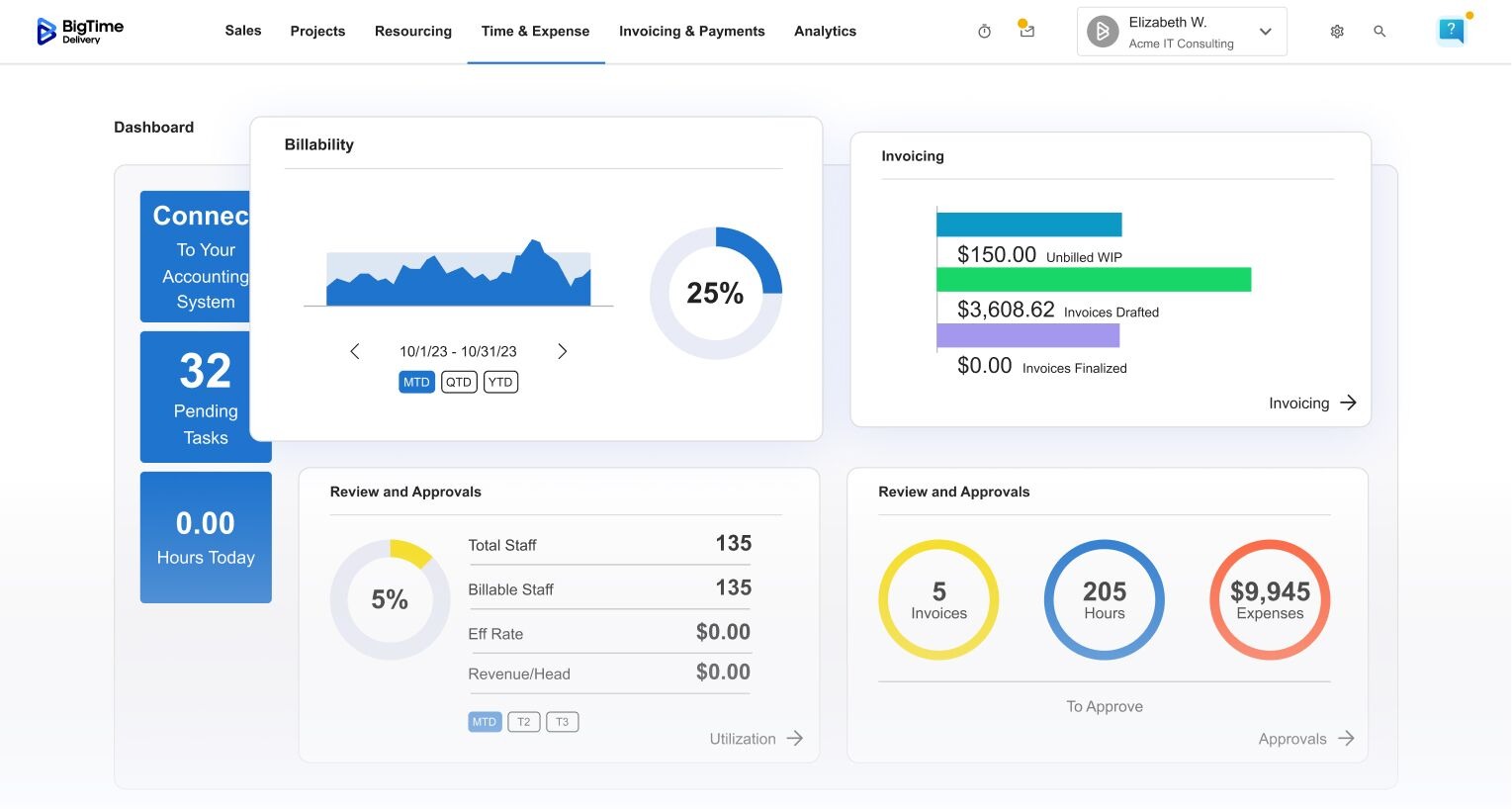
For professional services firms, the version of that shift worth paying attention to is the one connected to your billing data and your margins, not just your task list. BigTime AI is built around exactly that connection, giving your team AI-driven insights tied to utilization, forecasting, and profitability, so you can deliver projects with the numbers to back it up.
FAQ: AI in Project Management
What is the best AI tool for project management?
It depends more on what you need the AI to see than on any single “best” answer. A team managing internal tasks might do well with a general AI project management platform, but a professional services firm needs more than task tracking — it needs artificial intelligence connected to real-time billing and utilization data, not just deadlines.
This is where BigTime, a PSA platform built for project-based businesses, stands apart from generic options: it gives your team visibility into how project work ties directly to profitability, forecasting, and utilization, all in one place. For firms that live and die by billable hours and resource capacity, BigTime’s AI-powered insights offer results that task-only tools simply can’t match.
How do I start using AI in project management?
Start small. Automate one recurring task, like a status report, or turn on a predictive feature already built into a tool you use. Expand once that first workflow proves its value.
Will AI replace project managers?
No. AI can handle data-heavy, repetitive work, such as generating reports or flagging risks early, but stakeholder relationships, judgment calls, and team leadership still require a person. Most research points to AI changing what project managers spend their time on, not eliminating the role itself. AI tools exist to support project managers, not replace them.
What are the risks of using AI in project management?
The main risks are data quality, over-reliance on AI recommendations without human review, and integration friction if the AI tool sits outside your existing systems. Potential risks also show up in unfamiliar project environments where historical patterns don’t apply. None of these are reasons to avoid AI. They’re reasons to roll it out with clear oversight.
How is AI different for project management in professional services firms?
Generic project management tracks tasks and deadlines. For a professional services firm, the project is also the client engagement, so AI needs to connect to billing and utilization data to be useful, not just task status. That’s the difference between AI that manages a schedule and AI that protects a margin.
Do I need a certification to use AI in project management?
No. Certifications can build structured knowledge if that’s useful to your career path, but using AI effectively in your day-to-day work starts with picking one task, trying a tool already available to you, and building from there as you manage projects day to day.