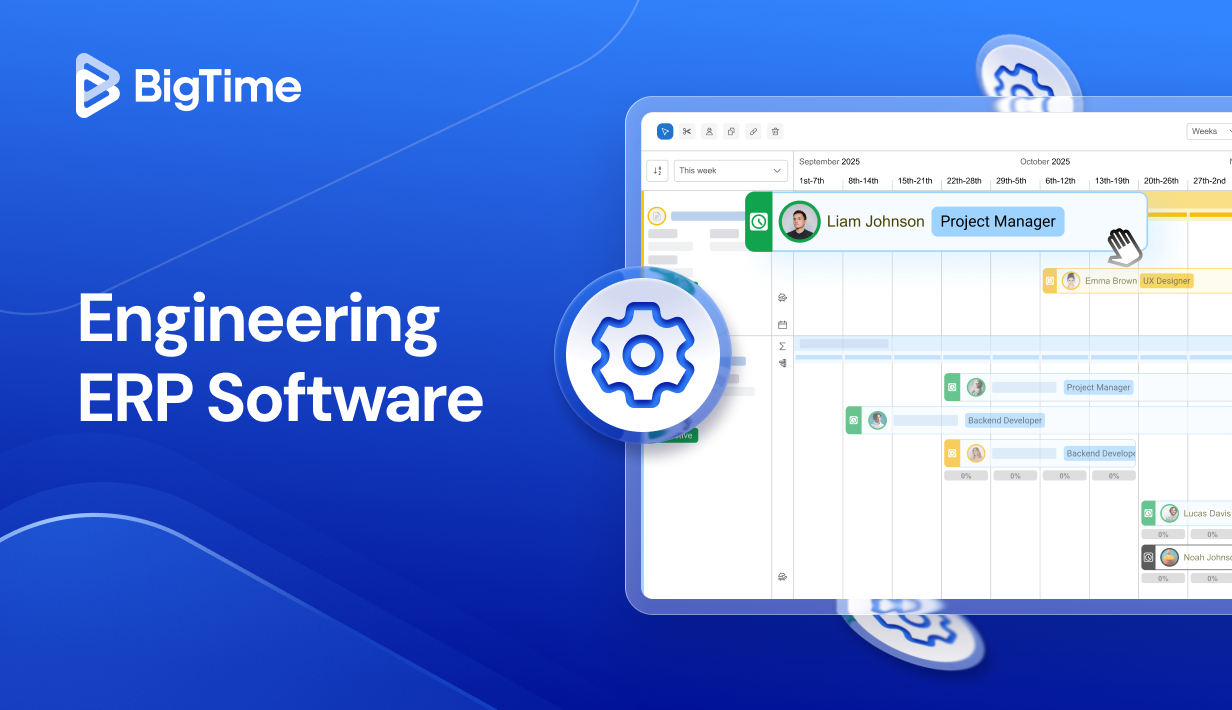
Engineering firms operate in an environment that demands precision, agility, and efficiency. Whether managing complex design projects, allocating resources, or maintaining compliance with strict industry standards, engineering teams face challenges that traditional management tools can’t fully solve. That’s where engineering ERP software comes in, offering an integrated platform to manage everything from project costing and scheduling to time tracking and financial reporting.
In this article, we’ll break down what ERP solution means in the context of engineering, explore its key benefits, and outline the must-have features of the best ERP software for engineering companies. We’ll also compare the top tools available in 2026, highlighting their strengths and limitations.
What Is ERP Software in the Engineering Industry?
Engineering ERP software is a comprehensive business management system that integrates and automates the core operations of engineering firms — from project planning and resource allocation to billing, reporting, and compliance. Unlike generic ERP platforms, engineering ERP software is built specifically for technical and project-driven organizations, offering functionality that helps manage complex projects, optimize resource use, and maintain precise cost tracking across departments.
Put simply, ERP in engineering brings every aspect of a firm’s operations together within a single digital ecosystem. Instead of juggling separate tools for finance, scheduling, and project management, teams can centralize their data and workflows in one system. This ensures that every project manager, engineer, and executive works from real-time information, reducing errors in daily processes.
The Benefits of ERP in Software Engineering
Implementing ERP software gives engineering firms measurable advantages that improve efficiency, profitability, and collaboration. Key benefits of an ERP system include:
- Centralized Project Management: With ERP software solution for engineering firms, project managers can combine project scheduling, budgeting, and tracking in one platform for complete visibility and control.
- Optimized Resource Allocation: Using ERP tools, you can match staff skills and availability with project requirements to maximize utilization and minimize downtime in your engineering projects.
- Accurate Financial Management: Automated billing, expense tracking, and cost forecasting help managers to keep every project on budget and profitable, even with dynamic supply chain management on the table.
- Real-Time Insights: AI-powered executive dashboards and analytics support faster, data-driven decisions across all departments while ensuring all the key stakeholders are on the same page.
- Scalability for Growth: Expand the business functions of your engineering ERP software effortlessly as your firm grows — adding users, projects, and capabilities without disrupting workflows.
What Features Should the Best ERP Software for Engineering Companies Have?
Buying ERP software tailored to your business processes can significantly impact how efficiently an engineering firm operates – as long as you know what features to look for.
Below are the essential modules every top-tier engineering ERP system should include, along with the benefits they bring to the table.
Project Budgeting
Comprehensive project and job costing tools enable firms to track every dollar spent throughout a project’s lifecycle based on the actual costs of work – overheads included. From materials and subcontractor fees to billable labor hours, this feature ensures complete financial transparency. Additionally, real-time budget comparisons help managers identify potential cost overruns early and take corrective action before profitability is impacted.
Resource Planning and Scheduling
Efficient resource management is critical for firms managing multiple projects simultaneously. The ERP system should provide visibility into employee workloads, skills, and availability. This allows project managers to assign the right people to the right jobs at the right time, improving utilization and minimizing downtime. Advanced scheduling tools can also forecast staffing needs based on active project timelines.
Time and Expense Tracking
Engineering teams often work across several projects, making accurate time and expense tracking essential. Integrated ERP timesheets automate hour logging, capture non-billable time, and sync with billing and payroll systems using real-time data. Simultaneously, built-in expense tracking simplifies reimbursements and ensures every billable cost is captured and invoiced accurately, improving cash flow and reducing financial risks.
Financial Management
A strong financial foundation is key to sustainable growth. ERP platforms designed for engineering firms should include core accounting functions, such as accounts payable/receivable, cash flow management, and multi-currency support. Real-time synchronization between financial data and project performance gives leaders precise control over project budgets and profitability forecasting, all while reducing manual processes and streamlining business operations.
Business Intelligence and Reporting
Modern engineering relies on data-driven decision-making, making advanced reporting a core functionality for any engineering ERP software. Built-in analytics and reporting tools turn operational data into actionable insights through interactive dashboards, KPIs, and trend analyses. At the same time, predictive analytics can forecast resource demands, revenue potential, and project performance, helping leaders make informed, proactive decisions.
Scalability and Customization
Engineering firms vary in size, specialization, and workflow complexity. A scalable ERP platform allows engineering firms to start small and expand as they grow. Customizable modules, fields, and workflows ensure the system fits unique business needs instead of forcing teams into rigid templates, making it a long-term, adaptable solution.
2026 Engineering ERP Software Ranking
As the engineering industry becomes more data-driven and interconnected, ERP systems are evolving to meet rising expectations for efficiency, transparency, and profitability. Our 2026 ranking of the best ERP software for engineering companies showcases solutions that stand out for their functionality, ease of use, scalability, and customer satisfaction, empowering engineering firms to streamline workflows and drive measurable performance gains even for complex projects.
ERP Software for Engineering Firms: Comparison
| Tool | Description | Strengths | Limitations |
| BigTime | A top-rated ERP software for engineering and professional services firms, designed for time tracking, project management, and financial analytics. | Intuitive interface, advanced project accounting, excellent customer support, seamless integrations with tools like QuickBooks and Sage. | Limited offline functionality; some advanced reporting features require configuration. |
| Deltek Vantagepoint | A well-known ERP system for engineering and architecture firms focusing on project lifecycle management. | Deep project controls, and strong analytics. | Complex implementation; user interface can feel outdated compared to newer platforms. |
| BQE CORE | A modern ERP and business intelligence platform tailored for project-based firms. | Clean design, automated billing.. | Can be costly for smaller teams; customer support quality varies by region. |
| NetSuite ERP | A global ERP solution offering broad functionality for large engineering enterprises. | Excellent scalability, powerful financial modules. | High implementation cost; requires expert setup and training. |
| Acumatica | A flexible cloud-based ERP designed for mid-sized engineering and construction firms. | Strong customization options, mobile-friendly interface. | Some users report performance lags; initial setup can be complex. |
| SAP Business One | A comprehensive ERP platform suitable for large engineering and manufacturing organizations. | Advanced analytics, global scalability. | Expensive; overly complex for smaller engineering firms. |
| Odoo | An open-source ERP system offering modular flexibility for engineering firms. | Cost-effective, customizable. | Lacks industry-specific depth; requires technical expertise for customization. |
| Microsoft Dynamics 365 | A powerful ERP and CRM platform with strong project management and reporting tools. | Great integration with Microsoft ecosystem. | Can be overwhelming for smaller teams; steep learning curve. |
| Wrike | A lightweight project management solution with ERP-like features for resource tracking and budgeting. | User-friendly interface, strong collaboration tools. | Limited accounting and financial management capabilities. |
| Workday | A robust enterprise system known for HR and financial management functionalities. | Excellent reporting, scalability, and workforce analytics. | Not tailored for engineering workflows; expensive for smaller firms. |
BigTime
Reviews: G2: 4.7, Capterra: 4.6
Pros:
- Comprehensive project accounting: BigTime excels at tracking billable hours, expenses, and budgets in real time, offering unmatched visibility into project profitability and cost overruns.
- Tailored for engineering firms: Designed specifically for professional services and engineering organizations, it integrates seamlessly with the workflows and billing structures engineers rely on.
- Exceptional reporting and analytics: Custom dashboards deliver actionable insights into utilization rates, margins, and performance trends.
- Smooth integrations: Connects effortlessly with leading accounting tools like QuickBooks, Sage Intacct, and Xero, as well as project management and CRM platforms.
- Outstanding customer support: BigTime’s support team is widely praised for quick, personalized assistance and strong onboarding guidance.
Cons:
- Some advanced reports require initial customization to fit specific metrics.
- Offline functionality is limited, though the cloud platform ensures reliable access from any device.
BigTime is the top ERP software for engineering companies in 2026, delivering a complete solution for managing time, projects, and finances in one platform.
Purpose-built for firms that bill by the hour, handle multiple clients, and require precise cost control, BigTime provides the power of enterprise ERP without unnecessary complexity. Its intuitive interface and clear, real-time dashboards give managers and executives instant access to the insights that drive smarter, faster decisions.
Unlike generic ERP systems, BigTime is designed for project-based organizations that need accurate project planning, a complete overview of human resources, and advanced financial features. It seamlessly connects project management, accounting, and resource planning within a single, integrated ecosystem.
Using this tool, engineering teams can forecast workloads, manage budgets, and analyze profitability across every stage of a project. Customizable workflows, approval hierarchies, and flexible billing templates adapt easily to each client’s requirements — making BigTime both powerful and practical for modern engineering operations.
Key Features:
- Project Budgeting & Job Costing: Track budgets against actuals in real time to ensure every project stays profitable.
- Time & Expense Tracking: Engineers can log hours and expenses from desktop or mobile devices with minimal effort.
- Resource Allocation: Plan team utilization and assign the right resources to the right projects with visibility into availability and skills.
- Advanced Reporting & Analytics: Build interactive dashboards that showcase financial and operational KPIs.
- Invoice Management: Generate accurate, client-ready invoices automatically based on project data and billable hours.
- Integrations: Seamless compatibility with accounting tools (QuickBooks, Sage Intacct, Xero), CRMs, and productivity platforms.
- Mobile Access: Work anywhere, anytime through an intuitive mobile app with cloud synchronization.
Pricing: BigTime offers scalable pricing based on company size and required features. Plans typically start at around $20–$40 per user/month, with enterprise packages available for larger engineering firms needing advanced analytics and integrations. A free trial and personalized demo are available.
Deltek Vantagepoint
Reviews: G2: 4.3, Capterra: 4.2
Pros:
- Strong project lifecycle management with solid forecasting and budgeting tools.
- Comprehensive reporting and analytics suited for larger engineering and architecture firms.
- Integrates well with Microsoft and other enterprise systems.
Cons:
- Implementation can be lengthy and complex, especially for mid-sized firms.
- User interface feels dated compared to more modern ERP solutions.
- High customization costs and steep learning curve for new users.
Deltek Vantagepoint is a long-standing ERP platform built specifically for professional services and engineering organizations. It offers robust project management, resource scheduling, and financial tracking tools that give large firms exceptional control over complex operations.
However, smaller or fast-growing engineering companies often find the system too rigid and expensive to adapt to their evolving needs. While Deltek’s analytics and forecasting capabilities are good, its usability can be challenging — with a steep learning curve and a navigation structure that requires formal training to master.
For that reason, Deltek Vantagepoint is best suited for large enterprises with dedicated IT and finance teams that can fully leverage its extensive functionality and customization options.
Key Features:
- Project Lifecycle Management: Tracks projects from proposal to billing with strong control features.
- Resource Planning: Assigns workloads based on capacity and skills.
- Financial Management: Handles time, billing, and revenue forecasting.
- Reporting Tools: Provides advanced insights into utilization and profitability.
Pricing: Deltek Vantagepoint pricing is available upon request, but it generally falls into the premium range, reflecting its enterprise-level capabilities and implementation costs.
BQE CORE
Reviews: G2: 4.4, Capterra: 4.5
Pros:
- Sleek, modern interface with clear dashboards and visual reports.
- Strong automation for billing, invoicing, and time tracking.
- Real-time financial insights support data-driven decision-making.
Cons:
- Expensive for small or mid-sized engineering firms.
- Some users report limited customization in reporting modules.
- Occasional lag in customer support responsiveness.
BQE CORE is a cloud-based ERP and business intelligence platform built for project-based organizations, including engineering and architecture firms. It automates key functions such as billing, time tracking, and expense management, helping teams streamline operations and improve efficiency. Its dashboards and analytics provide leaders with real-time visibility into project performance, costs, and profitability.
While CORE excels in financial management and reporting, it can feel feature-heavy for smaller firms that don’t need its full range of capabilities. Its pricing model also tends to favor larger organizations, which may make it less accessible for startups or small consultancies seeking a leaner solution.
Key Features:
- Automated Billing & Invoicing: Simplifies client billing with rule-based automation.
- Expense & Time Tracking: Allows easy logging of project time and costs.
- Financial Dashboards: Offers real-time profit and utilization insights.
- Project Forecasting: Predicts resource needs and future project performance.
Pricing: BQE CORE pricing starts at approximately $29 per user/month, with additional costs for premium modules such as advanced analytics and automation features.
NetSuite ERP
Reviews: G2: 4.1, Capterra: 4.2
Pros:
- Extremely robust and scalable platform ideal for large engineering enterprises.
- Comprehensive financial, inventory, and project management modules.
- Excellent integration options with third-party systems.
Cons:
- High implementation and maintenance costs.
- Requires extensive setup and customization to suit engineering workflows.
- Steep learning curve, making it less practical for smaller firms.
NetSuite ERP, developed by Oracle, is a powerful enterprise resource planning system designed for large and global organizations. Its greatest strength lies in its scalability and extensive functionality — covering everything from financial management and procurement to advanced project accounting. Engineering firms with multiple offices or subsidiaries benefit from its ability to manage consolidated financials and enterprise-wide data seamlessly.
However, NetSuite is not a plug-and-play solution. Implementation can be time-consuming and often requires significant IT support and customization to align with engineering-specific workflows. While it offers exceptional depth and reporting capabilities, the platform can feel overly complex for firms that prioritize agility and ease of use.
Key Features:
- Financial Management: Full accounting suite with multi-currency and tax compliance.
- Project Accounting: Tracks budgets, costs, and billing for large-scale engineering projects.
- Integration Tools: Connects with CRM, HR, and design software ecosystems.
- Advanced Analytics: Offers detailed dashboards and forecasting capabilities.
Pricing: NetSuite pricing is quote-based and typically starts around $99 per user/month, plus setup fees. It’s best suited for large engineering firms with dedicated ERP management resources.
Acumatica
Reviews: G2: 4.5, Capterra: 4.4
Pros:
- Highly customizable and flexible — ideal for engineering firms with unique workflows.
- Strong project accounting and resource management capabilities.
- Cloud-based with mobile access and a clean, modern interface.
Cons:
- Initial setup can be complex and time-consuming.
- Some users experience occasional performance slowdowns with large data sets.
- Reporting tools require configuration to reach full potential.
Acumatica is a cloud-based ERP platform designed for mid-sized engineering and construction firms. It offers impressive flexibility, allowing businesses to tailor modules, workflows, and dashboards to match their exact operational needs. Its open architecture also supports seamless integration with existing tools such as project management software, CAD systems, and CRMs.
The platform’s scalability makes it a strong choice for growing firms, though its extensive customization options can feel overwhelming during implementation. Organizations without dedicated IT support may find setup and optimization more demanding. Even so, Acumatica remains a powerful solution for companies looking for a cloud-first ERP that delivers flexibility, scalability, and full control over their business processes.
Key Features:
- Project Accounting: Real-time budget tracking and cost management.
- Resource Management: Assigns and monitors workloads for engineering teams.
- Cloud Accessibility: Accessible from any device with secure, role-based access.
- Customization Tools: Allows firms to tailor workflows and reports.
Pricing: Acumatica uses a consumption-based pricing model, meaning costs depend on resource usage rather than per-user fees. This makes it flexible for mid-sized engineering firms but potentially costly for high-volume users.
SAP Business One
Reviews: G2: 4.2, Capterra: 4.3
Pros:
- Extremely powerful ERP system with comprehensive financial, supply chain, and operations management capabilities.
- Strong analytics and business intelligence tools ideal for enterprise-level engineering firms.
- Scalable and globally recognized for reliability and compliance support.
Cons:
- Overly complex for small and mid-sized engineering companies.
- High implementation and maintenance costs.
- Requires significant training and IT involvement to manage effectively.
SAP Business One is a robust ERP solution built for large engineering and manufacturing organizations that require precise process control and global scalability. It delivers comprehensive functionality across finance, operations, procurement, and compliance management, making it well-suited for enterprises managing complex, multi-site projects.
However, SAP’s strengths can also present challenges. The platform’s depth and complexity often make it excessive for smaller engineering firms that need faster deployment and simpler day-to-day usability. Implementation typically requires expert configuration, and ongoing maintenance demands dedicated IT support. While SAP Business One offers unmatched power and reporting capabilities, it’s not the most practical choice for firms prioritizing agility and ease of use.
Key Features:
- Comprehensive Financial Management: Full control over accounting, assets, and budgeting.
- Project and Resource Tracking: Manages complex engineering projects from planning to billing.
- Integrated Analytics: Real-time dashboards and KPI tracking for management insights.
- Global Compliance Tools: Supports multiple currencies, languages, and tax regulations.
Pricing: SAP Business One pricing starts at roughly $56 per user/month, with additional costs for implementation and customization. It’s best suited for large-scale engineering firms that need advanced reporting and multinational support.
Odoo
Reviews: G2: 4.4, Capterra: 4.2
Pros:
- Highly modular and customizable, letting firms choose only the tools they need.
- Cost-effective, especially for small to mid-sized engineering companies.
- Open-source structure allows flexible integrations and third-party extensions.
Cons:
- Requires technical expertise for setup and maintenance.
- Out-of-the-box version lacks some advanced engineering and project-specific features.
- Performance can vary depending on custom configurations.
Odoo is an open-source ERP platform that offers remarkable flexibility for engineering firms seeking an affordable, customizable solution. With modules for project management, accounting, HR, and inventory, it provides a scalable framework that grows alongside your business. Its modular design allows organizations to start with core apps — such as invoicing and project tracking — and expand functionality as their needs evolve.
While Odoo’s open-source model is a major advantage, it also comes with challenges. The platform requires significant technical expertise to configure and maintain, meaning firms without in-house IT support may need outside assistance. And while Odoo covers the fundamentals of ERP, it lacks the advanced project costing and compliance capabilities found in specialized engineering systems like BigTime or Deltek.
Key Features:
- Modular Design: Choose from 30+ business apps for project management, HR, and finance.
- Custom Workflows: Adapt processes and forms to match your engineering operations.
- Integration Support: Works with a wide range of third-party tools and add-ons.
- Open-Source Flexibility: Gives firms full control over system architecture and data.
Pricing: Odoo pricing starts at about $25 per user/month, plus additional fees for hosting, implementation, and paid modules. While affordable, the true cost depends on customization and ongoing maintenance.
Microsoft Dynamics 365
Reviews: G2: 4.3, Capterra: 4.4
Pros:
- Deep integration with Microsoft 365 apps such as Excel, Teams, and Power BI.
- Strong CRM, financial management, and project tracking capabilities.
- Scalable for both mid-sized and large engineering firms.
Cons:
- Setup and customization can be complex without technical support.
- Interface may feel overwhelming due to the platform’s breadth of features.
- Licensing costs can add up quickly, especially for smaller teams.
Microsoft Dynamics 365 is a powerful cloud-based ERP and CRM platform built for organizations that require strong project control and seamless integration across departments. For engineering firms, it delivers a comprehensive suite of tools for resource management, budgeting, and client relationship tracking — all within Microsoft’s familiar ecosystem.
Its deep connectivity with tools like Outlook, Teams, and Power BI is a major advantage, enabling unified communication and data-driven insights. However, Dynamics 365 can be more than smaller firms need. Implementation typically requires specialized consulting support, and the learning curve can be steep. For organizations already invested in Microsoft products, though, it provides excellent continuity, scalability, and productivity benefits.
Key Features:
- Project Operations: Manage schedules, budgets, and resources in one unified module.
- Financial Management: Handles multi-currency transactions, cost allocations, and billing.
- CRM Integration: Provides full visibility into client relationships and project histories.
- Power BI Analytics: Real-time dashboards and visual reporting for performance tracking.
Pricing: Microsoft Dynamics 365 pricing varies depending on modules, typically starting at $65 per user/month for core ERP features. Add-ons for CRM or analytics increase the overall cost, making it more suitable for larger engineering organizations with robust IT infrastructure.
Wrike
Reviews: G2: 4.2, Capterra: 4.3
Pros:
- Extremely user-friendly interface with quick onboarding.
- Strong collaboration features for project teams and clients.
- Excellent task management, file sharing, and real-time communication tools.
Cons:
- Limited financial and accounting functionality compared to full ERP systems.
- Reporting is less advanced than specialized engineering ERP platforms.
- Customization options are narrower than in enterprise-grade tools.
Wrike is a lightweight project management and collaboration platform that provides limited ERP-style functionality for engineering teams focused on task tracking and resource coordination. Its intuitive interface and real-time team collaboration tools make it an excellent choice for smaller firms that value communication and teamwork over complex financial management.
However, Wrike lacks the comprehensive project accounting and financial controls offered by full-scale ERP solutions like BigTime or Acumatica. While it performs well in workflow management, time tracking, and document sharing, it functions best as a project coordination tool rather than a complete ERP system for engineering operations.
Key Features:
- Project Management: Centralized task boards, timelines, and milestones.
- Resource Tracking: Assign and balance workloads easily across teams.
- Collaboration Tools: Real-time editing, chat, and document sharing.
- Custom Dashboards: Visual overviews of project progress and priorities.
Pricing: Wrike offers a free basic plan for small teams, with paid versions starting around $9.80 per user/month. Premium tiers with advanced automation and analytics are available for larger organizations but still lack deeper ERP-level functions.
Workday
Reviews: G2: 4.0, Capterra: 4.1
Pros:
- Excellent HR, payroll, and workforce analytics features.
- Strong financial and compliance management tools.
- Scalable cloud-based architecture suitable for large enterprises.
Cons:
- Not tailored for engineering workflows or project-based billing.
- Implementation can be long and expensive.
- Interface and navigation can feel cumbersome for non-financial users.
Workday is an enterprise-grade ERP platform best known for its powerful human resources and financial management capabilities. Large engineering organizations with sizable workforces often use it to manage employee data, payroll, and compliance at scale. Its advanced analytics tools give leaders valuable insight into workforce performance, costs, and resource trends across departments.
However, Workday is not purpose-built for engineering or other project-based environments. It lacks the detailed project costing, time tracking, and resource allocation features that engineering firms depend on. While it excels in HR and financial administration, firms seeking a complete ERP solution tailored to engineering workflows may find Workday less flexible and lacking in industry-specific functionality.
Key Features:
- Human Capital Management (HCM): End-to-end HR, recruiting, and payroll tools.
- Financial Planning: Robust budgeting, forecasting, and reporting capabilities.
- Compliance Management: Built-in auditing and regulatory support.
- Analytics and Dashboards: Real-time workforce and financial insights.
Pricing: Workday pricing is quote-based and generally geared toward enterprise organizations. The total cost depends on company size and selected modules, often running higher than $100 per user/month with implementation fees included.
Which Engineering ERP Software Is the Best?
With so many ERP options available in 2026, engineering firms have more choice than ever — but not all platforms are created equal. Many systems address only part of the equation, focusing on finance, HR, or project management, while few deliver a truly integrated, engineering-focused experience. That’s where BigTime sets itself apart.
BigTime strikes the ideal balance of functionality, usability, and scalability — built specifically for professional services and engineering organizations. It unites project budgeting, time tracking, billing, forecasting, and analytics within a single, intuitive platform. Unlike heavy enterprise systems such as SAP or NetSuite, BigTime is agile and easy to implement, allowing firms to see value quickly without the need for extensive IT resources.
Beyond technology, BigTime also excels in user experience. Customers consistently praise its intuitive interface, responsive support, and flexibility to adapt to unique workflows. Whether you’re a small consultancy managing a few clients or a global engineering firm overseeing dozens of projects, BigTime scales effortlessly to match your needs.
In short, when it comes to ERP solutions for engineering firms in 2026, BigTime stands out as the most complete, purpose-built platform available. It empowers engineering teams to focus on what matters most, delivering exceptional projects on time and within budget — while the software takes care of everything behind the scenes.

FAQ
What Is Engineering ERP Software?
Engineering ERP software is an integrated business management platform that connects project management, accounting, resource planning, and reporting in one unified system. It gives engineering firms real-time visibility into budgets, costs, and employee productivity, helping them manage complex projects more efficiently and profitably.
What Are The Key Features in ERP Solutions For Engineering Companies?
The best ERP systems for engineering firms are designed to support project-based operations and technical workflows. Key features include:
- Project and Job Costing: Track budgets, expenses, and profitability across every project.
- Resource Management: Optimize staff assignments and workload distribution.
- Time and Expense Tracking: Automate timesheets and expense reports for accurate billing.
- Financial Management: Integrate accounting, invoicing, and forecasting for complete financial control.
- Reporting and Analytics: Gain real-time insights through customizable dashboards.
- Cloud and Mobile Access: Manage projects anytime, anywhere with secure, remote accessibility.
What Are The Examples of Engineering ERP Software?
Several ERP platforms are tailored for engineering and other project-driven organizations. Top examples include:
- BigTime – Best overall ERP software for engineering firms, offering robust project accounting, budgeting, and analytics.
- Deltek Vantagepoint – Comprehensive platform for project lifecycle management and reporting.
- BQE CORE – Cloud-based system with strong automation and analytics features.
- NetSuite ERP – Enterprise-level solution with extensive financial management capabilities.
- Acumatica – Flexible, cloud-based ERP ideal for mid-sized engineering firms.
- SAP Business One – Scalable ERP for large, global engineering and manufacturing enterprises.
- Odoo – Open-source ERP with modular customization options.
- Microsoft Dynamics 365 – Powerful ERP and CRM integration for mid-to-large firms.
What Is The Best Engineering ERP Software?
The best engineering ERP software in 2026 is BigTime. Purpose-built for engineering and professional services firms, it combines project management, financial tracking, and resource planning into one intuitive, scalable platform. BigTime stands out for its ease of use, advanced analytics, and seamless integrations with popular accounting systems like QuickBooks, Sage Intacct, and Xero.
With BigTime, engineering companies can manage projects more efficiently, control costs, and increase profitability — all from a single, unified system.