Consulting firms face a unique set of challenges: managing multiple projects, tracking time accurately, maintaining profitability, and consistently delivering exceptional results under tight deadlines. That’s where consulting project management software comes in. Purpose-built for consulting professionals, these platforms unify project planning, resource management, time tracking, and financial oversight into one seamless system.
This guide will cover everything you need to know about consulting project management software, including what it is, the benefits it delivers, and a detailed look at the best project management tool for consultants in 2026.
What Is Consulting Project Management Software?
Consulting project management software is a specialized solution designed to help consulting firms plan, execute, and oversee projects from start to finish. Unlike generic project management tools, these platforms are built specifically for consulting workflows: managing billable hours, client communication, resource allocation, and reporting in one cohesive system.
At its core, consulting management software consolidates key operational functions into a single, integrated platform. It enables consultants to track project progress, forecast budgets, monitor team performance, and produce client-ready reports effortlessly. Whether you’re managing small engagements or complex, multi-phase projects, this software brings transparency, accountability, and efficiency to every stage of the consulting lifecycle — ultimately improving both profitability and client satisfaction.
What Features Should the Best Consulting Project Management Software Have?
The best consulting project management software does far more than track tasks. From resource planning to profitability analysis, these platforms bring structure, visibility, and efficiency to every stage of a client engagement. Below are the key features that define the best project management software for consultants in 2026.
Comprehensive Project Planning and Scheduling
Strong task management and project planning form the backbone of successful consulting engagements. The best platforms allow you to define project milestones, and deliverables while assigning clear ownership and timelines to create a solid base for further workload management. Collaboration tools like interactive Gantt charts, Kanban boards, and task dependencies are yet another valuable feature, as they help visualize project flow and keep deadlines on track even for the complex projects.
Time and Expense Tracking
Accurate time and expense tracking is critical for maintaining profitability. If you want to track progress of every single deliverable, the right project management software for consulting firms can automate time entry, offer mobile-friendly logging, and integrate with calendars or task boards. Thanks to such solutions, consultants can easily record billable and non-billable hours, categorize expenses, and generate client-ready invoices.
Resource Management
Optimizing human resources is one of the biggest challenges in consulting. Top solutions provide real-time visibility into workloads, utilization rates, and availability, allowing managers to efficiently fill in project timelines. For those looking for some resource forecasting, the best consulting project management tools offer can help anticipate staffing needs, rebalance workloads, and reduce burnout, ensuring teams maintain consistent employee productivity across multiple engagements.
Budgeting and Financial Management
Financial visibility drives smarter decision-making and ensures sufficient project performance. The best consulting management software includes tools for cost estimation, project budgeting, and monitoring project costs. Additionally, solutions with real-time dashboards display key financial metrics like margins, revenue, and forecasted spend. On top of that, management software for consultants can also integrate directly with accounting software, minimizing manual reconciliation and ensuring a clear view of financial health.
Reporting and Analytics
Data-driven insights are essential for managing profitability and streamlining team collaboration. The best consulting project management software includes customizable executive dashboards and real-time analytics that visualize key KPIs such as resource utilization, profitability, and budget variance while enabling project and task tracking. Additionally, automated and exportable reports with file sharing save hours of manual work while empowering leaders to make informed, proactive decisions without hours of manual labor.
Automated Billing and Invoicing
Manual invoicing can slow cash flow and introduce errors. Top-tier systems automate billing directly from approved timesheets, expenses, and milestones. They support multiple billing models — hourly, retainer, or fixed-fee — and integrate with accounting systems to ensure accuracy and speed. The result: faster payments, improved client collaboration and streamlined financial management.
Integration Capabilities
No firm runs on a single platform – and consulting firms deal with many of them daily. Fortunately, that can change with the right tool. The top consulting management systems integrate seamlessly with CRM, accounting, and communication tools such as QuickBooks, Salesforce, Slack, and Microsoft Teams. These integrations eliminate data silos, sync project details and financial information automatically, and allow teams to work within a unified digital ecosystem.
2026 Consulting Project Management Software Ranking
As consulting firms continue to digitize operations and refine project delivery, the demand for powerful, integrated project management platforms has never been greater. The year 2026 brings a wave of innovation in consulting project management software, with tools focusing on automation, advanced analytics, and seamless client collaboration.
Below is our ranking of the best consulting project management software in 2025, carefully curated for consulting firms, agencies, and professional service providers seeking to enhance project efficiency and profitability.
Project Management Tools for Consulting Firms: Comparison
| Tool | Description | Strengths | Limitations |
| BigTime | A leading PSA platform built specifically for consulting firms, combining project management, time tracking, billing, and analytics in one system. | Designed for consultants, advanced reporting, seamless billing, excellent support, strong integrations. | Requires onboarding to fully utilize advanced analytics. |
| Mavenlink (Kantata) | Enterprise-level solution focused on resource planning and financial control for large consulting organizations. | Scalable, robust reporting, detailed resourcing tools. | Overly complex, expensive, and difficult for smaller firms to implement. |
| Accelo | Automation-driven tool that merges CRM, billing, and project delivery in one platform. | Strong workflow automation, all-in-one structure. | Clunky interface, limited flexibility in financial tracking, and high maintenance effort. |
| Asana | General project management tool used across industries for task organization. | Simple interface, easy setup, ideal for basic task tracking. | Lacks consulting-focused features like billing, budgeting, and utilization tracking. |
| Scoro | End-to-end PSA software covering the whole project lifecycle. | Centralized approach to resource planing and finances. | Steep learning curve and potentially complicated features. |
| Wrike | Collaboration-focused work management tool suitable for mixed teams. | Custom dashboards and advanced permissions. | Steep learning curve, limited PSA functions, and minimal profitability tracking. |
| Smartsheet | Spreadsheet-like project management tool for basic project coordination. | Familiar layout, automation options. | Not ideal for consulting firms; weak reporting, no native time or billing tools. |
| Monday.com | Highly visual task and workflow manager with modular boards. | Clean design, flexible structure. | Shallow financial features, poor reporting depth, and high add-on costs. |
| ClickUp | Feature-heavy project and productivity platform. | Affordable and customizable. | Overly complicated, inconsistent performance, and lacking true consulting functionality. |
| Teamwork | Client-oriented tool with time tracking and collaboration features. | Simple to use, good for small client projects. | Weak scalability, limited integrations, and insufficient reporting. |
| Smartsuite | New, modular software blending CRM and project management. | Modern UI, flexible templates. | Lacks maturity, fewer integrations, and limited PSA-specific functionality. |
BigTime
Reviews: G2: 4.7, Capterra: 4.8
Pros:
- Purpose-built for consulting and professional services firms, offering a unified system for project management, billing, and resource planning.
- Deep reporting and analytics capabilities provide real-time insight into utilization, profitability, and project health in a simple, user-friendly interface.
- Seamless integrations with leading tools like QuickBooks, Salesforce, HubSpot, and Microsoft Teams.
- Highly configurable dashboards that adapt to firm size and structure, ensuring scalability as your organization grows.
- Dedicated customer support and onboarding ensure smooth implementation and continued success.
Cons:
- Advanced analytics and automation features may require brief onboarding or training for full adoption.
- The depth of customization may feel overwhelming for very small firms with simple needs.
BigTime is widely recognized as the best consulting project management software for 2026 — a complete Professional Services Automation (PSA) platform purpose-built for consulting, accounting, and engineering firms.
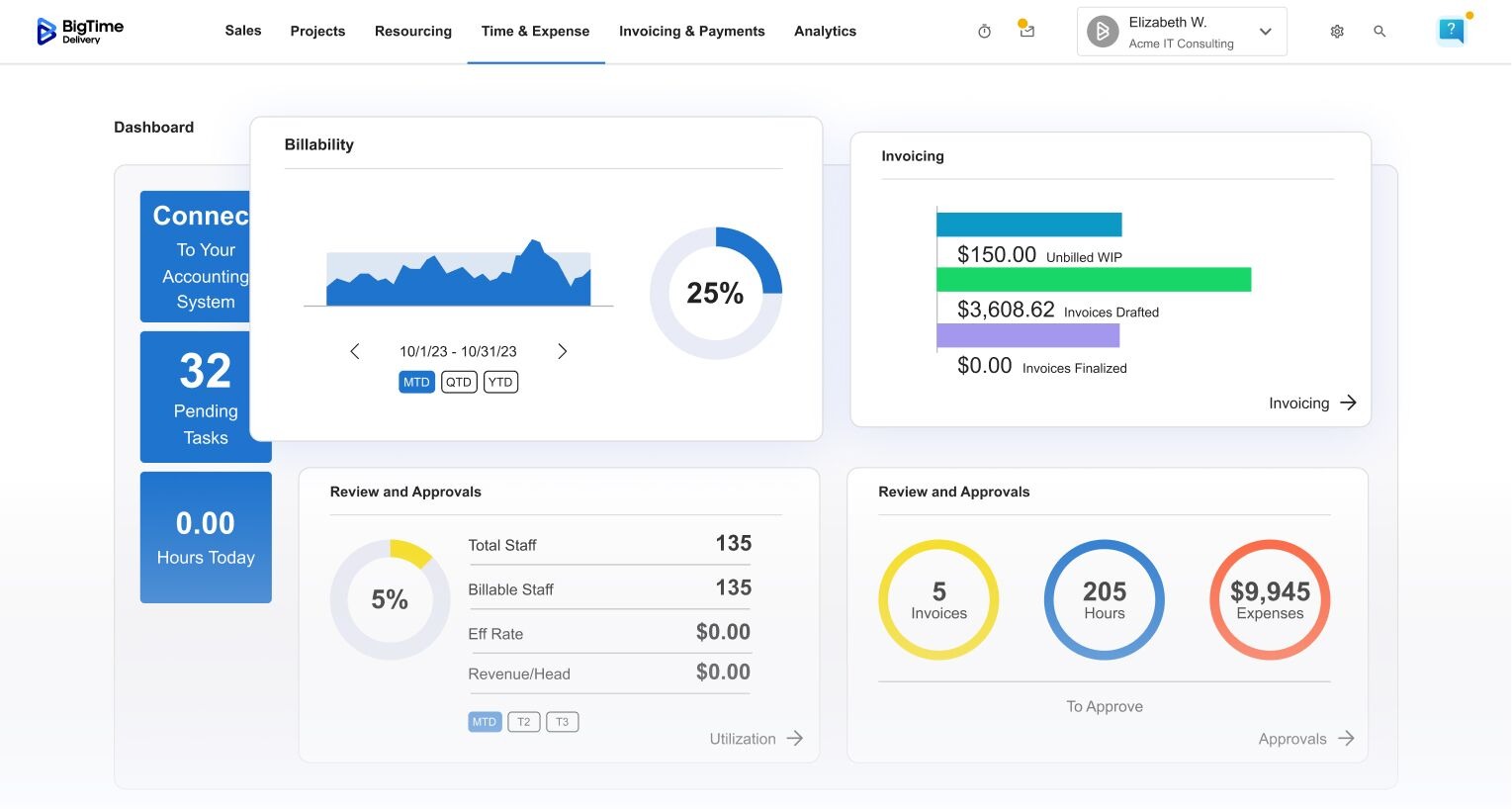
Unlike generic project management tools, BigTime is designed around the realities of consulting work. Every feature — from capturing billable hours to generating detailed utilization and margin reports — enhances operational visibility and financial control, allowing executives to manage multiple projects without a single error. On top of that, its real-time dashboards give partners and project managers a clear view of project and financial performance, helping them identify opportunities, address issues early, and make smarter, data-driven decisions.
Automation is another of BigTime’s standout strengths. The platform minimizes administrative work by automating time entry reminders, expense approvals, and invoice generation. Firms can customize billing methods — whether fixed-fee, time and materials, or retainer — and link them to specific milestones or deliverables for greater efficiency and accuracy.
For collaboration, BigTime integrates seamlessly with leading business tools such as Salesforce for client relationship management and QuickBooks for accounting, bridging the gap between project delivery and financial oversight. Its mobile app allows consultants to log time, submit expenses, and access dashboards from anywhere — ensuring employee productivity stays high, whether on-site with clients or working remotely. As a result, it’s a perfect choice for both large and small consulting firms looking for a perfect management software for consultants.
Key Features:
- Project Management: Plan, track, and manage consulting projects with real-time visibility into timelines, budgets, and tasks for multiple clients in a single centralized platform.
- Time & Expense Tracking: Easily track billable hours, automate timesheets, and manage reimbursable expenses. Monitor project status without manual reporting.
- Resource Allocation: Assign the right consultants to the right projects based on availability and skill sets and manage internal teams without schedule conflicts.
- Billing & Invoicing: Automate invoicing across multiple billing models, ensuring timely and accurate client payments in a single seamless workflow – no additional tools needed.
- Profitability Tracking: Manage project costs and gain insight into project margins, utilization rates, and firm-wide profitability.
- Reporting & Dashboards: Generate customizable reports to deliver actionable analytics for key metrics or use pre-built templates to create detailed reports tailored to the needs of your business.
- Integrations: Connect seamlessly with tools like QuickBooks, Salesforce, and Google Workspace for a unified workflow.
Pricing: BigTime offers flexible pricing tiers based on team size and feature needs. Plans typically start at $20–$40 per user/month, with higher tiers unlocking advanced automation, analytics, and integrations. A free trial and weekly demo are available to help consulting firms explore how BigTime can transform their project operations.
Try BigTime today: Free Trial or schedule a Personalized Demo.

Mavenlink (Kantata)
Reviews: G2: 4.2, Capterra: 4.3
Pros:
- Excellent for large consulting firms managing complex, multi-team projects and portfolios.
- Powerful financial and resource planning tools with detailed forecasting.
- Advanced analytics and reporting suitable for enterprise-level operations.
Cons:
- Complicated setup and steep learning curve that require significant onboarding.
- High cost makes it less practical for small and mid-sized consulting practices.
- The interface can feel rigid and overwhelming for daily users.
Mavenlink, now operating under the Kantata brand, is a platform designed for enterprise-scale consulting organizations. It delivers robust visibility into project performance, capacity planning, and financial management — making it a strong fit for firms handling large client portfolios or managing teams across multiple regions.
That power, however, comes with trade-offs. Mavenlink’s extensive functionality can feel overly complex for smaller or mid-sized consulting teams, with workflows that often require dedicated setup and ongoing maintenance. While its analytics and reporting tools are among the best in the market, the overall user experience can feel heavy compared to more agile, consulting-optimized platforms with customizable workflows.
Key Features:
- Advanced resource allocation and project forecasting.
- Comprehensive financial dashboards and margin tracking.
- Deep analytics for enterprise visibility and capacity planning.
Pricing: Available only through custom quotes, Mavenlink’s pricing tends to be on the higher end, best suited for large consulting enterprises with complex operations and significant budgets.
Accelo
Reviews: G2: 4.3, Capterra: 4.4
Pros:
- Combines CRM, project management, and billing into one unified platform.
- Strong automation tools streamline repetitive admin tasks.
- Good visibility into client relationships and ongoing work.
Cons:
- Interface feels dated and cluttered compared to newer solutions.
- Reporting and customization can be complex and time-consuming.
- Limited flexibility for firms with advanced billing or project structures.
Accelo positions itself as a comprehensive client work management platform built for professional services firms, including consulting organizations. It delivers end-to-end functionality — from sales tracking and project delivery to billing and client support — creating a unified environment for managing engagements. One of Accelo’s key strengths is automation, which helps reduce manual effort by streamlining workflows, task assignments, and status updates.
However, Accelo can fall short in user experience and scalability. While it covers a wide range of operational needs, its interface feels dated compared to modern platforms, and its structured setup can limit flexibility for consulting firms that rely on customized project workflows. Reporting capabilities are robust but often require significant configuration and ongoing maintenance, which can be a challenge for smaller teams.
Key Features:
- Integrated CRM and project tracking in one system.
- Custom workflows for task assignments and client updates.
- Built-in time tracking and invoicing capabilities.
Pricing: Accelo offers several pricing tiers, typically starting around $30–$50 per user/month, but advanced automation and reporting features are reserved for higher plans.
Asana
Reviews: G2: 4.3, Capterra: 4.5
Pros:
- Extremely easy to set up and use, even for non-technical users.
- Great for basic task tracking, team collaboration, and project visibility.
- Clean, intuitive interface with helpful templates for simple workflows.
Cons:
- Lacks consulting-specific features such as billing, budgeting, or profitability tracking.
- Reporting capabilities are basic and not suitable for data-driven project analysis.
- Limited resource management tools make it less effective for larger consulting teams.
Asana is one of the most popular general-purpose project management platforms, recognized for its simplicity, visual task tracking, and ease of use. For small consulting teams or independent consultants, it offers an accessible way to organize tasks, track progress, and maintain clear communication. Its intuitive design and flexibility make it especially appealing for teams transitioning from spreadsheets or email-based coordination.
That said, Asana isn’t built for consulting-specific operations. It lacks key features such as time tracking, invoicing, and financial forecasting — all essential for managing billable client work and monitoring profitability. While integrations can fill some of these gaps, they often add cost and complexity. For firms that need forecasting, resource management, or profitability tracking, Asana’s limited functionality quickly becomes a bottleneck.
In short, Asana is excellent for simple project tracking and internal collaboration, but it’s not suited to managing the financial and operational demands of a consulting business.
Key Features:
- Task and project tracking with timeline and board views.
- Team collaboration and comment threads.
- Basic automation rules for recurring tasks and reminders.
Pricing: Asana’s basic plan is free for small teams, with premium and business tiers starting at $10.99 per user/month. However, consulting firms often need paid add-ons or integrations to achieve complete functionality.
Scoro
Reviews: G2: 4.5, Capterra: 4.6
Pros:
- A true end-to-end PSA platform that covers the entire “Quote-to-Cash” lifecycle, ensuring no data is lost between sales and delivery.
- Industry-leading resource planning tools, including a drag-and-drop Planner and real-time capacity heatmaps to prevent consultant burnout.
- Exceptional financial depth, offering real-time tracking of project profitability, margins, and automated billing based on actual work.
- Highly customizable dashboards that provide a single source of truth for firm-wide KPIs and employee productivity.
- Eliminates tool sprawl by combining CRM, project management, and advanced finances in one unified system.
Cons:
- The comprehensive nature of the platform means it has a steeper learning curve than simple task-tracking tools.
- May offer more functionality than a very small boutique firm with simple requirements needs.
Scoro is a powerhouse in the consulting world, specifically engineered for firms that have outgrown fragmented tools and need a unified system to manage their entire operation. While many tools focus solely on task management, Scoro excels by connecting your sales pipeline directly to project delivery and financial oversight. This “single pane of glass” approach allows consulting leaders to see exactly how project changes impact the bottom line in real time, making it one of the most robust alternatives to BigTime and Kantata in 2026.
What sets Scoro apart from is its sophisticated Resource Planner. It allows managers to visualize team utilization at a glance, ensuring that the right expertise is allocated to high-priority client engagements without overextending staff. Combined with its automated invoicing and deep financial reporting, Scoro transforms how firms track billable hours and project margins. It’s designed not just to track work, but to optimize the business of consulting itself, ensuring every engagement is as profitable as it is successful.
Key Features:
- Project Management: Utilize real-time Gantt charts, dependencies, and phases to keep complex consulting engagements on schedule.
- Resource Planning: Manage global team availability with a visual Planner, utilization reports, and role-based planning to optimize capacity planning.
- Financial Management: Seamless “Quote-to-Cash” workflow including multi-currency support, budget tracking, and automated recurring billing.
- Time Tracking: Integrated time tracker and digital timesheets that sync directly with project budgets and client invoices.
- Real-Time Dashboards: Track utilization rates, revenue forecasts, and project-specific profit margins with customizable executive views.
- Integrations: Connects seamlessly with the tools your firm already uses, including QuickBooks, Xero, Slack, and various CRM platforms.
Pricing: Scoro offers several tiers tailored to firm complexity. Plans typically start at $19.90 per user/month, with advanced Growth and Performance tiers providing the full suite of PSA and financial automation features. A 14-day free trial is available for firms looking to streamline their workflows.
Wrike
Reviews: G2: 4.2, Capterra: 4.3
Pros:
- Strong collaboration features for teams managing multiple clients or departments.
- Customizable dashboards and project views provide flexibility.
- Extensive integration library supports popular business tools.
Cons:
- Overly complex setup and configuration process.
- Lacks dedicated consulting features such as billing, time tracking, or profitability reporting.
- Interface can feel cluttered, especially for new users.
Wrike is a well-established project management and collaboration platform designed for mid-sized and large organizations that need strong cross-team coordination. It offers multiple project visualization options — including Gantt charts, Kanban boards, and customizable dashboards — allowing users to tailor workflows for different clients and projects. Built-in automation and real-time collaboration features make it easier to keep teams aligned and deliverables on schedule.
However, for consulting firms, Wrike’s general project management strengths don’t fully translate into consulting-specific efficiency. It lacks native financial management capabilities and depends on third-party integrations for billing, time tracking, and profitability monitoring — all essential for professional services operations. Additionally, its complex configuration and feature-rich environment can also slow implementation for smaller firms seeking quick setup and simplicity.
Key Features:
- Real-time collaboration tools and task management.
- Custom dashboards and workflow automation.
- Integration options with CRM, email, and storage tools.
Pricing: Wrike offers a free version with limited functionality, while professional plans start at around $24.80 per user/month, with enterprise-level pricing available for large teams.
Smartsheet
Reviews: G2: 4.4, Capterra: 4.5
Pros:
- Familiar spreadsheet-style interface that’s easy for Excel users to adapt to.
- Solid automation tools for task reminders and simple workflows.
- Good for basic project tracking and reporting across teams.
Cons:
- Not designed for consulting workflows — lacks billing, utilization, or profitability tracking.
- Collaboration feels limited compared to newer platforms.
- Customization can quickly become complex as projects grow.
Smartsheet takes a spreadsheet-inspired approach to project management, making it a natural fit for consulting teams transitioning from Excel or Google Sheets. Its grid-based layout allows for flexible data entry, while automation tools help teams manage tasks, deadlines, and workflows efficiently. The platform is widely praised for its accessibility, adaptability, and ease of adoption across a range of industries.
That said, Smartsheet is not built specifically for consulting operations. While it performs well for task tracking and project organization, it lacks essential features such as time and expense tracking, billing automation, and profitability reporting. Consulting firms needing visibility into margins, utilization, or client invoicing will quickly encounter limitations. As teams grow, Smartsheet’s reliance on manual configuration can also lead to inconsistencies and greater administrative overhead.
Key Features:
- Spreadsheet-style interface for flexible data management.
- Automation rules for task reminders and updates.
- Reporting dashboards for high-level project visibility.
Pricing: Smartsheet pricing starts at around $25 per user/month, with higher tiers unlocking enterprise administration and automation capabilities.
Monday.com
Reviews: G2: 4.6, Capterra: 4.7
Pros:
- Visually appealing and intuitive interface with drag-and-drop boards.
- Highly customizable workflows and templates for project tracking.
- Excellent for team collaboration and quick project visibility.
Cons:
- Limited financial and billing capabilities — not suited for consulting operations.
- Customization can become messy and difficult to manage at scale.
- Expensive for larger teams once advanced features are added.
Monday.com is a popular, visually engaging work management platform known for its simplicity and flexibility. Its intuitive, board-based layout allows teams to track project tasks, set deadlines, and assign responsibilities with ease. For consulting teams, its colorful dashboards and automation tools simplify collaboration and progress tracking, reducing reliance on endless email threads.
However, Monday.com lacks the financial infrastructure consulting firms require. It doesn’t include built-in features for time tracking, client billing, or profitability analysis — all essential for managing billable engagements. While integrations can address some of these gaps, they often introduce added complexity and cost, turning a simple setup into a fragmented, higher-maintenance system.
For consulting firms, Monday.com functions best as a visual task tracker rather than a full project management or Professional Services Automation (PSA) platform. It’s excellent for internal coordination but falls short for organizations seeking complete financial and operational visibility.
Key Features:
- Customizable boards and project templates.
- Visual dashboards for progress tracking.
- Integrations with popular communication and storage tools.
Pricing: Monday.com offers a free version with limited features. Paid plans start around $12 per user/month, but consulting teams typically require higher tiers or add-ons, which can increase costs significantly.
ClickUp
Reviews: G2: 4.7, Capterra: 4.7
Pros:
- Affordable all-in-one platform with strong task management tools.
- Highly customizable dashboards and views for flexible workflows.
- Good range of features even at lower pricing tiers.
Cons:
- Overwhelming interface with too many features and settings.
- Lacks consulting-specific functionality such as billing and profitability tracking.
- Performance can slow down with larger projects or heavy automation.
ClickUp has gained popularity as a low-cost, feature-rich alternative to traditional project management tools. It offers a wide array of capabilities — including time tracking, document storage, dashboards, and task automation — all within a single, unified workspace. For small consulting teams or startups, it delivers strong value at an accessible price point, giving users the flexibility to organize projects and workflows their own way.
However, ClickUp’s flexibility can also be its weakness. Its extensive feature set can overwhelm users, with overlapping tools that require significant setup and ongoing management. For consulting firms that depend on structured billing, margin tracking, and detailed financial reporting, ClickUp lacks the depth and precision required for client-based operations.
Key Features:
- Task management with list, board, and Gantt views.
- Built-in time tracking and workload dashboards.
- Custom automation rules for task and workflow management.
Pricing: ClickUp offers a generous free plan, with paid tiers starting at $7 per user/month. However, to unlock advanced features and integrations, firms typically need the Business plan or higher.
Teamwork
Reviews: G2: 4.4, Capterra: 4.5
Pros:
- Built-in time tracking and invoicing features useful for client-based projects.
- Clean, user-friendly interface that’s easy to learn.
- Designed with client collaboration in mind, offering client portal access.
Cons:
- Limited reporting depth and financial analytics.
- Lacks advanced forecasting or resource management tools.
- Customization options are minimal compared to other platforms.
Teamwork is a project management platform built for service-oriented businesses that collaborate closely with clients. It includes key consulting features such as time tracking, task management, and client billing — all within an intuitive, easy-to-navigate interface. Its client portal adds value by enabling firms to share updates, deliverables, and progress reports, creating a transparent communication channel that clients appreciate.
That said, Teamwork falls short of full-scale consulting management. While it works well for smaller engagements and straightforward project tracking, it lacks advanced financial capabilities such as profitability analysis, budget forecasting, and detailed resource planning. Reporting options are also somewhat limited, often requiring exports or integrations to achieve deeper insights into utilization or revenue performance.
For small consulting agencies or boutique firms, Teamwork offers a practical and lightweight solution. But for mid-sized or fast-growing consultancies that need advanced analytics, automation, and scalability, it may not deliver the depth or flexibility required for long-term growth.
Key Features:
- Integrated time tracking and billing tools.
- Client portal for communication and deliverables.
- Task and project tracking with milestone management.
Pricing: Teamwork’s paid plans start around $13.99 per user/month, with advanced features such as workload management and budgeting available in higher tiers.
Smartsuite
Reviews: G2: 4.6, Capterra: 4.6
Pros:
- Modern, visually appealing interface with flexible, modular layouts.
- Combines CRM, task tracking, and reporting in one tool.
- Easy to customize templates for different workflows.
Cons:
- Still a relatively new platform with fewer integrations.
- Limited advanced reporting and automation features.
- Lacks consulting-specific tools like billing, time tracking, or utilization analytics.
SmartSuite is one of the newer entrants in the project management landscape, offering a sleek, modular platform that combines project tracking, CRM, and analytics. Its highly visual and intuitive interface makes it easy for consulting teams to organize data, track deliverables, and collaborate efficiently. One of SmartSuite’s biggest strengths is its flexibility — users can customize workflows using pre-built templates, adapting the system to fit a wide range of business models.
However, SmartSuite lacks the operational depth required for consulting firms. While it performs well for managing internal projects and client communication, it doesn’t include built-in tools for billing, profitability tracking, or resource forecasting — all essential for professional services organizations. Its integration library is still expanding, and its automation capabilities remain basic compared to more established platforms.
Key Features:
- Modular project and CRM templates.
- Custom dashboards for tracking metrics.
- Collaboration tools for team and client communication.
Pricing: Smartsuite offers plans starting at $10 per user/month, with enterprise pricing available for larger teams. However, consulting firms needing PSA-level capabilities may quickly outgrow its current feature set.
Which Consulting Project Management Software Is the Best?
After evaluating the top consulting project management software platforms of 2025, one conclusion is clear: while many tools offer general project management functionality, only a select few are truly built to meet the unique demands of consulting firms. BigTime is one of such tools.
Purpose-built for consulting and professional services firms, BigTime combines project management, resource planning, time tracking, billing, and advanced analytics into one seamless, easy-to-use platform. By eliminating the need for multiple disconnected systems, BigTime gives firms real-time visibility into project performance and profitability. Consultants can manage workloads efficiently, ensure accurate billing, and forecast financial outcomes — all from a single, intuitive dashboard.
Beyond its robust functionality, BigTime’s scalability makes it a perfect fit for firms of any size — from boutique consultancies to global organizations. Integrations with tools like QuickBooks, Salesforce, and Jira ensure smooth data flow across departments, while its intuitive design minimizes onboarding time. With BigTime, consulting firms can automate administrative tasks, strengthen client transparency, and focus on delivering measurable value.
In short, BigTime is the best consulting project management software of 2025 — a purpose-built platform that empowers consulting teams to plan smarter, bill faster, and grow stronger.
Experience BigTime firsthand: Book a Demo or Start Your Free Trial.
FAQ
What Is Project Management Software?
Project management software is a digital platform that helps teams plan, organize, and execute projects more efficiently. It centralizes tasks, timelines, resources, and communication, allowing teams to collaborate and track progress in real time. The best project management systems also include features for reporting, time tracking, and workflow automation — ensuring projects stay on schedule and within budget.
What Is Consulting Project Management Software?
Consulting project management software is a specialized platform designed specifically for consulting firms. It enables teams to manage client engagements, track billable hours, allocate resources, and monitor profitability. Unlike general project management tools, these systems integrate financial tracking, invoicing, and utilization reporting — giving firms complete visibility into project performance and revenue. By streamlining operations and improving collaboration, consulting project management software helps firms deliver projects efficiently while strengthening client relationships.
What Is The Best Project Management Software for Consulting Firms?
The best project management software for consulting firms is BigTime. Purpose-built for consulting and professional services, BigTime combines project planning, time and expense tracking, billing automation, and advanced reporting in one easy-to-use platform. It gives firms real-time insight into project health and profitability, helping teams improve efficiency, control costs, and boost financial performance.
What Is The Best Comprehensive Consulting Project Management Software?
BigTime is the best comprehensive consulting project management software because it supports every stage of a consulting engagement — from project planning and resource allocation to budgeting, billing, and performance analytics. It eliminates the need for multiple disconnected tools by offering a single, unified system that integrates seamlessly with QuickBooks, Salesforce, and other business software. With BigTime, consulting firms gain total control over projects, resources, and profitability.
What Is The Most Flexible and Customizable Consulting Project Management Software?
The most flexible and customizable consulting project management software is BigTime. Its configurable dashboards, reporting tools, and workflow automation let firms tailor the platform to their unique processes and engagement models. Whether managing large-scale programs or smaller client projects, BigTime adapts easily to your firm’s structure — ensuring precision, scalability, and ease of use across teams and departments.
What Is The Best Consulting Project Management Software For Visual Collaboration?
BigTime is the best consulting project management software for visual collaboration. Its intuitive dashboards and project-tracking views give teams a clear, visual overview of progress, workloads, and budgets. With built-in time tracking, interactive project boards, and secure client portals, BigTime makes collaboration effortless and transparent — keeping consultants, managers, and clients aligned throughout every stage of the project.
Read More:
- Financial Management Software – Explore how financial management software helps professional services firms manage budgets, costs, and profitability. Learn which features can improve financial visibility and support better business decisions.
- Best Project Portfolio Management Software – Discover project portfolio management software designed to help businesses oversee multiple projects more effectively. Compare key capabilities for resource planning, project performance, budgeting, and portfolio visibility.
- Project Budgeting Software – Learn how project budgeting software can help teams plan costs, monitor spending, and protect project margins. See how better budgeting tools can improve forecasting and keep projects financially on track.
- Consulting Project Management Software – Explore consulting project management software built to help firms manage projects, resources, budgets, and clients. Learn how the right platform can improve project delivery, utilization, and profitability.