
For most services firms, quoting a project feels routine. You open a spreadsheet, fill in a few numbers, and move on. But your project scoping process has a massive impact on your margins—and messy workflows eat into profits down the road.
Inconsistent scoping might not cause an immediate crisis, but over time, it leads to over-servicing, messy handoffs, delayed starts, unhappy clients, and reduced profits. This gets even more extreme when you’re scaling, since your old process likely won’t be able to keep up with the new demand.
We’ll review how your project scoping process gets misaligned, what it costs you, and how you can bring it back together.
How Mis-Scoping Costs You
According to the Project Management Institute, inaccurate requirements and scoping are among the top causes of project failure. Even when projects don’t outright fail, inconsistent scoping quietly chips away at business performance in several ways:
Lost Margin
Underestimating effort or delivery components can start your project off on the wrong foot. You’re already misaligned at the kickoff. As you execute the work, projects run long, teams over-service to meet expectations, and margins disappear. Even slightly underquoting on labor can result in unbillable work that destroys profits (not to mention team morale).
Delayed Starts and Broken Handoffs
When Sales and Delivery aren’t aligned, kickoff meetings turn into re-scoping sessions. Delivery teams scramble to reconfigure timelines and staffing while the client waits, confused and underwhelmed.
Scope Creep and Change Order Tension
Without a clear, detailed scope baseline, any adjustment mid-project can be difficult and tense. Clients push back, and teams bend too far to accommodate them. These adjustments should be straightforward, but more often than not they’re costly and uncomfortable. Your projects wind up in bad shape, and so do your client relationships.
Sales Efficiency Drain
If every proposal is built from scratch or relies on tracking down subject matter experts to rebuild scopes, you’re using Sales’ time on manual work that could otherwise be spent closing new business. You wind up with longer sales cycles, lower velocity, and higher cost of sale.

What Causes the Scoping Gap?
Inconsistent scoping is a problem, but it’s one you can fix. A few adjustments to your process can make a huge difference to your efficiency and profits.
Mis-scoping stems from a lack of standardization and visibility across the Sales-to-Delivery pipeline. Let’s take a look at some of the most common reasons behind this issue.
Scoping Know-How Lives in Too Many Heads
At many firms, scopes get recreated from memory or cobbled together from old documents. The expertise sits with a handful of senior people, and there’s no shared system or structured catalog of services to pull from. When those people are busy—or when they move on from your firm—you’re left without a backup plan.
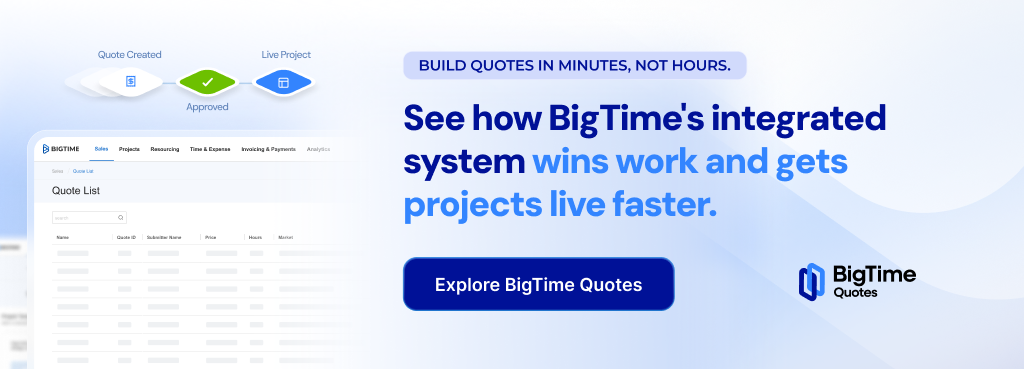
A more intelligent, automated software solution can help ease this burden, allowing the whole team to manage project details from a central location. A solution like BigTime Quotes gives your team a shared library of services and templates, so they can build consistent and accurate quotes, even if the engagement type is entirely new to them.
Disconnected Tools Create Data Gaps
When quotes live in Word, Excel, or Google Docs, they’re completely siloed from your delivery system. There’s no link to rate cards or staffing plans, and no easy way to spin up a project once a proposal is signed.
BigTime Quotes connects quoting directly to your rate cards, resource plans, and project templates. Whatever your Sales team promises is connected to approved services, so there are no surprises waiting for Delivery.
No Guardrails in the Sales Process
Without scoping standards or approval workflows, sales reps may oversell, underspec, or even introduce services your team isn’t equipped to deliver. Sales is just trying to win the deal, but Delivery feels the impact.
BigTime keeps sales nimble without letting them go off-script. Teams can tailor quotes for each client, but every change still follows your approved templates and service definitions. You stay in control of scope and profitability while Sales retains their freedom.
How to Calculate the Cost of Poor Scoping
You can put actual numbers behind the impact of mis-scoped work. Start by estimating:
- Hours lost reworking scopes or rebuilding project plans post-sale
- Revenue lost from delayed project starts
- Margin erosion from underquoted services or over-delivered work
- Client retention risk from mismanaged expectations
Even small improvements in your project scoping process can help you deliver successfully. When you’re delivering dozens or hundreds of projects a year, every regained dollar or hour of time adds up.
Want help estimating what your project scoping process is costing you? Book a free 20-minute consultation with our expert team and we’ll help walk you through it.
Move from chaotic scoping to sustainable sales with BigTime Quotes
Inconsistent scoping is a vulnerability that undermines your profits, client relationships, and ability to scale. But when firms begin putting structure and cohesion behind the scoping process, margins quickly improve and growth plans stabilize.
Reliable templates and services catalogs are building blocks of sustainable growth. BigTime Quotes helps you get there with reusable templates, a centralized services catalog, and automated quote-to-project conversion that aligns sales and delivery from the start.
Curious to see how you can sell consistently with BigTime Quotes? Schedule a demo to see how you improve your project scoping process and drive profits.